
As South Africans eargerly awaited the announcement of the final results of the 2026 Loca Government Elections on Saturday – news came in that United Democratic Movement (UDM )councillor Luxolo Namette had been shot dead in Gqeberha. Namette was shot and killed while leaving a barbershop in Motherwell in the Nelson Mandela Bay Metro on Saturday.
Although police have not yet established the motive for his killing, the UDM believes the murder was politically motivated. The party says it will escalate the matter to the Political Killings Task Team.
The party strongly condemened the murder saying that “political differences must never be settled through the barrel of a gun” and that no public representative should live in fear for their life because of their political affiliation or service to the community.

The conclusion of voting in South Africa’s 2026 local government elections has not necessarily brought an end to the threat facing politicians, party members and people involved in political activities.
While the security cluster has confirmed 21 murder cases classified as politically motivated during the election period, the bigger concern is whether the investigations will lead to prosecutions and what will be done to prevent further killings as newly elected councils take shape.
The killings have exposed a problem that goes beyond the security arrangements put in place for voting day. Police officers were deployed at all 23,000 voting stations on 4 November, but attacks on political figures have also happened away from voting stations, including at their homes, during political activities and while travelling.
This is not a new concern. Political killings have been recorded across several election cycles, with research showing that the violence often increases when political positions and control of municipalities are being contested.
The Global Initiative Against Transnational Organised Crime (GI-TOC), through its South Africa Observatory, recorded 27 political killings in 2016 and 30 in 2021, both municipal election years. It recorded 33 in 2024, a national election year, and 31 in 2025.
Its figures for 2026 were already higher by September. The organisation recorded at least 43 people killed in 45 suspected political attacks between January and September, exceeding its full-year figures for the previous election cycles.
These figures are based on GI-TOC’s monitoring and are not directly comparable with the official count announced by the National Joint Operational and Intelligence Structure (NATJOINTS). However, they show that political violence is not limited to election day or one particular election. It has remained a concern between election cycles.
Lieutenant-General Tebello Mosikili, Deputy National Commissioner of the South African Police Service (SAPS) and co-chairperson of NATJOINTS, confirmed the 21 politically motivated murder cases during a security briefing at the national Results Operations Centre in Midrand on 5 November.
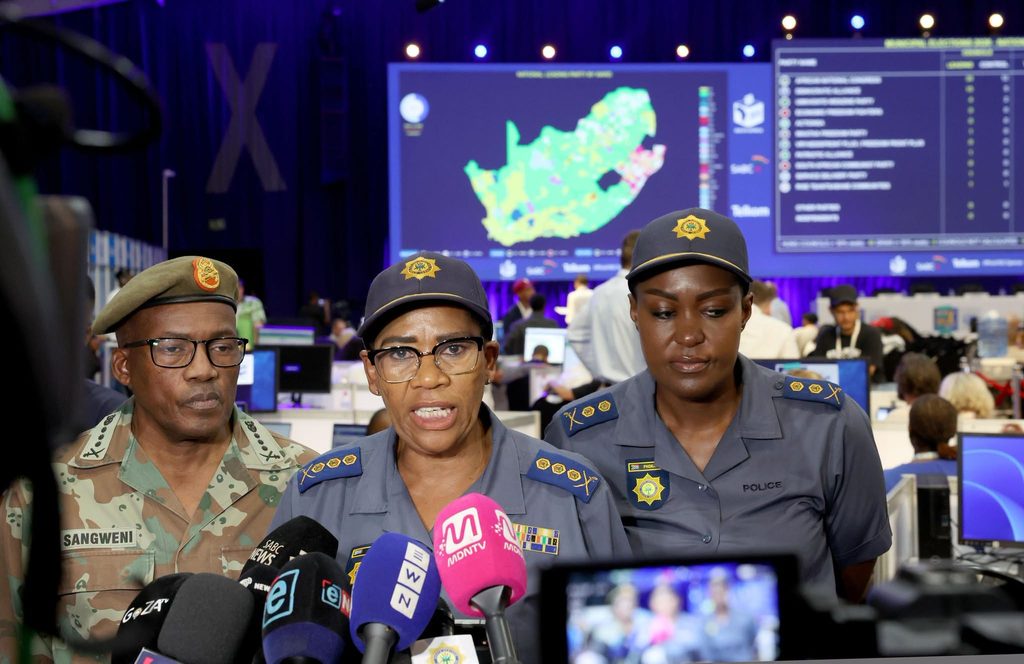
The cases include the killing of an uMkhonto weSizwe (MK) Party member in KwaZulu-Natal. The figure followed an earlier briefing on 1 November, when NATJOINTS reported 20 murders involving political representatives, party members and supporters, with seven arrests at the time.
Mosikili said the Political Killings Task Team, together with provincial and national detective structures, had been deployed to investigate the cases. However, she did not provide an updated number of arrests linked specifically to the 21 murders or indicate how many investigations had reached the prosecution stage.
The absence of an updated account leaves an important question: what progress has been made in identifying not only those who carried out the attacks, but also the people who may have organised or financed them?
Mosikili said political differences should never result in the loss of life.
“You cannot take the life of the other just because you are differing in ideologies or because of the position,” she said.
Murders and election-related incidents across provinces
The 21 politically motivated murder cases were not the only deaths reported during the election period. Mosikili also told the briefing that police were investigating three other murder incidents in Mpumalanga, Limpopo and KwaZulu-Natal. NATJOINTS did not confirm that these incidents were politically motivated or that they formed part of the 21 cases.
In Bushbuckridge, Mpumalanga, a 57-year-old man was shot dead in the early hours of Thursday, 5 November.
In Polokwane, Limpopo, a 31-year-old man was stabbed to death at a park opposite Florapark Comprehensive School. Police arrested a 35-year-old man in connection with the murder. However it hasn’t been established if this was a politically motivated crime.
Another man was attacked and killed while walking home in KwaZulu-Natal on Wednesday, 4 November, which was voting day.
The security cluster also reported two additional deaths during the election period. An elderly woman collapsed and later died after arriving at a hospital in Shallcross, KwaZulu-Natal. An IEC official also died following a similar reported incident at Buhrmansdrift in the Ngaka Modiri Molema District, North West, on Monday, 2 November. These incidents were reported separately from the politically motivated murder cases.

Beyond the murders, police recorded 85 incidents across the country on voting day. These resulted in 57 criminal case dockets being opened and 27 suspects being arrested.
Of the 57 cases, 32 involved alleged contraventions of the Electoral Act. The remaining cases included four assaults, two incidents of malicious damage to property, two intimidation cases, one theft, two cases of crimen injuria, one case of drunk and disorderly conduct, one public violence case, one business burglary and one fraud case.
KwaZulu-Natal recorded the highest number of voting-day cases, with 15, followed by Limpopo with 11 and the Eastern Cape with 10. Gauteng recorded eight, the Western Cape four, while Mpumalanga and North West each recorded three. The Free State recorded two and the Northern Cape one.
During the two special voting days on 2 and 3 November, a further 65 criminal case dockets were registered, with 32 suspects arrested. KwaZulu-Natal recorded 16 cases, followed by Limpopo with 13. The Eastern Cape and Western Cape each recorded eight, Gauteng seven, Mpumalanga five, while the Free State and North West each recorded four. No cases were reported in the Northern Cape.
Together, the special voting period and voting day accounted for 122 criminal case dockets and 59 arrests. These figures cover a broader range of election-related offences and should not be confused with the 21 politically motivated murder cases.
Mosikili also clarified that the fraud case reported on voting day did not involve an IEC official. She said it was opened after a voter discovered that her name had already been crossed off the voters’ roll before she could present her documents. Although the incident could have resulted from human error, it required investigation to establish what had happened.
The danger does not end when voting ends
Research by the Institute for Security Studies (ISS), published on 30 October, provides another picture of the violence surrounding the elections.
Its Protest and Public Violence Monitor recorded 34 deaths in 26 political attacks between May and 28 October. The victims included councillors, candidates, party members, campaigners, civic leaders and a traditional leader.
The ISS figures are based on its own monitoring and definition of political killings, and are not the same as NATJOINTS’ official count of 21 murder cases. They also differ from GI-TOC’s figures because the organisations use different monitoring periods and methods.
The ISS research raises a significant concern about accountability. Of the 26 fatal attacks it recorded, arrests or charges had been publicly reported in only four cases by the time its report was published.
The organisation found that the attacks occurred in three waves linked to the election calendar: voter registration, candidate selection and the final campaign period. This suggests that the danger is not limited to the day people go to the polls.
Its report also warns that the risk may continue during the allocation of seats, coalition negotiations and the formation of municipal councils.
This is particularly important because local government positions involve decisions about municipal leadership and the administration of public resources. The report points to the need to maintain security measures beyond voting day, including during council formation and mayoral elections.
It recommends that protection should extend beyond voting stations to candidates in contested wards and party agents travelling between locations. It also highlights funerals and memorial services for political victims as gatherings that may require security attention.
The report notes that at least 24 of the 26 attacks it recorded involved firearms. Eleven happened at or near victims’ homes, while others took place during or shortly after political activities.
A visible police presence at voting stations, although necessary to protect the electoral process, does not necessarily address the circumstances in which targeted attacks take place.
The ISS has called for the Political Killings Task Team to publish an updated, case-by-case account of investigations and arrests, as well as for prosecutions in cases where suspects have been charged to be concluded and their outcomes made public.
What the investigation record tells us
The Political Killings Task Team is central to the government’s response, but its previous record also shows the scale of the work involved in investigating these cases.
In September 2023, then Police Minister Bheki Cele told a media briefing that the task team had investigated 321 dockets since it began operating in July 2018. The figure included 134 cases reported between 2011 and June 2018, before the task team’s work began.
Of the 321 dockets, 155 involved murder, 51 attempted murder, 77 intimidation and 12 conspiracy to commit murder, with the remainder classified as other cases.
Cele said the investigations had resulted in 348 suspects being arrested and charged across 233 cases. At that point, 62 suspects had been convicted, while 155 were going through court processes.
These figures relate to the task team’s work in KwaZulu-Natal and should not be read as a national total or as an update on the 21 cases reported in November 2026.
They nevertheless show why investigations into political killings need to go beyond identifying the person who physically carried out an attack. The task team’s approach includes investigating possible networks behind the killings and identifying people who may have planned, financed or benefited from them.
The challenge is whether investigators have the resources and evidence needed to follow those links, build cases and bring all those involved before the courts.
Mosikili said political intolerance and politically motivated killings were being addressed through the country’s organised crime strategy, which had been presented to Cabinet and would be implemented in phases.
However, she did not provide a timeline for implementation or explain which specific interventions would be introduced in communities affected by political killings.
The strategy’s implementation is therefore another issue that requires answers. Communities need to know what will change on the ground, how high-risk areas will be identified and what protection will be available to people who face threats because of their political involvement.
Security measures must continue beyond the results
NATJOINTS said its security operations would continue during the counting and verification of votes, as well as beyond the announcement of results.
Mosikili explained that law enforcement agencies were monitoring intelligence and the mood in communities before deciding whether to maintain or reduce deployments.
“We continue to receive intelligence, we continue to observe the mood in the country, and we will then make that operational decision whether to continue with the staff that we have deployed,” she said.
She confirmed that all 23,000 voting stations had been covered by static law enforcement deployments on voting day. A total of 331 voting stations had been identified as high-risk, including 165 in KwaZulu-Natal, 119 in Gauteng, 33 in the Western Cape and 11 in Mpumalanga.
Mosikili also said police had taken action against an SAPS member in KwaZulu-Natal who arrived at a voting station in a vehicle displaying political party branding.
The security cluster described voting day as largely peaceful, with planned marches and protests not materialising. Mosikili said voter participation had increased by four million compared with the 2021 and 2024 elections, describing the security arrangements as effective.
“The country is safe. We said, South Africans, we are ready, go and cast your vote,” she said.
But the question is whether the same level of attention will be given to people who may be at risk once the election security operation is scaled down.
The ISS findings suggest that protection should take account of the political processes that follow the announcement of results, rather than ending with the closing of voting stations. The GI-TOC figures also show why this cannot be treated as a problem that only emerges during election campaigns.
Mosikili said the country’s organised crime strategy would address political intolerance and politically motivated killings, while calling on political parties, their leaders and supporters to respect differences.
“The democratic rights of South Africans must be protected, the integrity of the electoral process must be upheld, and the authority of the State must be asserted through lawful, visible and decisive action,” she said.-news@mukurukuru.co.za

Be First to Comment