
Before dawn on Christmas Day, the silence of Nokaneng village is broken by rhythmic drumbeats and layered voices rising into the summer air. By 05h30, men and women of the Barolong ba Lefifi move in disciplined formation toward the royal homestead, singing and dancing in a procession known as Mohauwane.
They are not yet dressed in uniform. At this hour, Diturupa is stripped of spectacle and grounded in meaning, remembrance before performance.
Nokaneng is located on the border of Mpumalanga and Limpopo, about 130km north of Pretoria. The area made up of tribal trust villages populated by Bakgatla and AmaNdebele, served as a resevoir for recruitment of men into the SA National Labour Contingent which comprised of African men who served on the side of the Allied forces during both world wars.
https://www.researchgate.net/profile/Mojuta-Motlhamme
According to Joseph Lekgowa Lephethi Mphake, the chairperson of Diturupa tsa Barolong ba Lefifi in Nokaneng, the formal organisation of Diturupa in the village dates back to 1945, at the end of World War II.
“Diturupa started in 1945 and was founded by elderly men who had gone to war during the Second World War,” he says. “When they returned home, they demonstrated what they had learned during the war.”
At the time, resources were limited. There were no proper musical instruments, and apartheid laws restricted cultural expression.
“They used donkey skins and empty fuel tanks to make drums called digubu,” Mphake explains. “They used tempedi, made from car tires, to beat the drums. Only after democracy were they allowed to use proper drums.”
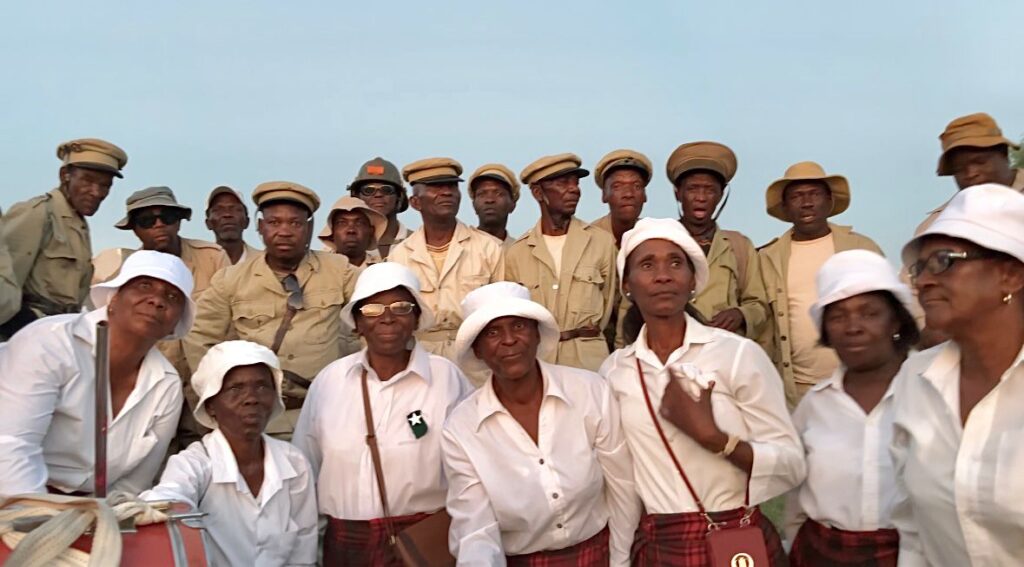
The instruments and movements reflected what the men had encountered during military service. Trumpets, marching styles, and uniforms were inspired by British and Scottish military traditions, introduced because England led the wars in which Black South African soldiers were enlisted.
Mphake recalls several men from the community who went to war, including Ambrose Mathabathe, Nell Dikobe, and Sepetla Leballo. He also mentions Jacob Setumo Mphake, who served as a soldier and worked as a cook for General Jan Smuts in what was then Rhodesia, now Zimbabwe.
Every year on December 25, Diturupa tsa Barolong ba Lefifi gather at the royal homestead to perform for the queen. Preparations begin on 16 December, when groups rehearse and organise themselves. Diturupa in Nokaneng operates under its own constitution, with agreed rules that guide conduct and participation.
On Christmas morning, the groups arrive without uniforms during mohauwane, singing and dancing as they greet the queen. Later in the afternoon, they return wearing full military-inspired attire, kilts, jackets, and polished boots, transforming the village into a moving archive of memory and identity.
“Diturupa are held at the royal homestead for safety and out of respect for traditional leadership,” says Mphake. “In the first week of January, all the groups return to the traditional council to officially close the season. The joy of Nokaneng is Diturupa. It is not a competition; it is done out of love.”
For many participants, turupa is deeply personal. Motshabi Ralekwa, who joined Diturupa in 1972 as a young girl, says she was drawn to the discipline and meaning behind the performances.
“I was inspired by the older men, the way they marched and the strong messages in their songs,” she says. “Through Diturupa, we communicate messages to the community. Each group has its own uniform, and I feel very proud when I wear it. It makes me happy and feel special.”

The songs themselves act as vessels of memory. Jerry Tlhabane Phora, 57, explains that even the name Diturupa comes from the English word “troop,” meaning a group of soldiers.
Phora believes Diturupa plays an important social role that is often overlooked.
“In villages where Diturupa is practiced in December, crime levels are lower,” he says. “This shows its importance. We are concerned about the lack of support from the Department of Sport, Arts, and Culture. COGTA should also support Diturupa because it takes place under traditional leadership, where safety and respect are prioritised.”
Elders see Diturupa as a legacy that must be protected. Andries “Slow” Rammutla has been part of Diturupa for 61 years, having started at the age of 15. “Our elders understood its importance and made sure it continued,” he says simply.
Women, too, have claimed space in a tradition once dominated by men. Betty Mphaga, who also joined in 1972, says participation was a conscious decision. “We saw the importance of Diturupa and decided to join as women,” she says. “I feel good wearing this skirt. It is my tradition to wear my Diturupa uniform every Christmas Day. This tradition must not disappear.” – Mukurukuru Media

Be First to Comment