This month marks the fifth anniversary of the state-sponsored massacre that gripped eSwatini in 2021. It began on 29 June when peaceful pro-democracy activists gathered in Mbabane to deliver a petition calling for reforms.
Police responded by killing at least 46 unarmed pro-democracy activists and bystanders in two days. Hundreds sustained wounds. Other people, including a 17-year-old student, were left paralysed. Many others disappeared or were tortured.
Five years later, fear engulfs the land. King Mswati III, who is celebrating his Ruby Jubilee this year, avoids the topic.
On the other hand, none of the persons suspected of committing violent acts in 2021 has been brought to book. Southern Africa’s finest laud the king on the 40th anniversary of his reign, in the landlocked kingdom of about 1.5-million people.
Not to be outdone, blue-chips, from Standard Bank to Nedbank, are doling out a fortune in ads to sing the king’s praises.
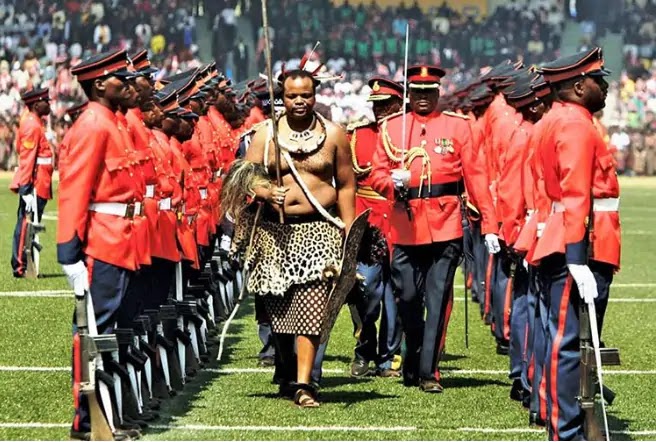
Deep bonds and smiles between the monarch and the region’s top brass were palpable. Official events here are big on colour, pomp, song and dance. Contrast these scenes with the region’s worst level of state-driven repression.
Critics lament eSwatini’s friends for turning a blind eye. For instance, King Letsie III of Lesotho, along with Mozambican and Zimbabwean presidents Daniel Chapo and Emmerson Mnangagwa, graced the official jamboree in Mbabane.
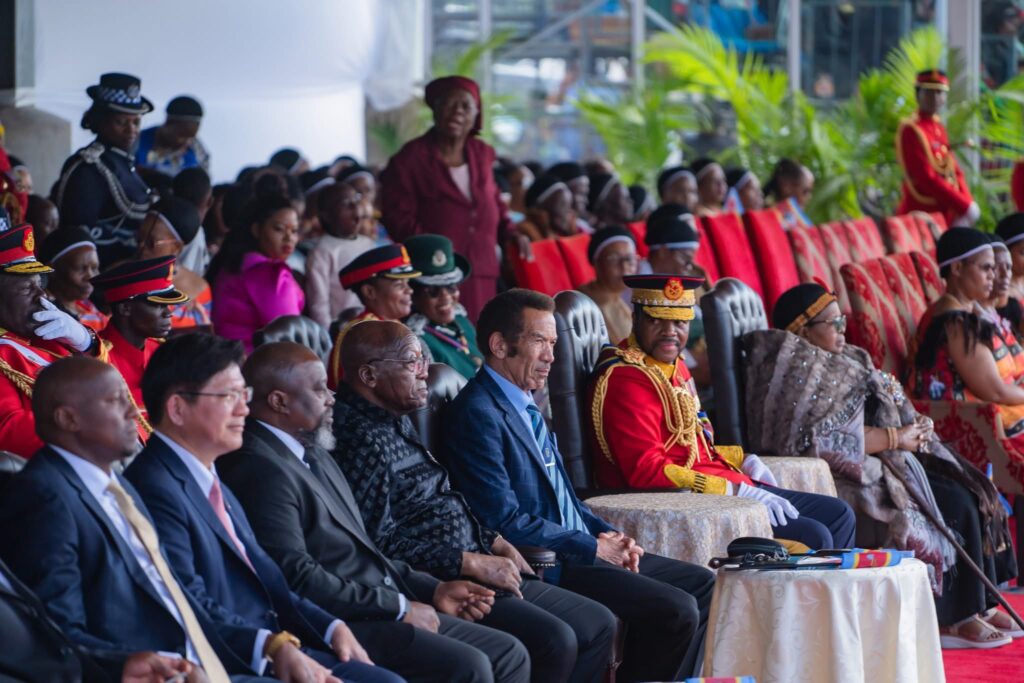
So did Botswana’s youthful Duma Boko, Andry Rajoelina, Madagascar’s ousted leader now at large and ex-presidents Ian Khama, Joseph Kabila and Jacob Zuma, the king’s father-in-law, also joined the celebrations. Taiwanese leader Lai Ching-te, whose itinerary fell victim to Beijing-Taipei wars, made it as a “stowaway”.
But just why is Lai, who blasted China as authoritarian after it blocked him from travelling to eSwatini in April, ingratiating himself with an openly authoritarian king?
Juxtapose the kingdom’s embrace of Lai to its human rights violations. The ban on a May Day rally in Hlatikhulu ended up confined to civil society circles and trade unions. International media gave Lai’s on-off-on travel a lot more airtime than the “real state of affairs”: fear and silence, notes Zweli Dlamini, one of a handful of investigative reporters inside eSwatini.
“Any media outlet run or sponsored by mainland China would give prominence to [Lai] but ignore the plight of the Swazis. Lai’s eagerness [to travel here] says a lot about him and what he’s getting through this relationship at the expense of the people of eSwatini,” Dlamini says.
“World leaders don’t care. Taiwan doesn’t care. China, the US, SADC or other global organisations don’t care. Human rights violations are well-documented,” he notes, segueing into the mid-2021 massacre, an event which continues to cast a long shadow.
“One MP is in jail. Another one is in exile. Thulani Maseko is dead. These things are linked to 2021.” Dlamini, then a human rights lawyer and The Nation columnist, and Maseko’s role in eSwatini’s now-aborted national dialogue.
“Who do you think killed him? If people are silenced by the barrel of the gun, who’ll speak out?” Still, the Swazi government is known for making all the right noises. State media plays along, and the world media is oblivious.
Mswati’s father, King Sobhuza II, died in 1982 after six decades of direct reign. Four years later – with LaTfwala, the Queen Mother, having warmed the seat as a regent – an Afro-spotting and fresh-faced 18-year-old prince was crowned King Mswati III of Swaziland at Somhlolo on a sweltering day in April 1986.
Four decades later, here is Mswati as the world’s second-longest-reigning monarch, after Sweden’s Carl XVI, and longest-serving leader in the 16-nation Southern African Development Community (SADC). In 2008, Mswati reverted the kingdom’s name to eSwatini, an eponym of a pathfinder ancestor. Swaziland had been imposed, in the 1800s, by the invading Anglos.
Despite a huge fan base and an unyielding regional top brass, Mswati’s record on human rights raises eyebrows. Fingers point at the king’s government for the many cases of bullying and mysterious deaths, including those of Maseko, Thabani Nkomonye and Sipho Jele, who died in custody, and targeting of groups like the LGBTI+ community.
The government’s ban on a May Day rally, with the help of the judiciary, was ignored by the media in the neighbouring South Africa – home to a sizeable Swazi exile community and expatriates. Yet, in singing the king’s praises, President Cyril Ramaphosa spoke of “strong and fraternal relations” between the two nations but avoided the repressive state of affairs synonymous with the absolute monarch’s 40 years on the throne.
Mswati has been called all sorts of names, “from tin-pot dictator to the last absolute monarch (in Africa),” writes Bheki Makhubu. One of the region’s most courageous journalists, Makhubu – who, along with Maseko, was incarcerated on trumped-up charges – has written extensively about Mswati.
On the route to Manzini, past the off-ramp to Lozitha Palace at the foot of majestic mountains, the veteran editor assesses the king’s decades-long rule, from his finest and sometimes iffy moments to the ugly.
The authorities hound whistleblowers for demanding accountability, Makhubu reiterates, moaning about the rise of conservative journalists. The state is accused of brutalising citizens who demand justice, improved social services budget, better health outcomes, the unbanning of political parties and the right to elect prime ministers and MPs, a switch from the current set-up where the king has absolute authority.
The outlawed People’s Democratic Movement (Pudemo) has been calling for reforms for decades, but the likes of Ramaphosa, Boko and their predecessors have disregarded those voices.
Direct elections would replace the current set-up whereby the absolute monarch can name anyone a premier. Fifteen PMs (all male), seven of them in acting positions, have served under Mswati. That revolving door raises questions of succession planning and, Makhubu adds, suitability and accountability.
In economics, GDP sits at US$4.86-billion, working out to a US$3,900 GDP per capita. That places eSwatini a dismal 149th globally, even in the face of clear signs of modernisation, such as world-class road highways. Prime Minister Russell Dlamini speaks of “monarchial democracy” and of prioritising economic empowerment but shows no will to achieve that.
“It’s visible that there are things that remain undone… Almost 60% of the population lives below the poverty line,” Dlamini, who once worked in Rwanda, conceded when he took over in 2023.
Things have since worsened. Metaphorically, spokesperson Donald Mdhluli reported in April that 20 eSwatini nationals had been arrested by the South African Police Service for illegal mining. The kingdom’s civil servants have been sent from pillar to post for demanding overdue salary hikes.
Maseko was shot dead in 2023 at his home. Make Tanele Maseko, his widow, is convinced that Mswati knew of, or ordered, that hit.
“It was around 8pm when Thulani expressed his concerns about being killed. The king had spoken at around 3pm. At 10.15pm, (he) was shot dead,” she once told The Nation. “We’re not children here, the king meant what he said.”
The fear factor also struck Nqobile Mkhatshwa, a political scientist. In her thesis, where she observes the regime’s brutality, Mkhatshwa highlights unionist Sipho Jele’s death in custody days after his arrest during a May Day rally for wearing a Pudemo T-shirt. “It is the threats of punishment and obvious brutality of the [state that instils] fear among (Swazis) to not dare challenge the state.”
Taking a look at the guest list with names like Ramaphosa and Boko, known for defending human rights, Communist Party of Swaziland’s international secretary Pius Vilakati worries that the monarch is emboldened by SADC.
As a law student at the then-University of Swaziland, Vilakati fled on the eve of his pro-democracy comrade Jele’s funeral. Jele’s death spurred activists, but Makhubu worries that “nobody can dare make a noise now” because of recent state-sponsored killings.
Vilakati says it’s “an unsurprising irony” that the king welcomes Rajoelina – who fled Madagascar in October amid protests – yet silences Swazis. “When people get ousted or step down … they find comfort in Mswati’s arms,” says the exiled student leader. “He’s run out of friends, so he’s taking everyone.”
Members of the royal family reportedly ditched Mswati in 2021. For her part, Princess Sikhanyiso has long fingered palace power struggles.
“The king is pretty much isolated,” she claimed in Without A King, years before the mid-2021 massacre.
Requests for comment on Rajoelina’s presence in eSwatini – where he has been seen in public at least twice – drew a blank. The government also ignored our requests for comments on brutality and reforms of the Tinkhundla system.
The monarchy justifies Tinkhundla as a link between modern and old political systems. Dissenters cry illegitimacy. Makhubu tracks the root.
“Even if Tinkhundla were replaced by multi-party democracy today, you’d still have a problem: accountability,” he says. “Constituting the type of people who work with the king into a party won’t change the fact that they have little philosophical understanding. They’ll remain accountable to the king. Others might believe that their authority is supreme and be accountable to themselves.”
While still living with fear of state violence, pro-democracy activists look set to commemorate the massacre. But things will likely lull, and the political climate will regress thereafter.
“Give it time, but we know that change is inevitable,” says Dlamini in guarded and clouded optimism.
“What we saw in 2021 made people think and reflect. It won’t be long, but at the same time it won’t be short.”

[…] a sombre assessment, investigative journalist Zweli Dlamini noted that SADC – like the United States and Taiwan – disregard brutality in the landlocked […]