
The Marikana strike on August 2012 – like many other such events was characterised by song. In this edited essay journalist Loyiso Solethu Sidimba searches for the meaning behind the music made by the workers who came from different walks of life
We were encouraged to sing and not run,” Lonmin employee Mziwoxolo Magidiwana responded when asked why he and his about 3 000 colleagues did not disperse on Thursday afternoon August 16, 2012.
Magidiwana, 24 at the time of his testimony at retired Judge Ian Farlam’s commission of inquiry in the events that left 44 mineworkers dead, said workers were just singing, and were told by the wildcat strike’s leaders they did not do anything wrong against anyone and should therefore not run away should there be trouble.
The workers were singing Idl’abantu le ngonyama, iphum’eBhizana (The mighty lion of Bizana devours all in its midst), among a repertoire of mainly Mpondo songs, the mineworkers apparently dedicated the ditty to their sangoma [medicine man], believed to Alton “Ndzabe” Joja or his associates (his mineworker sons), and a firm favourite in the group.
The workers had apparently ignored Association of Mineworkers and Construction Union (Amcu) leader Joseph Mathunjwa’s chilling warning: “The life of a black man is cheap. These people (police) are going to kill you”.
Magidiwana, an Amcu member, told the commission he never believed Mathunjwa.
“In fact I even saw the way in which the workers were sitting, further that they were happy and I never believed Mathunjwa. I never believed that what he was saying was true. I believed that he just wanted us to go back to work and eventually we were not going to get the money,” Magidiwana said at a March 2013 sitting of the commission in Rustenburg.

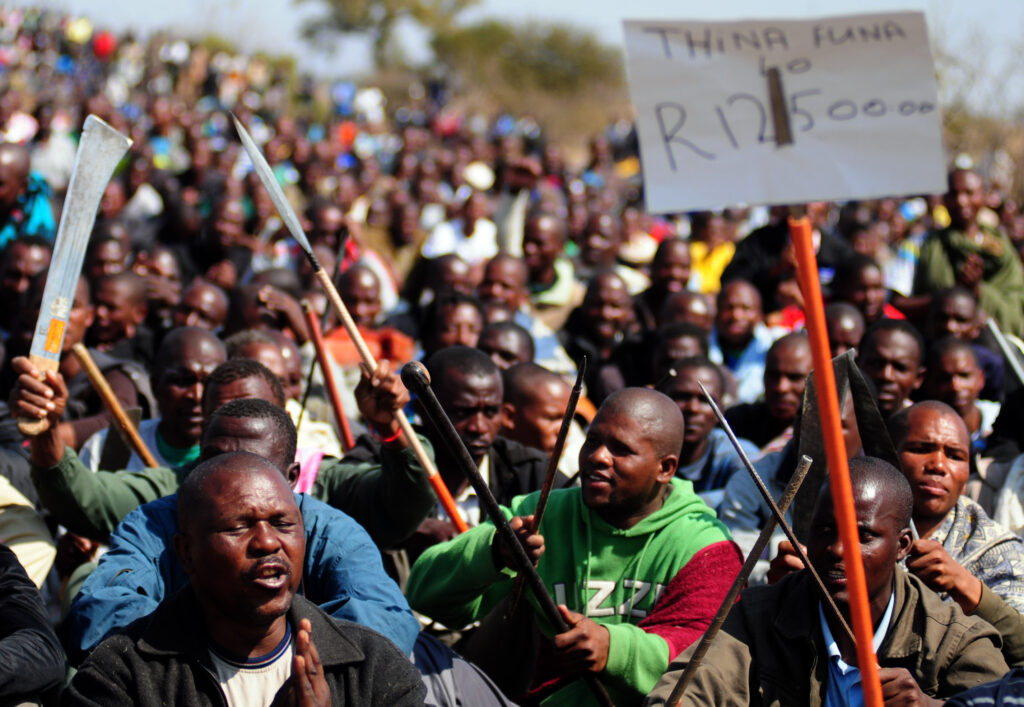
When marching from shaft to shaft, before and after the August 16 massacre, the workers would sing which such vigour as though attempting to show the nobility of their cause, maintaining crouching positions before the mineworker leading the group would raise his spear for them to proceed.
Another song, which also appeared to have resonance with the workers and would immediately transform their mood, caused a stir during the commission.
“Uqinis’amsende NUM (National Union of Mineworkers), soz’ulunge (You are hardening your balls, my boy, you will never come right),” a warning to the NUM that it would be no match for the workers.
Perhaps, it would be prudent to trace the history of the violence in protest or struggle songs.
Operatives of Umkhonto Wesiwe, the armed wing of South Africa’s ruling party the African National Congress (ANC) still sing: “Hamba Kahle Mkhonto, mkhonto wesizwe, thina bantu bamnyama siz’imisele ukuwabulala wona lamabhulu (We, members of Umkhonto Wesizwe, are prepared to kill these Boers)”.
The song is mostly sung at funerals and other commemorative events and is a clear call for revenge and National Heritage Council chief executive Sonwabile Mangcotywa has argued that there are some liberation songs that are simply sacred at rituals, be it a funeral or a memorial activity1.
For example, Hamba Kahle, a funeral song described by Pollard as “melancholic and militant, a powerfully evocative mix of hymn and war song, protest and pain”.
A funeral of a former uMkhonto weSizwe cadre or any of the ANC army founders is incomplete without this song.
Former President Nelson Mandela, to the dismay of many in post-1994 South Africa, sang the song and is captured on video, which was mucch later posted on Youtube, under “Mandela sings song about killing whites”. Much to the chagrin of a section of the South African population.
But such responses are unhelpful.
Mandela, later a venerated figure for reconciliation, was among the founders of the ANC’s military wing, uMkhonto weSizwe, and when he could freely make public appearances, he could not have distanced himself from the army he was at the forefront of forming in the early 1960s.
Many of uMkhonto weSizwe recruits were inspired by Mandela when he was still on Robben Island and his earlier exploits such as undergoing military training in Algeria.
At later former ANC president OR Tambo’s funeral , Nelson Mandela counted among the opponents of tyranny the woman, the man, the son, the daughter, the unknown soldier, the nameless heroes and heroines for whom no songs of praise are sung all of them continue, still, to speak to us because they live2.
Legendary South African trumpeter Hugh Masakela remembers jazz legend Dizzy Gillespie in filmmaker Lee Hirsch’s documentary, Amandla! A Revolution in Four-Part Harmony, saying: “I’d like to be part of your revolution, because the people always seem to be dancing and singing”3.
However, some South Africans, as evidenced by the raft of lawsuits against axed former ANC Youth League president Julius Malema after he sang the struggle song ‘Ayesab’amagwala (the cowards are scared)’ which contain the lyrics ‘Dubul’ibhunu (Shoot the boer)’”, feel some struggle songs constitute hate speech.
In September 2011, South Gauteng High Court Judge Colin Lamont interdicted and restrained Malema and ANC from singing the song at any public or private meeting held by or conducted by them.
The ANC had argued that struggle songs were a valuable body of South African cultural heritage and specifically cherished by its members.
Although the case was eventually settled out of court, just before it was due to be heard at the Supreme Court of Appeal n Bloemfontein, it showed the importance of struggle songs and what Mangcotywa describes as songs being “a repository of our [[history”.
According to Mangcotywa, some songs evoke uncomfortable memories and that this is inevitable because our history is full of horrors.
In their agreement, the ANC and Afriforum and Transvaal Agricultural Union SA, both oponents of publicly singing the song, recognised the need to celebrate the organisations’ individual heritage with conderation to the fact that certain struggle songs might be hurtful to minorities.
Many of these songs are different from the more conventional, popular music like Peter Gabriel’s Biko or Weeping written by Dan Heymann in the 1980s after refusing to be drafted into the SA Defence Force to fight during the state of emergency in the country’s townships or in the border wars against “terrorists”.
It would be unthinkable for protesting South Africans to belt out Stevie Wonder’s ”I Just Called to Say I Love You” even though it was banned by the apartheid government-controlled SA Broadcasting Corporation after the musician accepted the best movie song Oscar he won in 1987 “in the name of Nelson Mandela”.
For example, when the opposition Democratic Alliance (DA) marched on the Congress of South African Trade Unions (Cosatu) headquarters in Braamfontein, Johannesburg, among the repertoire of songs were some which were dismissed, rightfully, as crude and sexist.
But in protests characterised by angry workers or communities, there are hardly ever any other considerations by protesters.
Just a few blocks from the trade union federation’s headquarter, union affiliates sang this sexist song after the march turned violent on Jorissen Street: “Voetsek maan, fokof maan, Zille wa sefebe, o rekisa marete (making reference to DA leader Helen Zille imagined sexual indiscretions)”.
The songs were, some argued at the time, were highly sexist in a country with some of the highest incidents of sexual violence.
Another song Cosatu members sang during the march against the federation’s opposition to the youth wage subsidy was: “uZille uyakhala, uZille uyatetema, mniken’idummy (Zille is a cry baby)”. This was after Zille’s security personnel forced her and other DA leaders to flee the violence after Cosatu members pelted marchers with rocks injuring a few.
Late academic and expert on Latin American revolutionary songs Robert Pring-Mill said describing struggle songs as “protests songs” was “misleading insofar as it is interpreted to imply that all such songs are ‘anti’ something, denouncing some negative abuse rather than promoting something positive to put in its place”.
Pring-Mill prefered to call them “songs of hope and struggle”.
Mangcotywa warns South Africa to “never imbibe interpretation of anti-apartheid songs, tainted by prejudice, as factual accounts of history”.
It’s this that many who have been to Cosatu protests found strange when watching NUM president and ANC national executive committee member Senzeni Zokwana distancing the trade union movement from the graphic songs sung by the Marikana miners.
Zokwana, also a high ranking SA Communist Party official, told the Marikana commission of inquiry that “in the trade union movement we don’t sing such songs” in reference to the miners’ song “uqinis’amsende NUM, soz’ulunge (You’re hardening your balls, my boy (NUM), you will never come right)”.
Questioned by comissioner Bantubonke Tokota, Zokwana said “in our culture, there will be cultural events that people attend maybe such a language would be used in those forums for those particular audiences.
Zokwana continued: “Even to mention those words is not an easy thing to do in Xhosa because those are kind of words you don’t normally use but it would seem to me to be meaning, as an instruction, that harden yourself for the coming occasion if you’re not going to be able to withstand what you are dealing with”.
Zokwana would also admit, when asked by the mineworkers’ lawyer Dali Mpofu, that “songs that get sung in those kinds of occasions are not always to be translated literally” and that “sometimes the meaning is not what it purports to be”.
“Yes, but you have to take into account that African songs, I mean generally, are sung in different events. For instance, if young men are going to the mountain you will sing SoMagwaza (a Xhosa traditional song) and you know its meaning. Once, if you were to sing another song than SoMagwaza, people will look at you and wonder if you are up in your head,” Zokwana explained.
SoMagwaza is a traditional IsiXhosa song sung during a young man’s traditional circumcision ceremony.
He insisted that the song in question, the one on hardening balls, was not sung in NUM meetings.
Zokwana: “It is a song that would be like taking a vow that this is a stand we take and in taking this stand we are prepared, as we have, to make sure that we are strong”.
The anti-apartheid struggle songbook has songs and chants that have been reproduced along the way, especially after 1994.
For example, important figures such as President Jacob Zuma are mocked in sacred cultural, struggle songs turned service delivery protest chants or songs recreated in villages far from Lonmin operations.
”Ulawula ubudengeZuma, ulawula ubudenge eSouth Africa (Zuma, you’re governing South Africa foolishly,” the Marikana mineworkers sang, mocking the president.
Towards the end of the strike, when the mostly Eastern Cape workforce was in an dire situation, with no income for over a month, the songs got more personal, with some calling Zuma a “boy”, in reference to the fact the president was allegedly not circumcised.
For Lonmin mineworker, Magidiwana, the NUM song (the one asking for ways of killing the NUM) did not mean literally slaying the union, its members or leaders.
“It meant like how can we bring it to an end because among us there were also some people who were the members of the NUM,” he insisted.
“In fact, we were singing. All the workers (NUM and AMCU members) sang that song,” Magidiwana said.
Magidiwana’s testimony revealed that in the early morning workers would sing the song on the killing of the NUM and other songs were sung but the one (killing NUM) also would be sung repeatedly.
He described the mood, leading to the events on August 16, 2012, among the workers as a very good one.
“They were just singing. They were singing the songs, cultural songs according to their different cultures, where they came from and if ever there would be someone singing song in Sesotho every one would follow and if there would be another one singing in isiXhosa everyone then would follow and it was like people were happy. They were celebrating,” he explained.
Magidiwana said the rule was that people who wanted to join the singing would have to move from the big group to where the singing was taking place and those who were tired of singing would remain there and those who went for the singing and got tired of singing would then revert back to the group.
Magidiwana, an Amcu member, twice volunteered to sing the anti-NUM song but Judge Farlam ordered him not to, as there were NUM members present at the commission sitting in Rustenburg and that it might have been dangerous so he suggested that the young mineworker not to sing it.
But one could have easily mistaken the Lonmin strike for an Eastern Cape protest. The most widely spoken language was IsiXhosa, which was also the language in which most of the songs were sung.
That the majority of the strikers were from Eastern Cape is a product of the country and the mining industry’s history. But there was also a strong contingent of mineworkers from Lesotho, Mozambique (often referred to by their colleagues as “AmaNdau”) and locals from the surrounding areas.
Even among the Eastern Cape contingent, many came from the Mpondoland part of the province, which stretches from east of the Mthatha River to Mthamvuna River, part of the province’s border with KwaZulu-Natal.
Officially, Mpondoland includes the towns – Ngqeleni, Libode, Port St Johns, Lusikisiki, FlagstaffX, Mbizana and Ntabankulu – as well as surrounding villages. The Mpondo royal family also claims subjects in Mount Ayliff and AmaMpondo are also found in parts of southern KwaZulu-Natal, mostly the sugarcane producing areas.
Of the 34 mineworkers killed by police on August 16, 28 were from the Eastern Cape and nearly half of those (13) were from Mpondoland.
The thirteen include Ntandazo Nokhamba and Babalo Mtshali (both from Libode), Mvuyisi Pato and Makhosandile Mkhonjwa (both from Bizana), Thabile Mpumza (Mount Ayliff), Mphumzeni Ngxande, Mphangeli Thukuza and Phumzile Sokhanyile (all from Ngqeleni), Mzukisi Sompeta, Thembinkosi Gwelani, Thobisile Zibambele and Semi Jokanisi (all from Lusikisiki) and Thembalakhe Mati (Ntabankulu).
AmaMpondo are not new to revolting despite volumes of evidence and research showing their respect for authority.
More than half-a-century before thousands of mostly rock drill operators at mining giant Lonmin’s shafts in Marikana, AmaMpondo had a similar protracted and violent protest.
Although circumstances and times were different, there are no doubt striking similarities between the two events.
The 1960 Mpondo Revolt is described by late African National Congress (ANC) president OR Tambo in Luli Callinicos’ s biography of South Africa’s ruling party’s longest serving president as influential in the ANC’s decision to take up arms in the 1960s in what came to be known as the “armed struggle”4.
In some instances, the Marikana strike was similar to the Mpondo Revolt.
The killing of village men, in what is now dubbed the Ngquza Hill massacre on June 6, 1960, also saw the men (no women were allowed) gathering on a koppie to discuss their opposition to the hefty taxes under what was called Bantu Authorities Act, pass laws and the introduction of the Bantu Education Levy, believing they were paying for the indoctrination of their children and their training for more efficient servitude6.
Writing in the 1960s journal, Africa South, journalist Dennis Kiley, who covered the aftermath of the Mpondo Revolt, observed that the no Mpondo man wanted to move about without a fighting stick. In conservative villages across Mpondoland, it is still unacceptable for a man not to carry a stick.
Likewise, among the Marikana mineworkers wielding a stick was a rule and earlier in the strike the men carried the dangerous “incula”, a homemade steel sword.
Mineworker Magidiwana defended his decision to bring a weapon, saying when a person carries an own object that he kept in his house he would not have questioned that person.
When questioned by the police’s lawyer Vuyani Ngalwana about bringing a weapon, a knobkierie, and being spotted on video, Magidiwana said: “The assegai, I think that the President (Jacob Zuma) himself also carries it”.
Magidiwana was referring to Zuma’s penchant for traditional ceremonies, where he brandishes a knobkerie.
Magidiwana admitted “incula” was a dangerous weapon but the mineworkers’ idea was to use it when their hands were tired, to enjoy the song by clapping the more than one “incula” together.
1 http://www.archivalplatform.org/news/entry/criminalizing_struggle/ [Accessed 30 March 2013]
2 http://www.anc.org.za/show.php?id=4086 [Accessed 23 February 2013]
3 http://socialistworker.org/2003-1/453/453_09_Amandla.shtml [29 March 2013]
4 Callinicos, L (2004). Oliver Tambo: Beyond The Engeli Mountains. David Phillip
*This essay was part of the chapters that were planned for the celebrated book We Are Going To Kill Each Today – The Marikana Story – NB Publishers 2013.
*Loyiso Solethu Sidimba is a Johannesburg based journalist who covered the aftermath of the Marikana massacre in 2012.

Be First to Comment