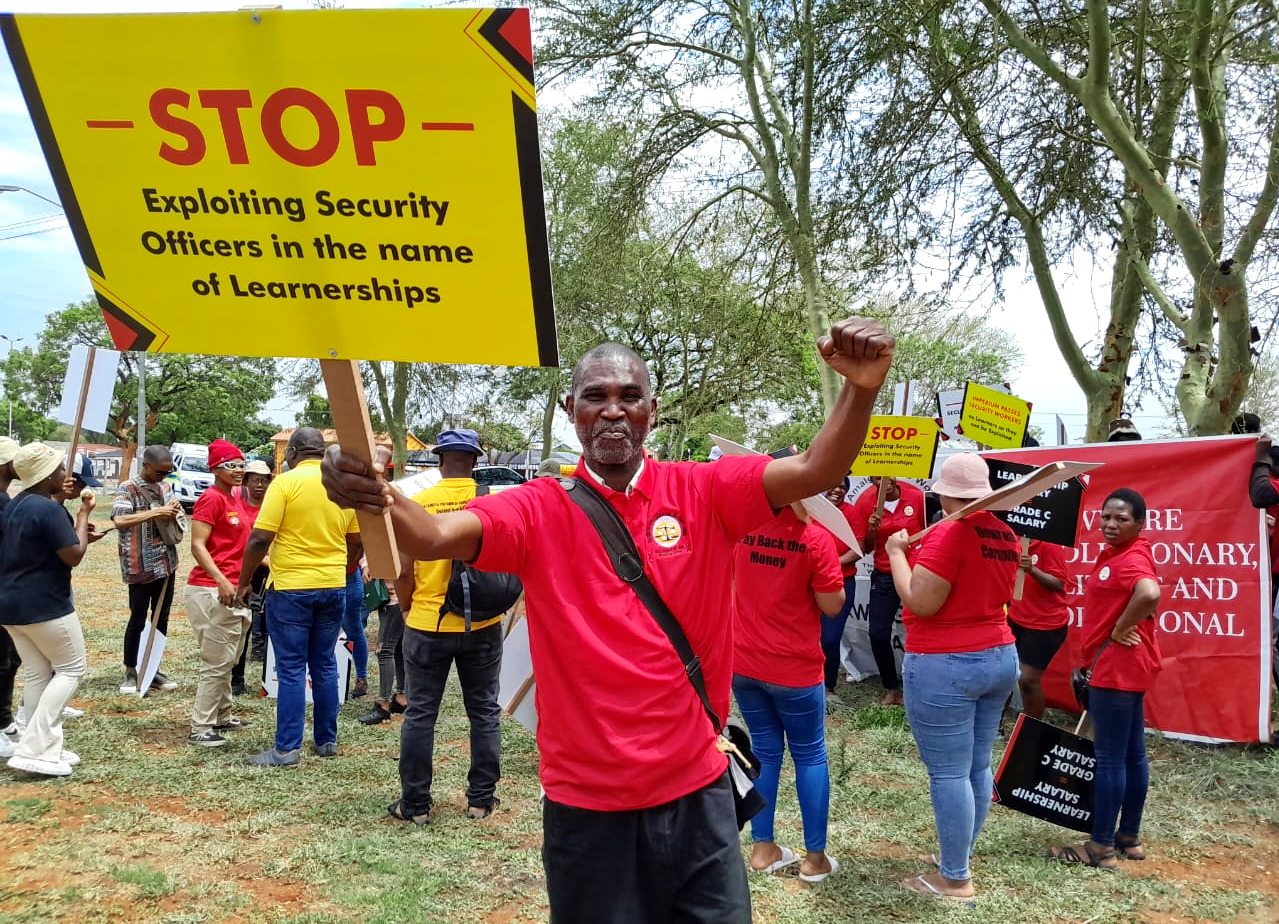
A company that supplies security guards to the private sector as part of a learnership programme has become the latest target of labour unions fighting for workers to receive healthcare benefits, be paid a living wage and to be registered with the relevant authorities.
On Wednesday scores of union members organising in the sector delivered a memorandum of grievances to Imperium Business Solutions in Sinoville, Pretoria.
On its profile the company describes itself as a service provider for business solutions and salary administration as well as the facilitation of legal services on a retainer basis.
The union federations included in the protest included the Abanqobi Workers Union (AWU), Kungwini Amalgamated Workers Union (KAWU), National Union of Metalworkers of South Africa (NUMSA) and the South African National Security and Allied Workers Forum (SANSAWF).
The private security sector unions have been engaged in a sustained campaign to force companies that failed to adhere to the NBCPSS agreement to pay back the millions of rands that were deducted from workers. Philemon Bhembe, SATAWU’s national coordinator for the security sector described Imperium as a company that provides and supplies companies with security guards.
“This company in collusion with other companies is underpaying the workers,” said Bhembe.
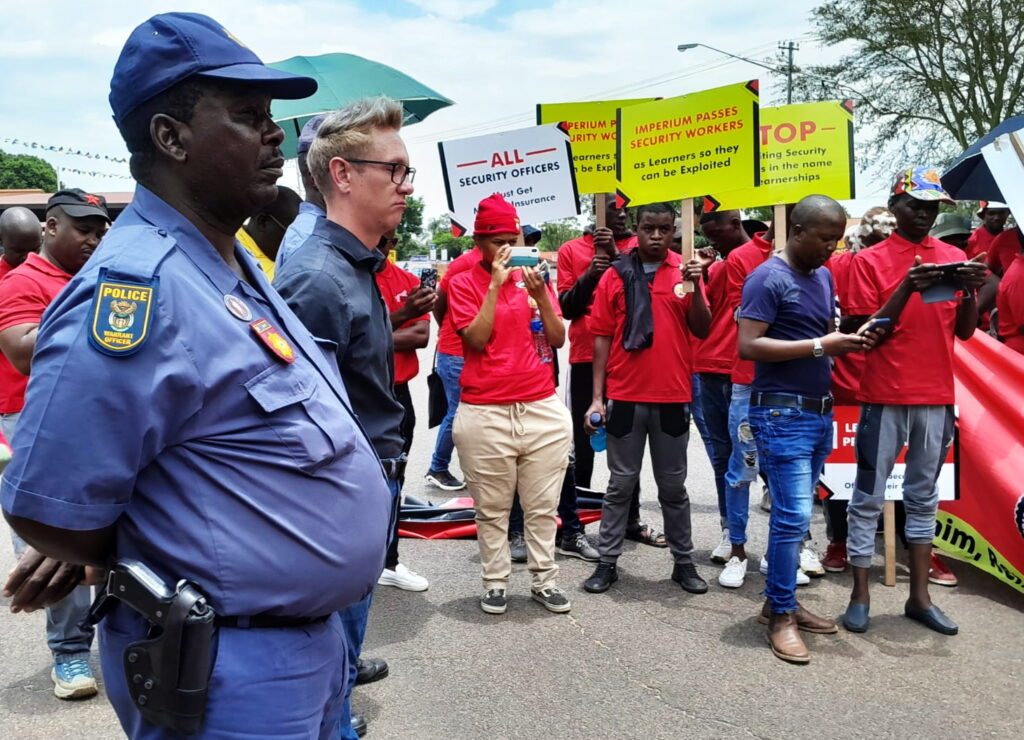
“The Main Collective Agreement provides that a learner must be paid equal salary to a grade C, now what Imperium does, it pays far less than what is written in the Main Collective Agreement. The other part is that, Imperium, if the workers are on the learnership they are not providing them with benefits and we are saying, enough!” said Bhembe.
“They are challenging us in court saying that, we are wrong when we say a learner must earn an equal salary with a Grade C,” Bhembe said. The matter dates back to March 2021 when the NBCPSS approved a health insurance benefits scheme for the sector following the signing of a collective bargaining agreement with employers and unions.
Affinity Health was later appointed as administrator for the health insurance benefits scheme. The benefits include chronic disease management and medication, doctor consultations, hospital and casualty benefits, including an HIV and TB management programme.
However according to unions and workers thousands of security companies have failed to adhere to the agreement whilst deducting money from employees’ salaries but failing to provide the health care benefits, or using other service providers either than the one appointed by the NBCPSS.
In their memorandum the unions demand that Imperium Business Solutions stop the ongoing alleged exploitation of security officers by complying with the Main Collective Agreement (MCA).
Compliance with the MCA includes among others registration with the Private Security Sector Provident Fund (PSSPF) and the NBCPSS Health Insurance, administered by Affinity Health, provision of a basic salary, agreed upon allowances and overtime.
“We want benefits, equal benefits in terms of the collective agreement in the private security sector,” said Anna Mashego, the general secretary of the SANSAWF.
In the memorandum the unions accused Imperium of being “a labour broker masquerading as a skills development provider.”
“The practices of Imperium Business Solutions are the 1 (one) absolute contradiction to the principle of decent work. Imperium’s fraudulent use of the learnership programme has driven down workers’ wages and conditions of employment. Imperium do not add any value to the sector but sponge off the labour of others and replace secure jobs with temporary and casual forms of employment,” the memo read in part.
Imperium representative Marius Wiese acknowledged receipt of the memorandum and said it will be handed over to the company directors and top management.
The unions noted on the memorandum to Imperium Business Solutions that “in terms of the main collective agreement, all security companies must contribute R175 per month for each security officer contributing the balance.

“Alas, the majority of security companies working with Imperium Business Solutions do not pay over these premiums to the designated service provider,”
“Learners or learnership programmes must benefit, must have medical cover. They must have the provident fund. When you are on duty you need to qualify, you need to benefit,” said Mashego.
Kenneth Khamisa, 23, said he is still under a learnership even though he has been a security guard for two years.
“I am a well trained security guard but I am under a learnership programme. These people are not paying us enough money and it takes time for them to pay us,” said Khamisa.
Khamisa further said his employers are deducting R70 from his salary monthly for medical benefit and Unemployment Insurance Fund.
“Employing security officers as learners is a sophisticated way of stealing from workers, as these so called learners do not enjoy the health care benefits. These so called learners are always at the risk of sinking even further into poverty because of the adverse effects of illness on duty on their earnings and family savings.”
In its 2021/22 annual report, the Private Security Industry Regulatory Authority (PSIRA) said there were 586,042 registered active security officers as at the end of March last year and 11,540 active registered private security businesses.
“We are saying to Imperium that we are tired of double dipping. They get a stipend from SETAs and also charge service providerS for the very same service but they are not willing to pay a living wage, they are not willing to place the learners in terms of the Main Collective Agreement,” said Mashego
Beatrice Mohlabe who has been a security officer since 1999 is worried about the working conditions of the security officers that are under a learnership programme at her work place.
“They are security officers working in retails where they don’t register them coming with a name of saying learnership. There is nothing like a learnership in the security industry.
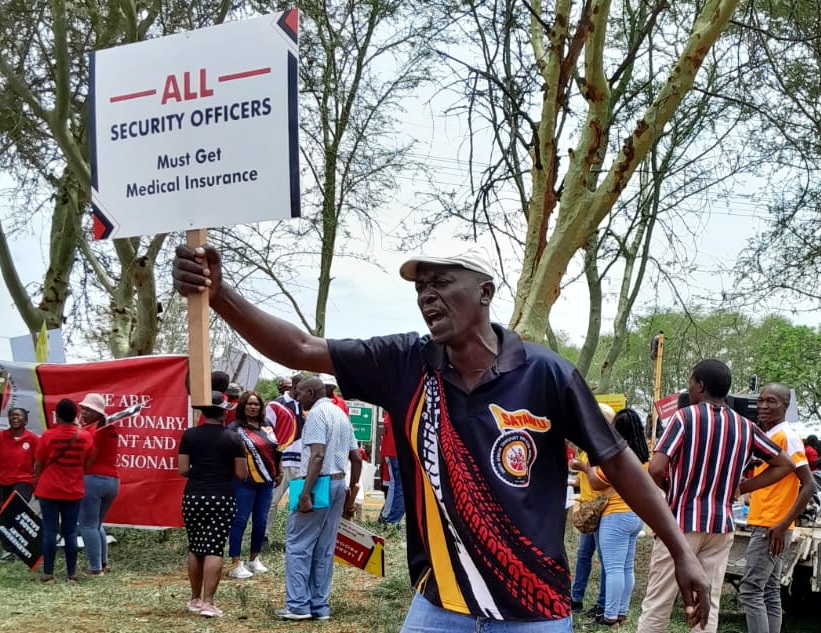
“The learners are given R3500 to R4000 that is not enough as the basic for security is R5700, not mentioning the overtime and working on weekends,” she said.
“Their lives are in danger while earning peanuts as the security industry is a very difficult industry because when you are there, you’re even risking your life because you are working in the shops where there are shoplifters and they threaten the security officers after work most the times,” said Mohlabe.
According to the unions ‘several security companies including some contracted to some of the top retail chain stores are failing to provide their workers with agreed upon benefits despite deducting millions of rands from their salaries as part of the MCA. – news@mukurukuru.co.za

Be First to Comment