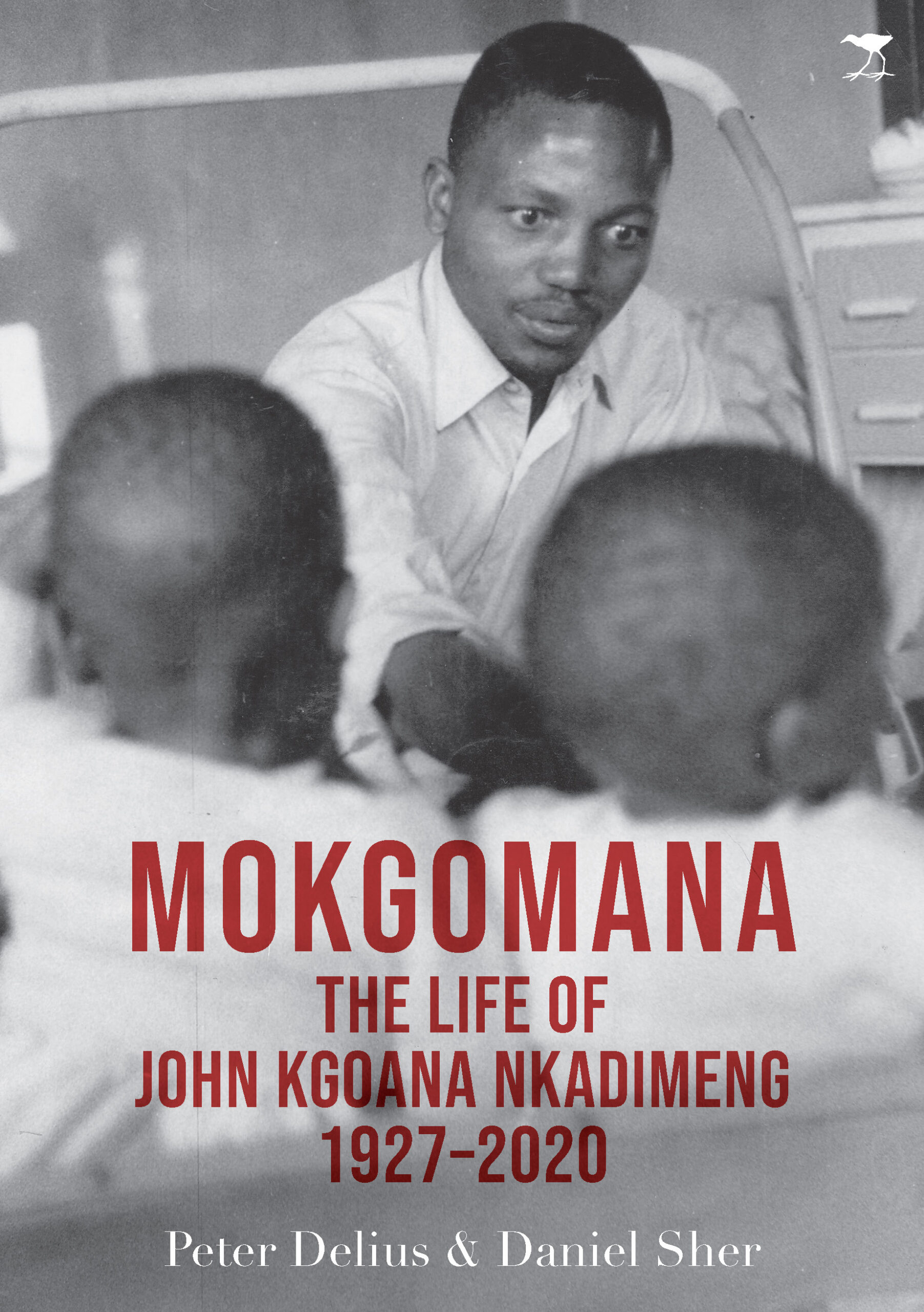
WHEN John Kgoana Nkadimeng travelled from Sekhukhuneland to the Witwatersrand in 1944, he was one of thousands of migrants seeking work in town. But his encounters with racial injustice and contact with activists drew him down a very different path, one which was dedicated to the struggle. In this extract from the recently published historical biography MOKGOMANA- The life of John Kgoana Nkadimeng the authors Professor Peter Delius and Daniel Sher trace the early life of Nkadimeng, from his origins in the rural village of Manganeng, in an area with a long history of resistance to colonial rule, through his growing involvement in trade unions, the Communist Party and the ANC.
Kgoana Nkadimeng was born on 12 June 1927 in Mashite near the village of Manganeng. His roots in this region and its long history of resistance would be deeply embedded in his consciousness.Nestled in the foothills of the Leolu Mountains, Manganeng lay in the heartland of the once mighty Pedi Kingdom.In the late 18th and early 19th centuries, the Pedi had held sway over much of Lekwebepe – the land between the Limpopo and Vaal rivers. Under King Sekwati (1828–1861) and then King Sekhukhune (1861–1882), the Kingdom had fought tenaciously to retain its independence and had repelled a number of invading armies, including the Swazi, Zulu, Boers (twice), and the British.But in 1879, after crushing the Zulu regiments at Ulundi, a British army supported by Swazi warriors finally defeated the Kingdom.
Sekhukhune was captured and taken to Pretoria, where it was decided he would be transported to Robben Island.He did not complete his journey, because in late 1880 the Boers rose up against the British annexation of the Zuid-Afrikaansche Republiek (ZAR or Transvaal Republic).On the basis that anyone who had resisted British rule deserved a second chance, Sekhukhune was released in 1881 by the re-established ZAR and allowed to return home.
He settled at Manganeng and attempted to rebuild his power base.But his brother Mampuru, who had long sought to usurp his position and had aided the British attack on the Pedi capital, would not accept Sekhukhune’s reinstatement. In 1882, Mampuru sent a band of assassins who stabbed his elder brother to death. Sekhukhune was buried at Manganeng and his grave remains there to this day.12
Although defeated, the residents of the region were far from utterly vanquished.Undercurrents of resistance to colonial control and disputes about the rightful heir to the throne coursed through Pedi society. Conflicts in the 1890s resulted in the ruling group being forced to move further north. But with the outbreak of the South African War in 1899 and the loosening of control by the ZAR, Sekhukhune II entered the fray and took control of much of the old core of boPedi. His regiments raided Boer cattle
and blocked the movement of Boer commandos.
Once the British secured victory, they reneged on their promises to black South Africans and set about entrenching white political and economic dominance. What was left of boPedi became one part of the reserve areas in South Africa, which were intended to keep the black majority in a marginal position. Land losses were entrenched by the 1913 Land Act. Taxation was increased, pass laws were intensified, and African farmers were excluded from the markets and the range of support available to white farmers.
From the early 20th century, most African households could no longer meet their basic needs for food and money by working the land. Migrant labour had a long history in the area, dating back to the 1840s.Initially young men had spent limited periods working on the mines and in the towns, but under mounting economic pressure, repeated and long periods away from home became the dominant reality.
From the 1930s onwards, women also joined the ranks of migrant workers in growing numbers. The villages in Sekhukhuneland had several internal divisions.One of the most important was between chiefs, embedded in a royal lineage, and commoners. Bogoši (chieftainship) was still held in high regard by many but commoners also resisted and resented traditional leaders who neglected the maxim Kgoši ke kgoši ka batho (a chief is a chief by the people).Generational and gender-based tensions played out within households and communities, but the most profound gulf that people recalled in the 1930s was that between Christians and traditionalists.
These were rooted in clashes between missionaries and converts on the one hand, and chiefs and most of their subjects on the other, from the 1860s onwards. Converts lived in separate sections of villages and had distinctive values in relation to key institutions such as initiation and Western schooling. John Phala, who worked closely with Nkadimeng in the struggles of the 1950s, recalled of his childhood in the 1930s:
‘We can see that apartheid started there among black people. There was a contradiction between the majakane (Christians) and those they called the baheitene (heathens).’13
While tensions along these lines existed in many rural areas, the specific history and
intertwining of the forces of colonialism and conversion left an especially deep mark on Pedi
society. Kgoana’s father was Mahudu Nkadimeng (later called Phillip) who, although descended from the royal lineage, was by then several steps removed from it. In the 1980s, when asked whether he came from the chiefly family, JK explained: ‘No, we are the family of the old chiefs.My father’s family are the ones who were the chiefs many years ago…If you come to that place, you will find 50 people, Nkadimeng all of them.’14
His mother was Masethe Moumakwe (later Sefora), who was in fact more closely connected to the royal family than his father.Despite the fact that both acquired Christian names, neither were from Christian families.Kgoana was the third of their four surviving children.
A fifth had died young. Mahudu was a migrant worker on the gold mines and was away for most of every year. JK saw very little of him and his most vivid memories of his father date from 1936 when he was nine years old. Many mine workers were afflicted by a fatal dust-induced lung disease – silicosis or miners’ phthisis. Those who developed the illness were often sent home so that the mines did not have to pay the costs of treatment or provide compensation. Mahudu was diagnosed with the disease in 1936 and sent home.
JK recalled: ‘The means of transport at that time were very poor. He was collected at Geduld Mine in
Benoni in a donkey cart.It took two months to reach Sekhukhuneland. Apparently, that aggravated his disease because during this time he had no medical attention.’15
On his father’s return, the young JK only saw him once, briefly. Soon after, his mother was performing mourning rituals and he realised that his father had died. The death of Mahudu left his mother and family in a vulnerable position. While his mother had land on which she could eke out a livelihood, she and her children now formally fell under the authority of her husband’s elder brother. This was a practice that was a recurring source of tensions in the region as widows chafed under the control of their brothers-in-law and the latter attempted to enforce control over both their person and property.
JK remembered this as a very painful period in his life, saying later, ‘My uncle was very vicious with my mother and myself…’.His grandmother was sympathetic to their plight and tried with little success to moderate her son’s behaviour. Eventually matters came to a head. Kgoana, like his peers, had from early in his life herded livestock, first sheep and goats and later graduating to cattle: ‘One day there was a small fault, the cattle that we [JK and his cousins] were looking after went into somebody’s fields… [They were lashed in punishment. When his uncle beat his sons] he just did a little bit but when it came to me, it was terrible – an aggravating factor was each time he lashed me I did not cry.’
The beating became so severe that his grandmother intervened, saying, ‘It is quite clear you want to kill him because he is not your son. His father is gone. Rather bring him to me.’16
For a period, he and his mother stayed with the grandmother, but fearing for their future once she became frailer, she suggested that they move to live with his mother’s brother in the main village of Manganeng.
12 Peter Delius, The Land Belongs to Us (Johannesburg: Ravan, 1984).
13 John Phala, interview with Peter Delius, 14 October 1992.Wits Historical Papers, Peter Delius interviews, A3340, A9.2.
14 John Nkadimeng, interview 2 with Hugh Macmillan for Peter Delius, 10 July 1988.Wits Historical Papers, Peter Delius
interviews, A3340, A12.2.
15 John Nkadimeng, interview 2 with Macmillan.
16 Nkadimeng, interview 2 with Macmillan.
About the authors
Peter Delius is Professor Emeritus in the History Department at Wits University. He has spent most of his adult life researching political systems and struggles in rural South Africa and the nature and impact of migrant labour. Books he has authored and edited of particular relevance to this biography include: The Land Belongs to Us, A Lion Amongst the Cattle, Mpumalanga: History and Heritage and with L. Phillips (eds,) A Long Way Home: Migrant Worker Worlds 1860–2014.
Daniel Sher grew up in Johannesburg and studied history at Wits University. He has worked in education rights advocacy and in 2018 completed an MA in History at Leiden University, The Netherlands. He works on a variety of research projects with Peter, particularly on matters of land restitution.
More about the book

Be First to Comment