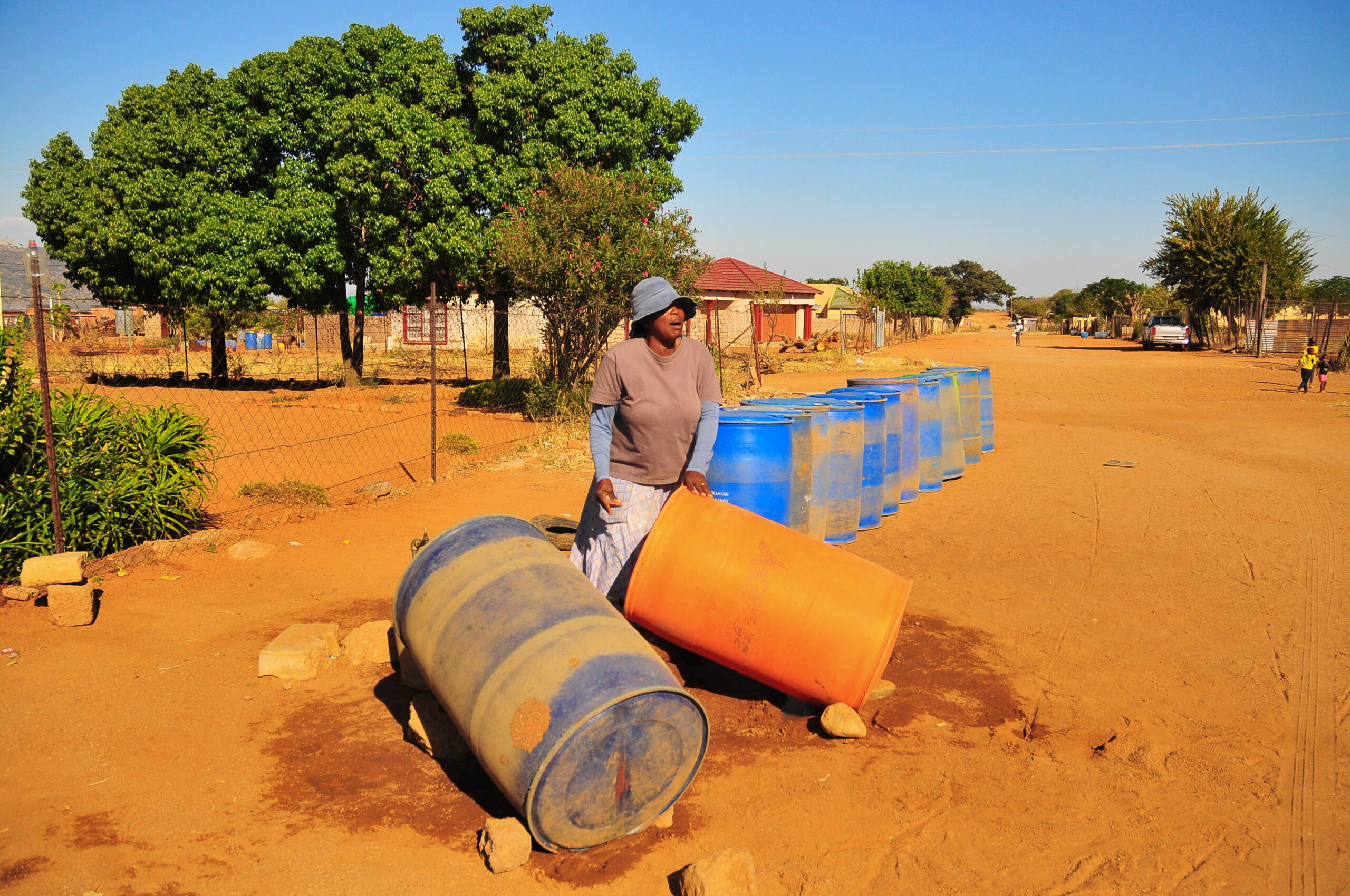
“I’m old now and I still don’t know what it is like to have clean running water in my home. I have spent my whole life struggling to get water,” Ramadimetja Selema, 83-years-old expressed her deep frustration pointing at the dozen blue 200-litre tanks lined up against the fence of her home in Marulaneng, a village in the Lepelle-Nkumpi local municipality in Limpopo.
In April 1994 she was one of the millions of South Africans who braved the early winter chill to cast their votes in the country’s first democratic elections. She was hoping her vote would among others help bring water into her home.
“I’m still going to vote. I can’t give up because we are pleading for water. We should vote,” she said.
Yet three decades on, the only change she has seen is the electrification of her home and being able to get a monthly old age state pension. The taps in her village remain dry. She supports a family of five people with her old age pension which she also uses to buy water for R240. The water never lasts until her next pay.

In late April her daughter Raisibe Selema asked Minister of Water Sanitation Senzo Mchunu and his delegation to donate all the bottled water being consumed during a ministerial imbizo to her, so she could take it home to cook as she had no water.
Mchunu and his deputy David Mahlobo were in Lebowakgomo under the Lepelle Nkumpi municipality to inspect progress on the Olifantspoort and Ebenezer Water Supply Scheme Refurbishment and Upgrade project.
“Since I was born in 1979 water has been a nightmare in our village of Marulaneng. We spend the whole day crowded around one borehole battling to get water. Our bodies ache from pushing around drums of water every day,” Selema said on the sidelines of the gathering.
“I left my mother and young children at home without water so I could come here and tell the minister our problems. That is why I asked them to give us this water they are drinking here because we are thirsty, we have no water and we have been waiting forever,” Selema said.
She recalls a time when residents dug up wells in the bush and waited hours to fill up containers.
“If germs truly kill we would not be alive today because we have been drinking dirty water from wells and broken pipes all our lives that is why I came here to beg the minister to help us get water,” said Selema.
Her village Marulaneng in the Ga-Mphahlele traditional authority falls under the Lepelle-Nkumpi Local Municipality, one of the areas hardest hit by water shortages.
The municipality which is one of the four local municipalities within the Capricorn District Municipality is predominantly rural with a population of approximately 233 925 people, and about 95% of its land falls under traditional authorities. It also has very high levels of poverty, with more than 15% of households without any form of income.
At the ministerial imbizo, residents took turns to express frustration about taps that are forever dry, water tanks that have stood empty for years, and broken promises.
Civic activist Matshidiso Malapela from Ga-Molapo said in her village they did have water running intermittently on the communal taps, but early last year, they dried up and have not had water since.
“We are buying water every day. A drum [200 litres] costs R40. But people are unemployed and poor. They don’t have the money to pay for water every day,” said Malapela who is also a member of the SA National Civics Organisation (Sanco) in the Capricorn District.
She said they had reached out to the municipality to ask for trucks to deliver water to the community as a temporary measure while plans were being made for a permanent solution.
“People are angry. They swear at us when we go to their homes to canvass for votes. They want to know when they are going to have water,” said Malapela whose organisation campaigns for the ANC.
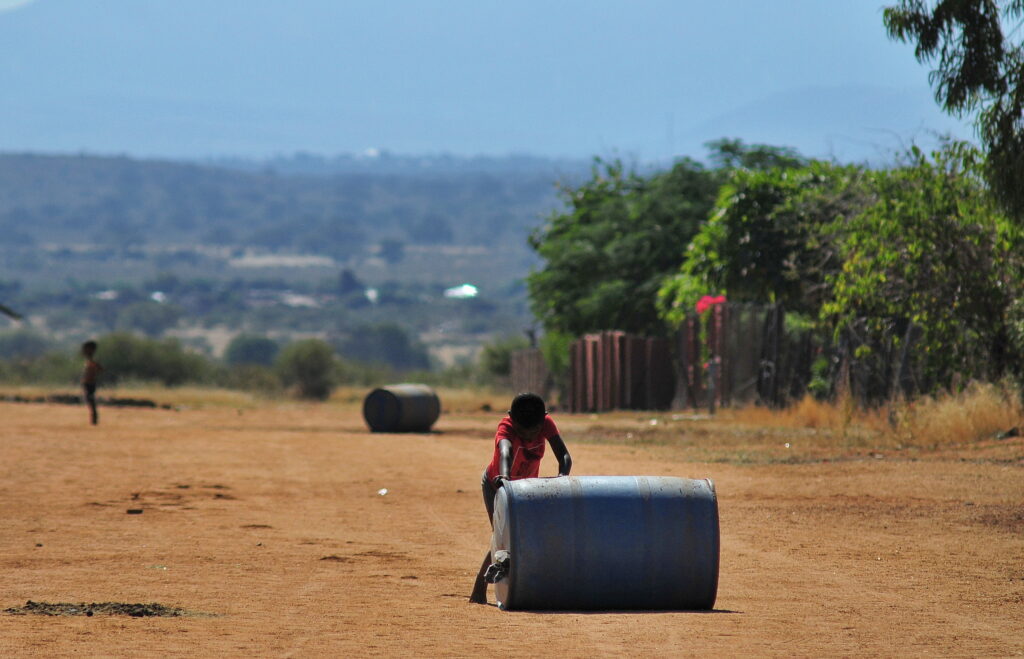
At intersections in the sandy streets of Marulaneng women gather in groups near dozens of the big blue drums that have become part of the village’s daily life. They spend hours, even during the night waiting for the communal taps to run so they can fill up the drums.
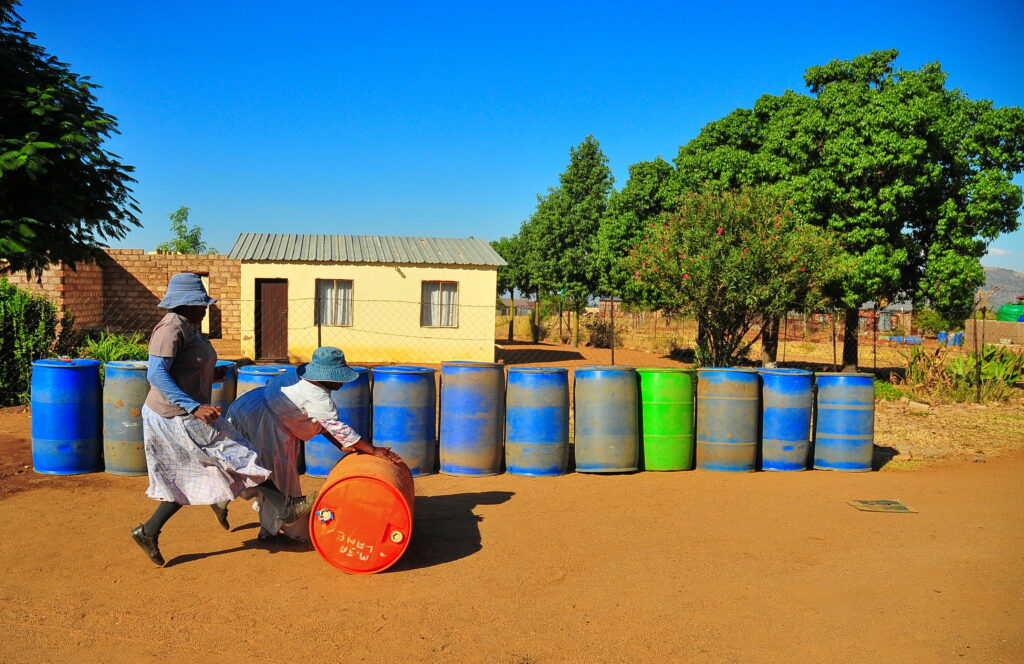
Everywhere, women, youth, and young children spend the better part of their days rolling the heavy drums along the wide, sandy streets.
Selina Lekgau has spent the night at a spot where one of the water supply pipes is broken and water drips painfully slow into a ditch dug by residents. She scoops the water using a small container into a bucket. She waits until the brown dirt has dissipated down the bucket before pouring it into one of the big drums.
“It takes me three hours to fill up one [200l] drum. I have been here since last evening. We wait here and we are not safe from criminals. When we see shadows in the night we hide. But there is nothing we can do because if don’t come here we won’t have water,” said Lekgau who grew up here and also has no recollection of a time when residents had water.
Tsoro Mangwale, chairperson of a residents water committee in the village said two projects had been previously appointed to lay down infrastructure in the form of bulk water pipes and a reservoir.
“The projects were completed but we have not seen a difference. People here live searching for water. When children return from school, they go to search for water so their parents can go home and cook. Children have no time to play or study because they are always in search of water,” said Mangwale.

During a visit to the area in August last year, Mchunu read officials working on the Olifantspoort and Ebenezer Upgrade Project the riot act, saying they should take their work seriously and revise plans to implement the project and come up with workable solutions that will address the current challenges.
The projects entail the refurbishment and upgrading of aging water infrastructure to meet the current water demands of the increasing population. The DWS said last year phase 1A of the Olifantspoort and Ebenezer Upgrade Project included the refurbishment of the water scheme to function at full capacity of 114 m/l per day by October this year and to be increased to 144 m/l per day by 2026 depending on the funding. At the recent imbizo, Mchunu accepted government had not delivered.
“What we are doing here, we’re doing something that should have been done some 10 years ago,” Mchunu said.
He said they will be refurbishing or replacing 15 pumps and 15 boreholes in the area. “And it’s a huge project. And it’s going to cost initially R4 billion just to do that,” he said.
He pleaded for more patience from the gathered public who had been bussed to the gathering held in a marquee on a dusty field.
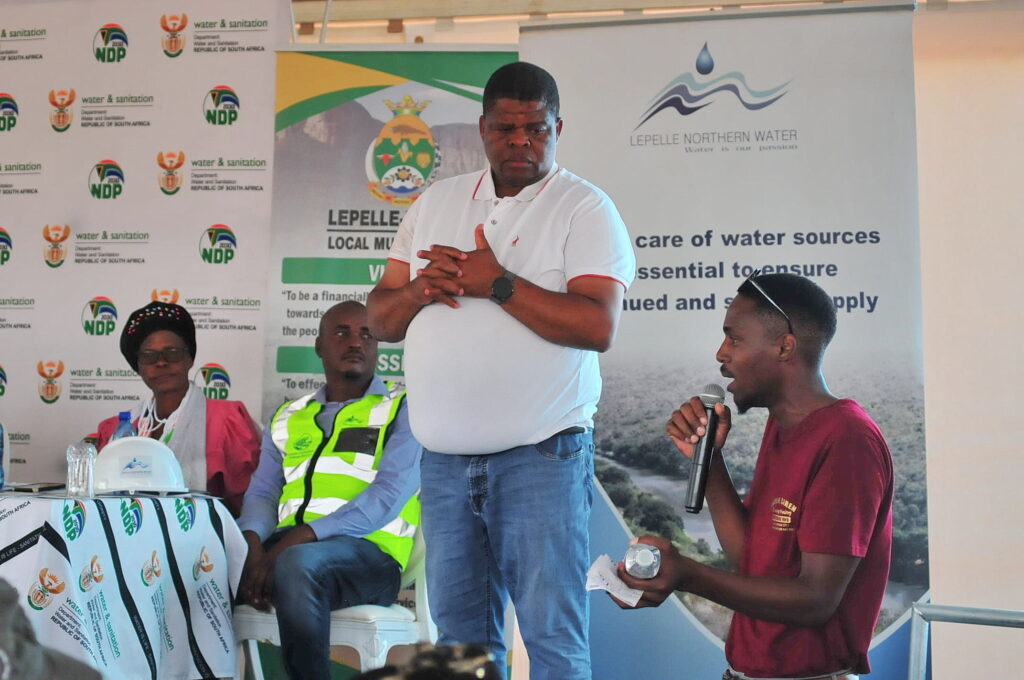
“We just want to say to you, we understand when you say you need water and you need to water urgently. We know that you’ve been very patient and we appreciate your patience. And we’re asking for more [patience] because of where we are now. We’ll see to accomplish it. There’s nothing that will leave unfinished, we will finish at the time that we say we will finish,” he said.
But some residents remained skeptical, dismissing this as a ploy to canvass for votes for the ANC ahead of the 29 May general election.
“I don’t think there will be a difference. We have been voting for a long time. Each time there’s an election, promises are made, but after that, they forget about us,” Mangwale said. – Mukurukuru Media/DM

Be First to Comment