
IN the face of climate change and its far-reaching impact on agriculture and food security, Njabulo Mbokane, a 28-year-old crop farmer finds herself grappling with the challenges of preparing for predicted future weather patterns.
However, she firmly believes that conservational farming practices offer practical and effective solutions to adapt to the changing climate.
As climate change brings increased uncertainty and unpredictability to farming, small-scale farmers in South Africa have acknowledged the complexities of preparing for the future.
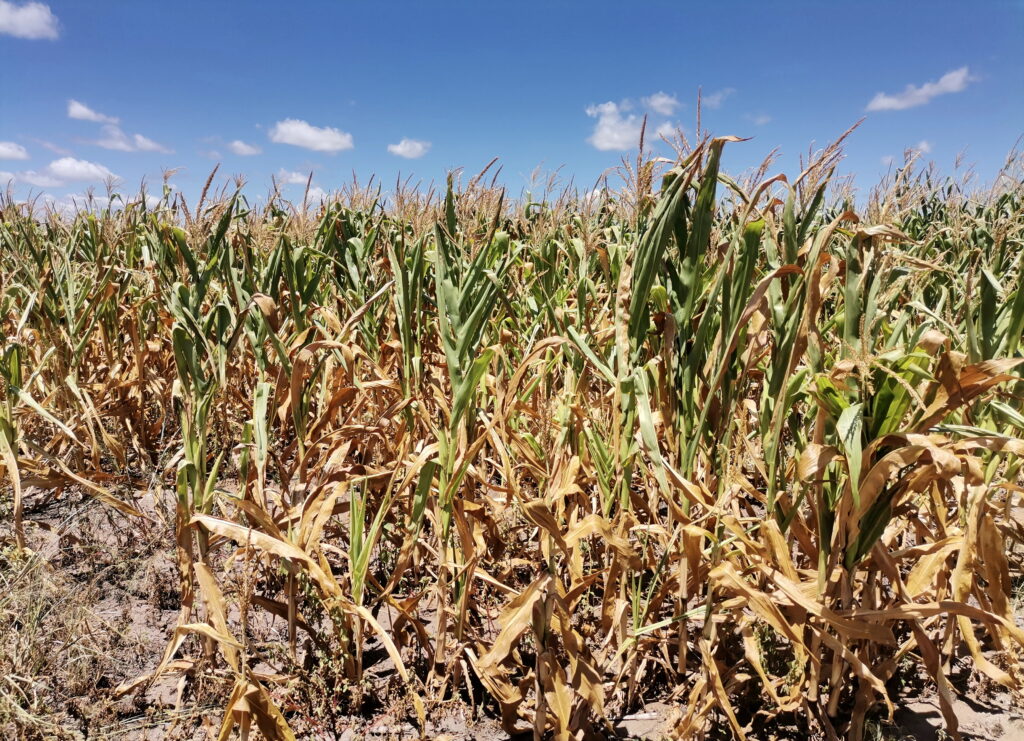
“In 2018, I experienced drought that led to the loss of crop yield, so I did not harvest as much as I anticipated. So I thought I should implement crop rotation and take a break from the maize. I then planted soya beans. To my surprise the following year we experienced excessive rains,” Mbokane said.
Ermelo in Mpumalanga, where Mbokane is based was not spared in 2019, after heavy rains and catastrophic floods battered the southeastern part of the country for days — flooding roads, collapsing buildings, blocking sewer lines and toppling electric wires.
The El Niño-induced drought in South Africa during 2015/2016 and 2018/2019 have been recorded as among of the worst in decades.
The events of flooding and drought resulted in decreased agricultural production and negatively affected the country’s food security and prices.
According to the Intergovernmental Panel on Climate Change Assessment Report Six (IPCC AR 6), indicated that 30% of the SADC region’s physical area would be exposed to climate hazards.
That means that like in the case of South Africa “high temperatures and drought, together with growing season reductions and high climate variability” is expected in the near future.
Turning to conservational farming techniques, Mbokane prioritises practices such as soil conservation, water management, agro-forestry and crop diversification.
“I personally do not wait for normal planting season any longer, or the first rains. I use crop rotation as a solution so as to generate a profit for those crops that don’t yield because of the erratic weather.
“Maize comes with a high production input, and after the drought, I needed to tread carefully in terms of keeping my farming business alive. So I rotated to soya, leaving the nutrients in the soil from the previous season in hopes that it will assist my new crop,” she said.
Mbokane laments the lack of government support, making it challenging to inspire other youth to pursue farming, particularly in the absence of assistance after natural disasters.
The department of Agriculture, Land Reform and Rural Development which has been appropriated R17.25 billion for the 2023/24 financial year, has allocated R2.2 billion to the Food Security and Agrarian Reform sub-programme.
A report by the portfolio committee on the department’s 2023/24 annual performance plans and budget however noted a worry around food security programmes and their impact.
“A concern that was raised by the Committee was the lack of a framework or a clearly defined indicator to measure food security besides the Department’s reliance on quantitative targets that are implemented by provinces in the form of producer support programmes (conditional grants) without measuring the actual impact of such programmes on food insecurity especially at the household level.”
Agri-Specialist for Farmsol-which empowers smallholder farmers; Karabo Puswe said that small-scale farmers are met with challenges of not affording multi-peril crop insurance for disasters such as floods or drought.
“Commercial banks do not consider agriculture as a viable business. And they all become reluctant to invest in agriculture now because of unforeseen circumstances. Climate change really poses problems because if winter temperatures are not cold enough it is a sure sign that we may not have enough rainfall in summer,” Puswe said.
Statistics South Africa’s Agricultural survey released in December 2022 indicated that the agriculture industry earned R417.1 billion in 2021. The leading sector was animals and animal products, followed by horticultural crops and products at R110.4 billion, and ‘field crops’ at R81.4 billion.
Despite the prevailing trend of crop farmers shifting towards livestock farming, 26-year-old Nqobisizwe Ntuli remains hopeful that crop farming can still make a difference. Ntuli said by adopting climate resilient farming methods, farmers can effectively adapt to the challenges posed by climate change.
“I work with my dad on the farm. It is interesting because he prefers conventional practices whereas I am more conservational farming style. After a period of excessive rains prevented our machinery from accessing crop, we tried 90 % conventional and 10% not tillage. Every farm is unique but for us we now mix both ways and include indigenous knowledge systems to try and ensure we are resilient,” he said.
Permanent soil cover, minimum tillage and crop rotation result in less fuel usage, lower investment costs and produces less green house gas emissions.
The Southern African Confederation of Agricultural Unions (SACAU) hosted its annual conference in Polokwane, Limpopo last month and themed the two-day gathering: “Putting young agripreneurs, technological innovations, and policy at the centre of climate solutions.”
Giving an address at the conference Food and Agriculture Organistion (FAO) Southern Africa Resilience Team leader, Lewis Hove said more information, research and investment including indigenous knowledge is needed.
“There are early warning systems that need to be developed for farmers in response to climate change.
“We need to understand that while the research has been done and a lot of technologies are available, they are still not being used by farmers and that is the challenge and maybe that is where the youth needs to come in and unlock that and ensure that they are used by the farmers who are supposed to be using them,” he said.
Hove emphasised that for young agri-preneurs to have meaningful opportunities, it is crucial to incorporate elements such as early warning systems, production techniques, transportation networks, processing facilities, and market value chains. -news@mukurukuru.co.za

Be First to Comment