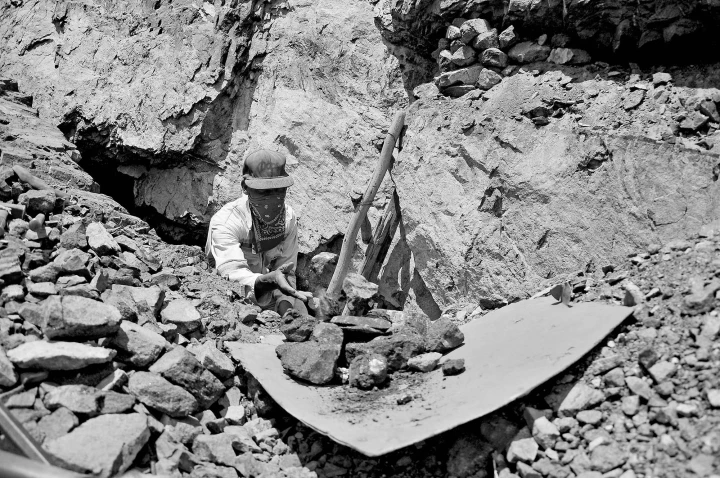
“We can’t go there anymore. There are soldiers everywhere now,” Zethu Hlatshwayo, national spokesperson of the National Association of Artisanal Miners (NAAM) said in response to whether artisanal miners were still operating at the Golfview Mine.
The mine located in Ermelo is one of many derelict and abandoned coal mines in the Mpumalanga Highveld.
Dozens of men, women, and youths from around Ermelo spent hours daily digging for coal in dangerous conditions underground before packaging it to sell to local communities for domestic use.
The diggers, using picks and shovels earned up to R450 a day while wheelbarrow loaders who carried the coal from the shafts made around R150 for 10 loads.
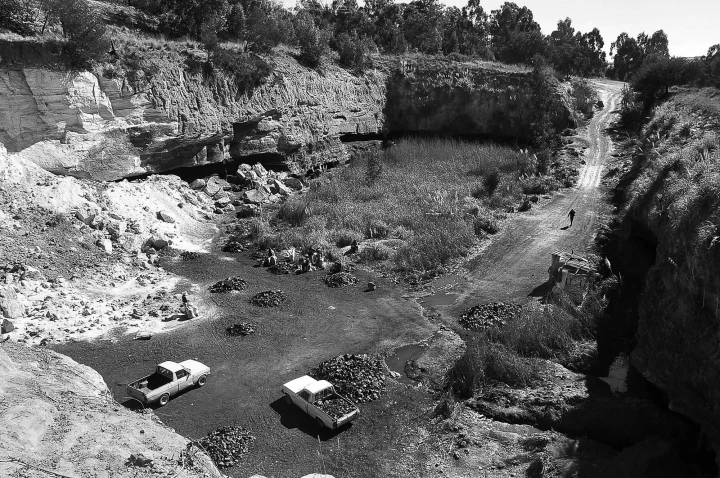
Faced with high levels of poverty created by high unemployment resulting from the closure of old mines and shrinking job opportunities in the agriculture sector, many found working at the abandoned mines as the only way to put food on the table.
However, in recent weeks the cling-clang of shovels and pick axes on the abandoned mines has been silenced by the presence of soldiers and police who are deployed there as part of the government’s Operation Vala Umgodi which is aimed at clamping down on illegal mining.
On February 5, president Cyril Ramaphosa told the Investing in African Mining Indaba in Cape Town that since 2019, the DMRE has closed and sealed 251 derelict holes and shafts. He said over the next three years, the DMRE intends to close a further 352 shafts.
Ramaphosa further told the captains the mining industry gathered there that one of the government’s objectives was to tackle illegal mining and damage to infrastructure. He said since the establishment of a specialised police unit, working with the defence force, “we have seen a number of arrests, prosecutions and convictions of the perpetrators of this crime.”
Operation Vala Umgodi which includes SAPS, SANDF, Home Affairs, and DMRE is cracking down on mining operations in Limpopo, Mpumalanga, Northern Cape, Gauteng, North West, and other affected provinces.
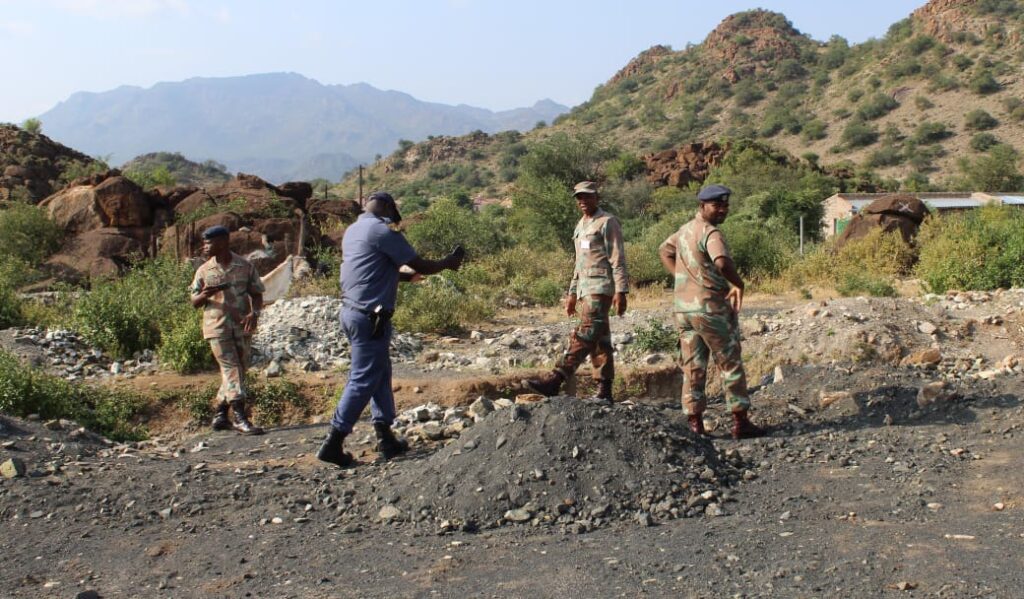
The SAPS said they have arrested numerous suspects for illegal mining and other offences including contravention of the immigration act, possession of illicit cigarettes, kidnapping, assault, and extortion as well as transgression of the Road Traffic Act.
They have also confiscated mining equipment that includes earth moving machines, tipper trucks, shovels, pick axes, power drills, generators, and thousands of rands worth of illicit cigarettes and dagga, as well as illicit drugs.
Hlatshwayo whose organisation, NAAM, advocates for the formalisation and decriminalisation of artisanal told a recent mining communities summit that the government’s failure to formalise the sector has created conditions that criminalise the activities of artisanal miners.

“The issue that this sector, by it not being legalised, it has caused a lot of negative impact to artisanal miners when it comes to their livelihoods because they are being hijacked by syndicates and middlemen and people that are connected to the industry,” Hlatshwayo said.
The lines between ordinary artisanal miners who operate individually on a small scale and those working under organised, usually armed syndicates remain blurred.
In its 2023/4 annual performance plan the DMRE attempts to explain the differences.
“Illegal mining is generally clubbed with artisanal and small-scale mining, which should not be the case as illegal mining is a criminal activity that negatively impacts the fiscus, the environment, local communities, and the overall sustainability of the industry,” the DMRE says.
It further goes on to say that “artisanal and small-scale mining is mining that complies with all regulatory requirements, and the department has in place a program to support those entities that operate in this space.”
The DMRE further acknowledges that “illegal mining is on the rise in the country; it takes place at both ownerless (abandoned) and operating mines. Illegal mining can be attributed to several factors, including but not limited to socio-economic challenges, illegal immigration, and inadequate compliance enforcement.”
https://www.dailymaverick.co.za/article/2019-12-05-this-chrome-is-our-only-hope/
However, it seems that in its crackdown on the organised illegal mining syndicates, the government has also shut the door on ordinary artisanal miners like those at Golfview who are criminalised by the mere fact they have no operating licenses or permits.
“We need to play a much more productive role in assisting artisanal miners to put the necessary pressure so that we can get the permit. Because our goal is to get the permit in the hands of artisanal miners,” Hlatshwayo said.
He said the government needs to ensure that artisanal miners are trained, regulated, and supported to comply with the relevant health and safety regulations so they can also participate in the economy and be part of the formal mining value chain.
“Soldiers have been deployed in the space of artisanal miners. We all know that the money that is going to be spent or is being spent, as you speak, is in the billions. And if you look, if those monies were channeled, or were redirected, or used for the artisanal sector, we could have created a lot of jobs,” he said. – news@mukurukuru.co.za

Be First to Comment