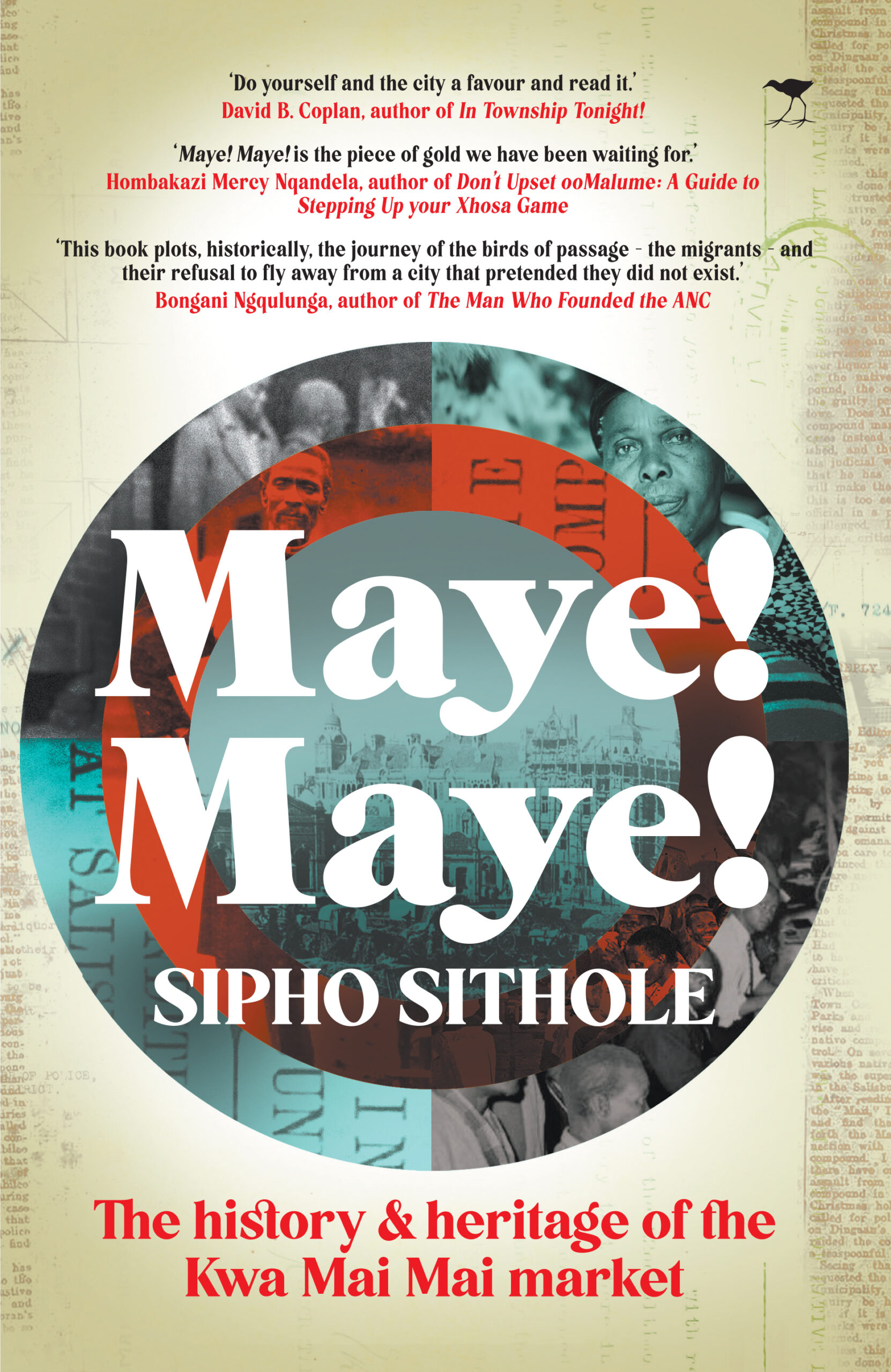
In this chapter titled Formalising the informal from the book Maye! Maye! The history & heritage of the Kwa Mai Mai market – author Dr Sipho Sithole interrogates the issues of identity, placement and urban planning with regard to small businesses operating in a city space like this bustling market in the great metropolis of Johannesburg.
Johannesburg is the second-largest city in Africa, with more than 6 million people calling this large and bustling metropolis home. ‘Joburg’ or ‘Jozi’, as some people affectionately call it, offers visitors experiences as unique and as diverse as is the city itself. Whether you are on business, in search of a cultural treat or an adrenaline rush, or you simply want to relax and unwind for a few days, Johannesburg has everything a visitor could wish for, and more. Johannesburg is a transit city, a destination city, a place to live and a place to work. It is also an immigrant city, with many of its residents hailing from other provinces in South Africa or elsewhere in the continent and the world.With its diverse cultures and creative offerings, the city has the potential to become a real magnet for business people and tourists, but in pursuing this vision a difficult road lies ahead. The city is full of hope, disappointments, dreams and despair. It is rich in opportunity, but only if enough people dare to dream and keep the possibilities alive. It buzzes with an eclectic mix of people with talent and good ideas, but it is vulnerable to short-sightedness, bureaucracy and greed. There is so much latent talent in the city – particularly in the creative industries (cultural performers, designers, craftspeople, artists, musicians, event planners and wellness practitioners) – but government’s attention is often elsewhere. So much energy, both in government and in society at large, goes into trying to get a bigger slice of the pie. But if everyone focused instead on creating a bigger pie, the individual pieces would take care of themselves.
Johannesburg is home to Kwa Mai Mai – a hostel, a small business hub, a market, a training ground, a source of spiritual guidance and a place of worship, all rolled into one. Its long history and the colourful personalities who have written its story make Kwa Mai Mai a truly unique entity, one that leaves an indelible mark on the minds of those who visit the place and take the time to absorb its many sights and sounds. At times shocking, at times inspiring, Kwa Mai Mai shows that effort and imagination can be lethal weapons in the face of displacement, uncertainty and loss.
The inner city of Johannesburg is not for the faint-hearted, given its tough exterior and proliferation of opportunists and thugs. It lacks the order and decorum of the suburbs, and is unfailingly unpredictable. Danger and uncertainty are always in the air, and courage is essential. But it is alive. And where there is life, there are opportunities for growth and renewal. Kwa Mai Mai, situated in downtown Johannesburg, is a community of survivors – not just because they have learned to navigate the dangers on the streets and in the alleyways but also because they are still holding their own and looking confidently to the future after years of personal and professional hardship.
A residential, business and semi-industrial district, the inner city throbs with activity, thanks to its commercial disposition, vibrancy and sense of urgency. At the centre of it all are its cultural agency and the entrepreneurial spirit of its many inhabitants. The never-say-die attitude, the will and determination to make it – come what may – put pressure on City Council officials to create a space that facilitates working, living and playing. The inner city is also an important transportation hub that fans out in different directions to innumerable destinations, both near and far. Though much of the infrastructure is old and worn, there are some wonderful historical buildings that City Council officials have recognised as being worth preserving, notwithstanding the fact that there seems to be no clear plan on how this should be done. Finally, the inner city remains an important location for many informal business operators to ply their trade, with many of them living a hand-to-mouth existence.
Small businesses in a big city
The question must be posed: What does the City Council do about those who are operating on the fringes of society and economic opportunity – those who are desperately calling out for economic inclusion and an environment in which they are free to hustle in pursuit of the dreams that brought them here in the first place? What does the City Council do about the people of Kwa Mai Mai?
The answer lies in whether or not City and Suburban, which is KwaMai Mai’s locale, forms part of the City Council’s oversight function. If it does, one would expect various stakeholders from government, the private sector and civil society to be actively involved in delivering what is best for businesses and residents in the area. However, it does not appear that the City Council has any particular interest in this part of town, much less a transformation roadmap.
Chapter 9 highlighted that Kwa Mai Mai residents and traders are crying out for proper operational and financial oversight from the City Council, for responsible and committed spatial planning, for a roadmap for the rejuvenation of their compound, and for swift action – all the things that are promised in the Integrated Development Plan. The basis of their cries is the desire to improve the image of the area so that they can ply their respective trades in comfort and confidence. This will snowball into more sustainable and lucrative business opportunities, and lift the tone of the neighbourhood.
In such a scenario, everyone wins. As things currently stand, the Kwa Mai Mai community are being deprived of that yearned-for sense of pride in their city. Yet they have not allowed their hopes to die. Though Kwa Mai Mai as a cultural centre is hamstrung, it still has great potential. Examples from around the world should teach us (and City Council officials) that culture can be a bright beacon leading an economy’s growth and development efforts.
What Kwa Mai Mai has going for it (apart from its appealing diversity of product and service offerings) is that it is a self-driven cultural community, hell-bent on making ends meet with the limited resources it has at its disposal.
Kwa Mai Mai’s competitive edge is that it has taken its collective cultural heritage (generational knowledge, beliefs, customs and skills) and commercialised it in different ways, but without yielding to mass production. The fusion of people and activities in a relatively confined space can pose significant challenges to city managers and planners. Charman et al. (2020) posit that spatial ordering is particularly complex in areas faced with a ‘multiplicity of logics’. For example, it may be desirable to encourage economic activity but not to the extent that it leads to unfettered competition, which can have many adverse consequences.
What makes Kwa Mai Mai a spatial development challenge is that its community of micro enterprises would normally occupy about a kilometre radius, either in separate stalls or clusters of stalls. However, Kwa Mai Mai’s traders are housed under one roof in an area measuring less than 200 m2. In addition, the diversity of product and service offerings (such as fruit and vegetables, wood products, upholstery services, panel beating, childcare, hair care, herbal medicine and traditional healing) calls for specific infrastructure and facilities for the different shops.
Street-side markets also have a broader reach than it does. Just as the township economy is built on the social relations of the community it serves, Kwa Mai Mai is anchored on its long-established ‘social connections’ (Watson 2009), which can be traced back many years, often to previous generations. Kwa Mai Mai has become a space for social interaction and intercultural engagement, particularly among
Zulu migrants (acting as traders) and urban Zulus (as consumers). Watson (2009:120) refers to this interaction between the two Zulu groups as ‘rubbing along’, a setting where urban Zulus, in particular, like to be seen with their rural counterparts. This is often an attempt by the urban Zulu to achieve ‘cultural affirmation’, to assuage the fear of missing out for not having grown up in a rural setting.
The concept of the city (or a section of the city) being a place where people can work, live and play emphasises the importance of a culture led urban regeneration and development strategy. In this regard, Kwa Mai Mai is a neighbour of an established area where the privileged work, live and play in a lively juxtaposition: the Maboneng precinct.
The apparently thriving economy of Maboneng is founded on four pillars: (i) a space to live, (ii) a space to work, (iii) a space to make and (iv) a space to sell. Maboneng boasts a mixture of restaurants, small venues for entertainment gigs, coffee shops, clothing boutiques, art galleries, and retail and studio space. Attracting those living downtown as well as the chic, art-loving crowd from the suburbs, the precinct is helping to bring life back to what was once a very dubious part of the city.
What is interesting about Kwa Mai Mai is that it offers almost everything that Maboneng offers, except that it lacks the aesthetics and the well-heeled clientele that Maboneng enjoys. In other words, Kwa Mai Mai is a space to live, a space to work, a space to make and a space to sell. Unlike Maboneng, however, Kwa Mai Mai is not a place where friends hang out (except for the braai area at the entrance to the market), or a place to have drinks and snacks or even dinner while enjoying some musical entertainment. Those who visit Kwa Mai Mai have a specific purpose and destination in mind; they do not come to linger or fraternise.
About the author
Dr Sipho Sithole is a Research Fellow at the Johannesburg Institute for Advanced Study and holds a PhD in Anthropology from Wits University. Dr Sithole’s research interests are marginality and belonging, language and identity, music and society, culture and celebration, migration and integration, post-coloniality and re-imagining, as well as the creative economy.

Be First to Comment