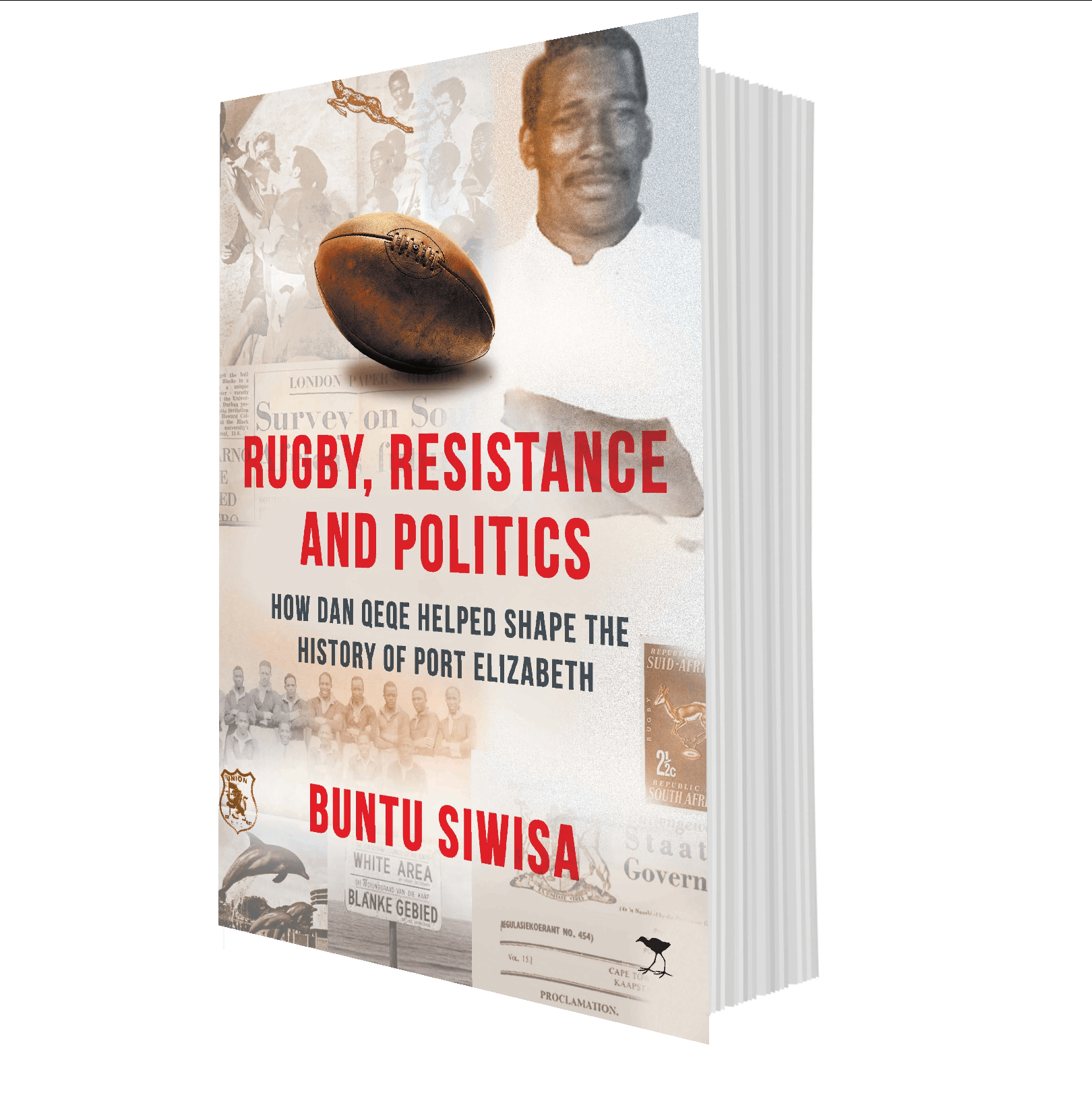
Central to the transformation of sports towards non-racialism, Dan Qeqe paved the way for the mainstreaming and liberation of black rugby and cricket players in South Africa. He co-engineered the birth of the KwaZakhele Rugby Union (Kwaru), a pioneering non-racial rugby union that was more of a political and social movement. Kwaru was a vehicle for political dialogues and banned meetings, providing resources for political campaigns and orchestrations for moving activists into exile. This is an excerpt from the book on the activist’s life titled Rugby, Resistance and Politics: How Dan Qeqe Helped Shape the History of Port Elizabeth
THE fearless character of Dan Qeqe in the presence of local white authority, and his selflessness in
helping out community members: Housing eviction notices were issued by the Port Elizabeth Municipality in terms of the Housing Act No. 4 of 1966. Between 1970 and 1971 in New Brighton, 11 519 eviction notices were issued. Only 177 evictions were carried out, and of these, 160 were reinstated after payment of the outstanding rentals, with only 17 tenants permanently evicted. In KwaZakhele, a township less well serviced than New Brighton, there were 27 170 eviction notices served. Only 1 per cent of these were carried out – a total of 284 evictions. A total of 199 were reinstated after payment of arrears, and only 85 families, out of a total population of 88 000 individuals, were permanently evicted. Qeqe addressed the corruption in his individual capacity, as he had done with the schools upgrading project. Unlike James Mpanza, who had turned social discontent on housing into a collective political campaign for Orlando, Soweto residents in the 1940s, Qeqe addressed the matter on a case- by-case basis. Sloti explained that his uncle, Dan, had been deeply moved by the injustices of evictions on account of rent defaults. More painful was the harsh manner in which these were carried out, with
izibonda throwing furniture out of the house, without any form of negotiations or alternative arrangements being made for housing. Mpumelelo ‘Sbhidla’ Majola recounted one particular incident involving a rather odd tenant in upmarket Thembalethu:
For instance, one of our neighbours, Bhilayi, Mr Bhilayi, was thrown out of his house. Those houses are big, and people wanted to move into his house. Bhilayi was well known. He had his own particular lifestyle. In modern times, you can call him a criminal, you know? So, people looked down on him, and found it inappropriate and above his station that he lived there … I remember we were small then, and the headmen were called to throw him out of his house. They called Mr Qeqe … Baas Dan came over. The headmen left, running away. He literally chased them away, and he used his foul language … He would say, ‘You are going to shit, my friend.’ He would say, ‘Go and shit. Come with your boer.’ The headmen ran away. So, he was that kind of a person. The knobkerrie-wielding Qeqe was regarded as a brave man who feared no one. In outlining this bravery, Judge Somyalo recalled how Qeqe came to his aid in securing a proper, comfortable house for his young family when he started practising as an attorney in the mid-1970s. Then, Somyalo lived in a two-roomed house at 207 Gqamlana Street in New Brighton. ‘There were houses, [but] you could not get a house. You could not extend a house … You know, things were really, really, very tough.’ He detailed his housing-procurement difficulties,
struggling with a ubiquitous and well-oiled bribery system. It was well managed by izibonda who were, in turn, overseen by a location superintendent pliant to corruption.
As Somyalo put it, ‘Most of the municipal police, you had to bribe them. It was common. If you wanted to get any favours, you had to bribe …’ Scoffing at bribery as inappropriate and repugnant, he rather
negotiated for a house on Dora Street in New Brighton. The house he eventually found was quite comfortable for his family – a four-roomed home, with extensions and bathrooms. He concluded the deal with the proprietor of the block encompassing his house, without the involvement of local authorities. However, the landlord suddenly reneged on their agreement, and wanted to evict Somyalo and his family. He then approached Qeqe for help:
I went to Dan Qeqe. I explained to him, ‘Look, man, I’ve got this problem.’ And he said, okay, he arranged that we go and see … [There] was somebody above the superintendent … Let’s go and see that chap, McNamee. Indeed, we went there. We go there, and Dan gave that chap fireworks. I was there … McNamee, he gave that chap fireworks. Not in a bad sense. He said, what are you? This is the person … why are you? And then this chap phones Stomielautous, and said, bring this, bring this. My position was rectified there and then. Perhaps Qeqe’s most selfless act was how he salvaged Mrs Majola’s
house. She and her late husband, Eric Majola, and the Qeqes had bought houses in Thembalethu at the same time in the mid-1960s. Mrs Majola maintained that towards the end of the 1970s, she was on
the verge of paying off the balance of the mortgage. However, the municipality wanted to kick her and her family out of the house. And so Mrs Majola recalled how the enraged Qeqe intervened:
Yes, they wanted my house … I went with Baas Dan. I was working at Daku at that
time. I used to work there at the municipality. I worked there for 22 full years here at
the municipality. He said, ‘Let’s go and attend to this challenge with your house’ …
We got there when they were on tea break … He said, ‘I came here on behalf of
Jumartha to attend to this matter concerning her house.’ He said, ‘What is happening
here?’ He said, ‘What is happening is also going to happen to my wife. I have paid
my house to the full. And she hasn’t fully paid up her house. No, it’s 10 years,’ and
this and that. He said, ‘Tell me what is her settlement balance? How much is left?’
Baas Dan paid up the settlement balance that had remained.
Title: Rugby, Resistance and Politics: How Dan Qeqe Helped Shape the History of Port Elizabeth
Price: R280 at bookstores nationwide and available on various online platforms
Author: Buntu Siwisa
About the author: Buntu Siwisa obtained his DPhil in Politics and International Relations from St Peter’s College, University of Oxford. Most recently, he was a Research Fellow at the Johannesburg Institute for Advanced Study (JIAS). Siwisa is now a Senior Research Fellow at the Institute for Pan-African Thought and Conversation (IPATC) at the University of Johannesburg. Siwisa’s debut novel, Paperless, was been shortlisted for the 2022 James Currey Prize for African Literature.

Be First to Comment