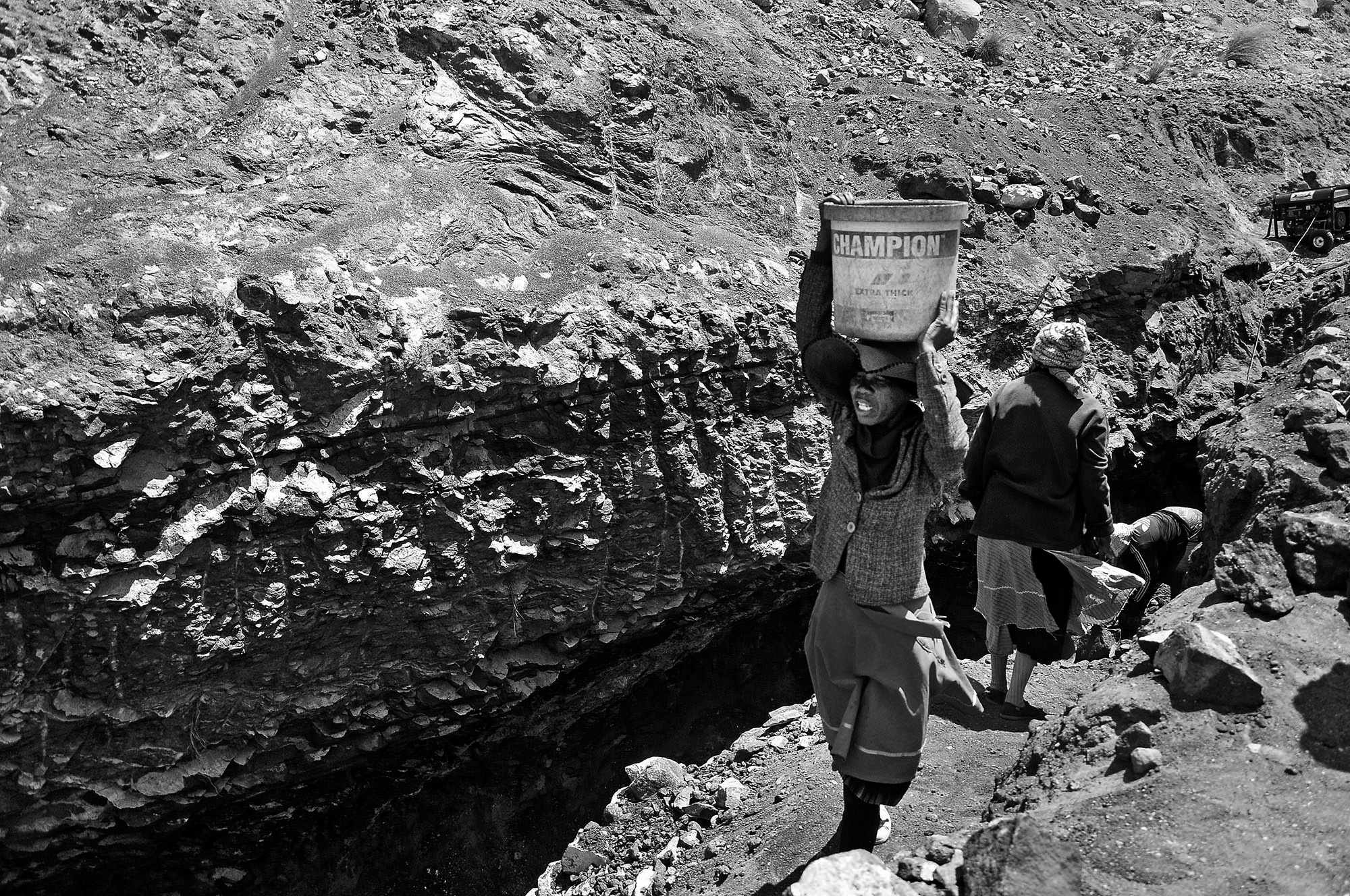
IN May 2019 artisanal miner Suzan Makgareetsa was crushed to death by a column of falling rocks in the Sekhukhune area of Limpopo province. Efforts by her frantic, traumatised colleagues to save her life failed. They did not have the required resources and equipment.
Theirs is a life lived on the edge, working in extremely dangerous conditions with very little protection or safety measures. Suzan was among scores of women from the impoverished villages along the area’s chrome and platinum belt earning a living from back breaking toil in the lower rungs of artisanal mining.
The dead woman’s father Petros Mmampholo Teka, said Suzan who was unemployed went to the mines with the others because they were hungry. Petros said in the village everyone goes there because that’s one of the few areas where they can make some money to feed their families.
Suzan’s gruesome death highlights the fact that although women are generally still relegated to the bottom ranks in artisanal mining, they however face the same dangers as their men colleagues.
The report launched on Tuesday by Wits University and Action Aid titled UNDERSTANDING THE ROLE AND PARTICIPATION OF WOMEN IN ARTISANAL MINING, notes that in the Burgersfort area where Suzan was killed, women make up more than 70% of the zama-zama workforce.
The report by Pontso Twala, also notes that most of the women zama-zamas are breadwinners and have dependents and some bring their children to the mining sites. The report further reveals that women in this sector are more vulnerable to violence and assaults which is worsened by the remote and isolated location of mining sites.
The International Institute for Sustainable Development notes in a report on the sector that women represent a large percentage of the workforce engaged in artisanal and small-scale mining (ASM)—up to 40 or 50 per cent in Africa alone.
However, the IISD highlights some worrying factors in the 2018 report titled Women in Artisanal and Small-Scale Mining: Challenges and opportunities for greater participation.
It alludes to “an invisibility problem” affecting women in the sector, saying “the contribution of women to the mining sector is often masked by the dominant profile of men’s roles in mining, which hinders women’s meaningful participation.”
Even more worrying the ISSD notes, that when women are unable to participate in key stages of mining they are often unaware of key information, “which gives men an advantage that allows them to exercise control over financial matters.”
The report reads in part: “Although cultural and historical aspects have relegated women’s participation to the periphery, women have always been part of the mining workforce. Women have primarily been involved in crashing, sluicing, washing, panning, sieving, sorting, mercury-gold amalgamation, amalgam decomposition and, in rare occasions, actual mining.”
It further highlights some worrying gender-related and cultural stereotypes that have relegated women to part players in the sector.
“Women are also active in the provision of goods (e.g., food and drink vending, sales of artisanal equipment such as sieves, and credit for mobile phones) and services (e.g., transporting dirt, ores, ore particles and water; cleaning; laundry; sex; nightclub entertainment; and trading).”
Limpopo’s platinum group metals belt which stretches approximately 90km from the villages in Atok in the north-west to Steelpoort in the south-east, is a battlefield between small scale artisanal miners, large scale industrial mines, state security forces and private security who stage regular raids to curb the practise.
In a recent raid in the Mecklenburg area the Limpopo Provincial Illegal Mining Task Team and Organised Crime Investigation Unit in collaboration with private security arrested eight men and seven women who were in the process of digging for chrome.
The artisanal miners operate without mining permits, a factor which they blame squarely on the government’s failure to formalise the sector and issue permits that would help decriminalise their work.
In this respect, women bear the brunt of these arrests as they still play a central role in running their domestic affairs. Spending prolonged periods in detention means they leave behind families and children without anyone to look after them. In most cases, women artisanal miners are family heads and bread winners.
A 2015 special report by the African Union and the African Mineral’s Development Centre titled African Women in Artisanal and Small-Scale Mining painted a typical role of the domestic role played by women in this sector.
In a chapter titled ‘Mining’ their own business, the report chronicled the life of Esi Ahema, “a 37-year-old female artisanal miner at the Ankafo Junction quarry site. Married with three children.”
It articulated her daily life as follows: “Her daily routine involves waking up as early as 5am to clean the compound, bathe her children, prepare breakfast for the family and get the children ready for school. She then prepares herself and leaves for quarry work by 8am. She usually departs the quarry at 4pm to prepare supper and to undertake other unpaid care work. She actively takes part in her local community and contributes money towards community infrastructure development and maintenance activities .”
In most instances, like in the case with the Sekhukhune case, artisanal miners operate from and are based in economically deprived areas with low chances of employment.
In June 2022, the Statistics South Africa revealed in its General Household Survey that social grants remained a vital safety net, particularly in the poorest provinces.
“Grants were the second most important source of income (51,0%) for households after salaries (59,4%), and the main source of income for about one-fifth (24,4%) of households nationally. Grants were most important as a main source of income for households in Eastern Cape (42,0%) and Limpopo (35,2%).”
The reality of unemployment hits harder among rural based communities, especially among women who due to land degradation by mining, climate change and lack of access to markets, are forced to move away from agriculture and find alternative ways of survival, including artisanal mining.
The findings of the 2015 research articulated in the African Union and the African Mineral’s Development Centre report highlighted a number of key gender-related challenges that women face in the sector. Sadly, these remain true today as they were back when the research was undertaken.
The report highlights among key issues, “critical inaccessibility of capital and financing for the mining operations from mainstream financial facilities; the lack of appropriate machinery and technology; lack of access to information on availability of mining claims; extreme difficulty in acquiring mining licences and lack of geological information on the output capacity.” of
In the days after Suzan’s death Rakgadi Kgomo, a spokesperson for the Babina Tlou baga Teka Traditional Authority remarked: “This mineral is like bananas on a mountain. If people are hungry and they see bananas on the mountain you can’t tell them they can’t have it because they don’t have a licence. If they are hungry they will go for it.”
*Lucas Ledwaba is the author of Broke&Broken – The Shameful Legacy of Gold Mining in South Africa and A Desire to Return to the Ruins. He is the editor and publisher of Mukurukuru Media.

Be First to Comment