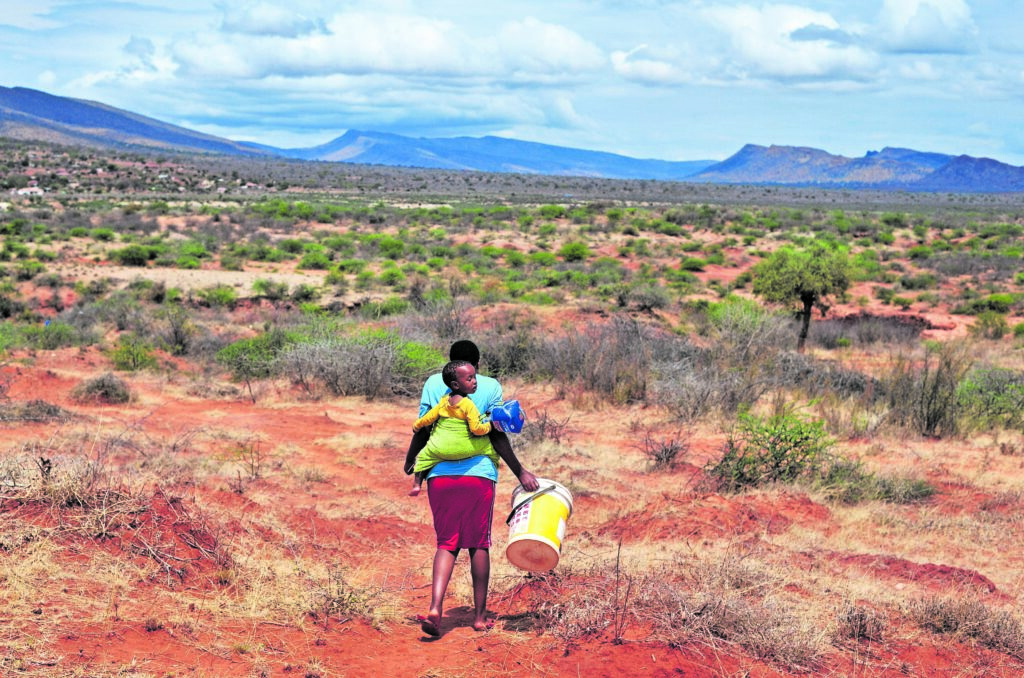
Freedom Day remains a dry occasion for many rural residents, who continue to struggle with limited access to clean drinking water, writes Lucas Ledwaba
On the morning of New Year’s Day, January 1, 2022, Mudzanani Humbelani walked the short distance from her home in Tshitomboni to the edges of the Nandoni Dam, where she planned to do her family’s laundry. This marked the last time her family saw her alive.
The next afternoon, on January 2, after an exhaustive search, a team from the SA Police Services’ Search and Rescue Unit retrieved Mudzanani’s badly dismembered body from the dam. She had only been 29 years old.
A police report gave a glimpse into what could have happened to Mudzanani. It appears that while focused on washing her family’s clothes on the banks of the massive dam, a crocodile leapt from the depths of the water and grabbed her.
Crocodiles are defined as stealth hunters that often hide just below the water’s surface before pouncing on their victims. Their jaws are designed to crush bones instantly. They often strike by grabbing a limb or the torso, pulling the victim into the water. (Real Wild) Given this, Mudzanani stood no chance against such a formidable predator.
The powerful reptile dragged her deep into the water, where she is presumed to have died either from drowning or from injuries inflicted by the animal.
Either way, there’s no question that hers was a grisly, harrowing and violent death that one could argue was a direct result of the corruption, greed and mismanagement that has plagued the Giyani Water Project for years.
Mudzanani’s home is within walking distance of the Nandoni Dam, the spot where she was killed by a crocodile. A decade before her death, the government allocated funds for a project to connect her village and more than 90 other such settlements to clean drinking water on their doorstep.
By 2021, officials had spent in excess of R3-billion on the project – yet the project was nowhere near completion. It still isn’t.
This is why Mudzanani and hundreds of thousands of other residents in the Giyani area had no access to clean drinking water.
As South Africans mark 32 years of democracy on Monday, the harsh reality of a lack of access to water remains a daily struggle for rural-based residents. Women who largely carry out the chore of collecting water continue to face daily exposure to danger.
UN Water, the United Nations agency that coordinates the organisation’s work on water and sanitation, notes that where people lack safely managed water, sanitation and hygiene services, women and girls are more vulnerable to abuse, attack and ill-health, affecting their ability to study, work and fully participate in society.
The agency further highlights that women and girls usually have the responsibility of fetching water, which can be a dangerous, time-consuming and physically demanding task.
“Long journeys by foot, often more than once a day, can leave women and girls vulnerable to attack and often precludes them from school or earning an income.”
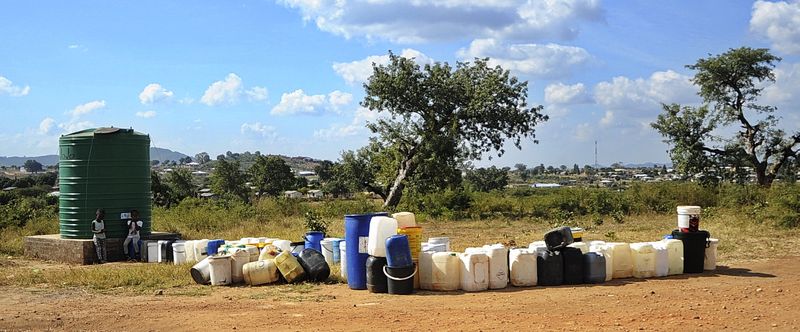
While South Africa remains the most industrialised and technologically advanced nation in Africa, people in rural areas, women in particular, remain trapped in the dark ages as far as access to clean drinking water and sanitation is concerned.
They are reduced to zombies who spend hours waiting at communal taps, pushing wheelbarrows and carrying large containers during all kinds of weather conditions, sizzling hot or extremely cold.
Hours that could have been spent working on providing food or doing other chores for the benefit of families are gobbled up by this waiting, pushing and carrying.
Children are not spared. When they return from school, they, too, are forced to join in the exhaustive search for water. By the time dusk falls, they are too exhausted to engage in other activities such as sport and studying. Too bad for the rural-based child. Even worse for the rural-based girl child.
In Limpopo’s rural villages, being waterless has become so normalised that people actually seem to have accepted it’s just how life should be – spending hours a day queuing for hours to fill up just one 200-litre drum with water.
The deplorable scourge of corruption, incompetence, poor service delivery and lack of accountability that has permeated into every sphere of government has not left the delivery of water services to communities untouched.
The state has incurred a reported R437 billion bill nationally due to corruption. A great cost to the taxpayer, and to the lives of Mudzanani and many others, we may never get to know about.
And it appears to be business as usual.
In 2021, during a government imbizo, Giyani municipal officials shamelessly told Senzo Mchunu, then Minister of Water Affairs, they needed a further R1,1 billion to finish the project.
Yet on the ground in Giyani’s rural villages, townships and the town, the taps remained dry, water pipes and other infrastructure lay rotting at construction sites, monuments to a rotten culture of corruption, mismanagement and a startling lack of accountability.
The water project remains the subject of an investigation by various entities, including the Special Investigation Unit. It has also been the subject of an investigation by the office of the Public Protector.
Municipal coffers are being milked dry by politically connected swindlers through dodgily awarded water tankering projects that render an erratic service to communities.
This erratic water tankering system doesn’t meet the demand for this basic resource, which leaves desperate families being forced to spend their last penny to pay for water.
In its Poverty Trends in South Africa: An examination of absolute poverty between 2006 and 2023 report released in December 2025, Stats SA noted that the proportion of the population living below the lower-bound poverty line (LBPL) – set at R1 300 per person per month (in 2023 prices) – fell to 37,9% in 2023, a reduction of 19,6 percentage points since 2006.
This equated to approximately 23,2 million people living in poverty in 2023, roughly 4,1 million fewer poor individuals compared to 2006.
But importantly, the authority highlighted that the provinces of KwaZulu-Natal, Eastern Cape, North West and Limpopo, which are largely rural, continue to experience the highest poverty headcounts, irrespective of the poverty line applied.
“Collectively, these provinces were home to nearly 60% of South Africa’s poor in 2023, with KwaZulu-Natal alone accounting for about one in four.”
In such circumstances as articulated by Stats SA, every cent earned matters, and basic services such as water should not come at great cost for the poor.
Back in May 2024, elder citizen Ramadimetja Selema, 83, of Ga-Molapo in Limpopo, expressed the frustration felt by rural based residents daily during a ministerial imbizo to the area.
She supported a family of five with her old age pension, which was R2,280, of which she spent R240 on water. It never lasted until her next grant payment.
In April 1994, Selema was one of millions of South Africans who cast their votes in the country’s first democratic elections. She was hoping her vote would help to bring piped, clean water into her home.
Three decades on, this remains a distant dream. Even the communal taps in her village remain dry.
“I’m old now, and I still don’t know what it is like to have clean running water in my home. I have spent my whole life struggling to get water,” she said.
When politicians sip on cold bottled water while delivering Freedom Day speeches, elsewhere, women will be risking their lives collecting water from crocodile infested dams and rivers.
Millions like Selema will be either waiting for the water tankers or lining up at the communal taps, hoping they cough up just enough water to sustain their families for a few days.
Those who hold the levers of power should act decisively to hold those who deny citizens such as Selema the basic human right of access to clean drinking water accountable. They should face the severest form of punishment, for they are no different from murderers who daily violate citizens’ right to life.
*Lucas Ledwaba is the author of A Desire to Return to the Ruins and editor of Mukurukuru Media

Be First to Comment