Ramotoana Richard Mokgomme’s latest exhibition Tša sefaleng le meraloko e mengwe peels off the layered and unfolding drama of South Africa’s current affairs through complex, unscripted compositions writes Kolodi Senong
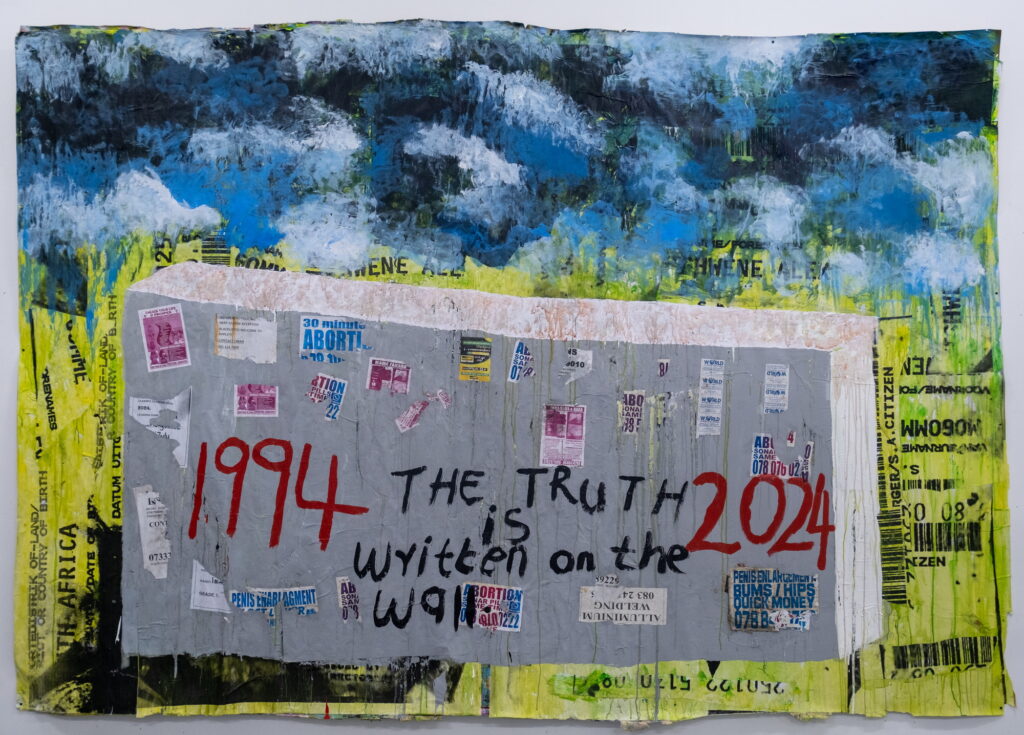
Dominated by the neoliberal realities of corruption amid glaring snippets of abundance, the immediacy of these visual explorations read like some shocking social media posts on platforms like Facebook, X and TikTok.
His instinctive experiments in collage, painting and additive sculptural installations reveal a psyche obsessed with the daily survival strategies of ordinary people.
Curated by Ayabonga Matintela, the exhibition explores nostalgia emanating from unfulfilled conceptions of political, academic, economic and spiritual freedoms.
The ‘cultural platform’ Artistry in Sandton, opened the second instalment of Mokgomme’s third solo on Human Rights Day, 21 March.
The show’s first episode took place at the Oovookoo Art Gallery in Village Deep, south of Johannesburg, between February 15 and March 10 this year. The exhibition’s title evokes memories of one of those prescribed Sepedi books read in some of the country’s public schools.
A sense of the artist’s wonder over the country’s post-1994 material realities frames these text-laden compositions in titles such as City to Let e ya swa ebile e ya wela, Tenders and Connections and Memories of My Father.
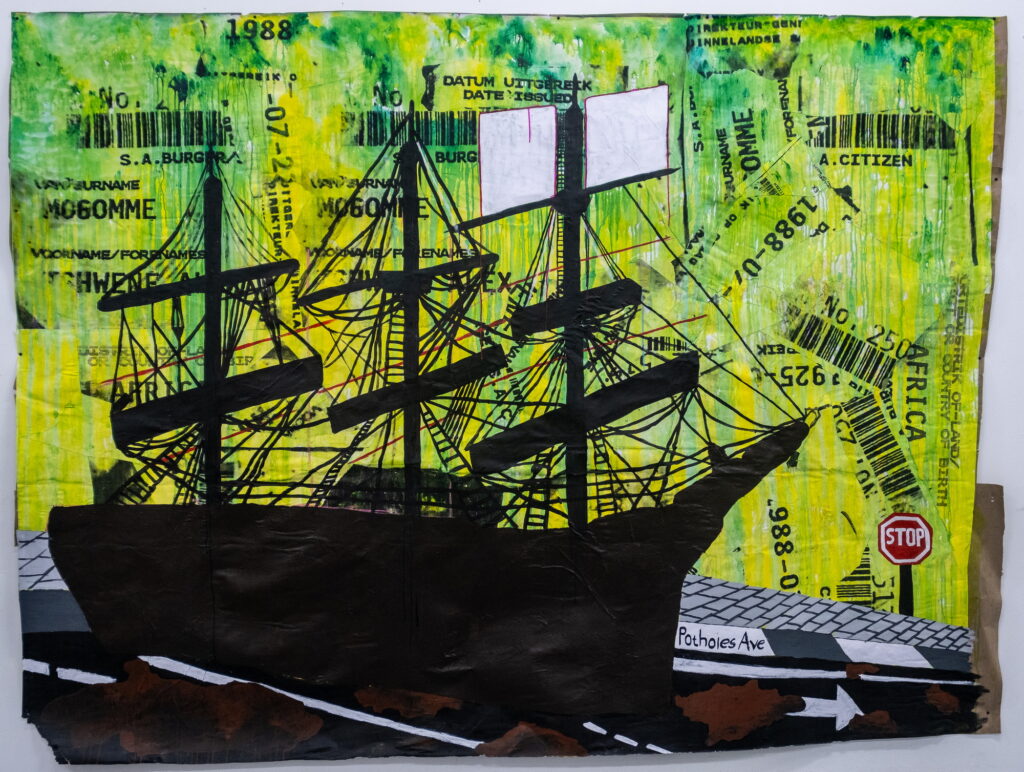
Mokgomme conceptualises the work through a stringent research process that entails anthropology, sociology, history and personal experience studies. For example, the gigantic Stuck in 1652 represents a silhouette of one of Jan Van Riebeeck’s three ships, which landed in present-day Cape Town on April 6, 1652.
Analogous to a dream, Mokgomme paints this imposing vessel in black as it sails from the north to the south pole along Potholes Avenue. Superimposed washes of green and yellow against copies of his father’s identity document form the background, which indicts the ruling African National Congress (ANC).
Through the calculated use of colour, the composition contrasts the ruling ANC government’s empty promises and normalised corruption against the backdrop of excuses and lack of accountability. These weaknesses grant the supposed dead Apartheid a stranglehold over the present reality while encouraging those on the far right. Following these challenges of establishing an efficient post-1994 government, whispers of a de facto independent and Zionist state in the Western Cape float around.
Furthermore, Mokgomme explores how black women came to assume roles of subservience in the name of culture through the sculpture Tša mehleng ga di lebalwe. An assemblage of cow bones forms the figure of a young wife with a tilted head. The pitiful female figure, seemingly resigned to her role, is depicted serving tea from a tray with collaged copies of an identity document, a sun-burnt yellow teapot and cups.
Generally revered as a symbol of respect among black people around South Africa, a small criss-cross patterned blanket hangs on her shoulders. Mokgomme uses this German-made kaross to interrogate this so-called cultural garb’s absurd origin and trickery. This sculpture amalgamates uncomfortable memories of the violent infiltration of lives with birth pangs reminiscent of a neocolonial state.
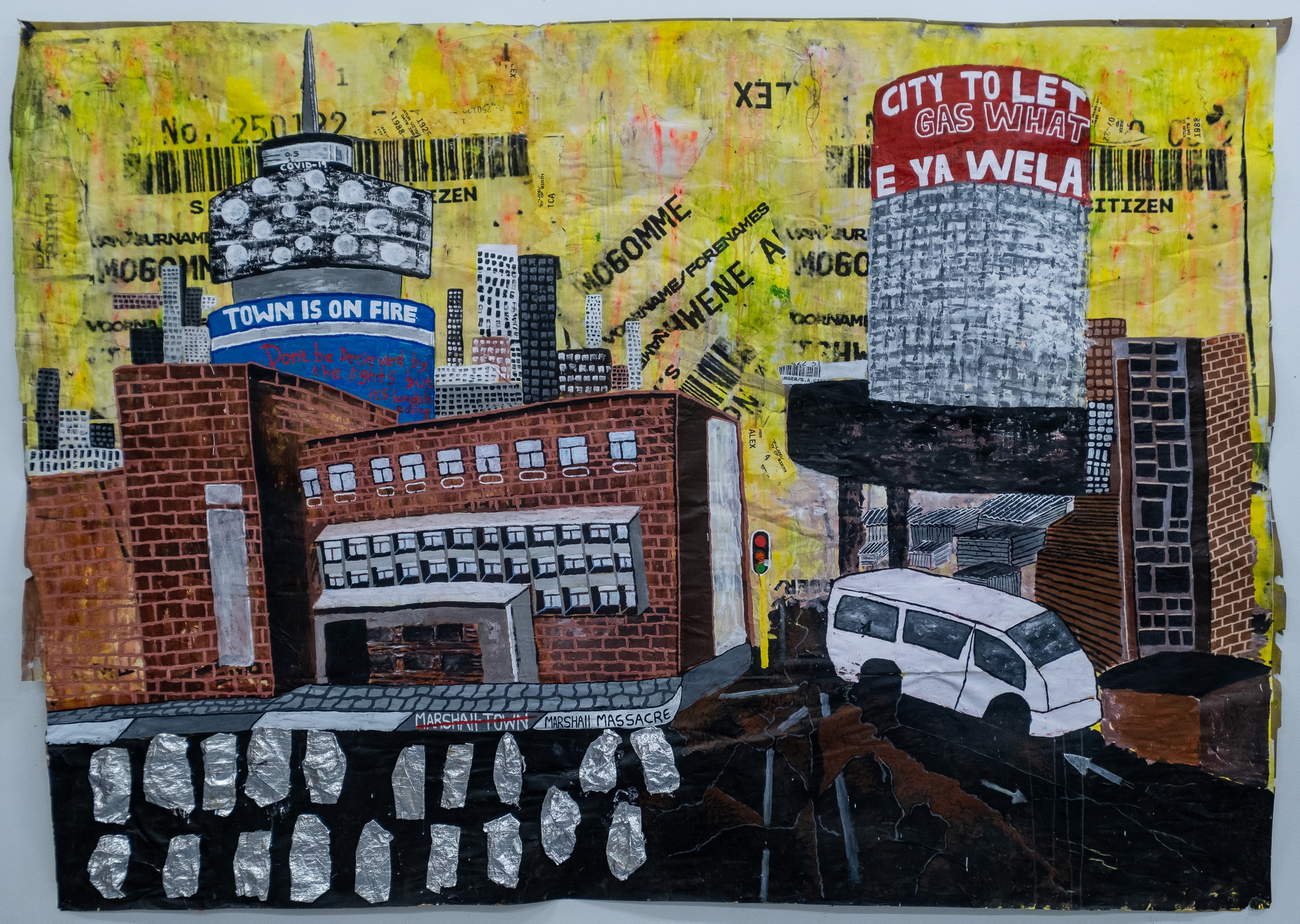
In another composition, the artist questions the role of art in a society dominated by social media-inflected celebrities and demigod politicians. Titled City to let e ya swa ebile e ya wela, the work depicts a barren and prison-like downtown Johannesburg. Characterised by the once flourishing and now ruined Ponté skyscraper and Telkom (formally Hillbrow) Tower in the background, a ghostly disposition dominates the painting.
At the bottom left corner, 19 vertically placed silver rectangles in two rows stand for the dead whose bodies lie across Marshall Massacre Street. These foils symbolise the 76 individuals who callously lost their lives in the fire that consumed the Usindiso Building at the historical 80 Albert Street in Marshalltown. Formally, this notorious Central Pass Office and ‘the nerve centre of apartheid’ from 1954 used to issue permits that controlled the movement of black people in the City.
Since then, the building metamorphosed into the Usindiso Ministries Women’s Shelter in 1994 before some faceless and powerful individuals hijacked and partitioned it into shacks. Rented out to African immigrants from countries like Zimbabwe, Malawi and Tanzania, these stinking shacks inside the building mysteriously caught fire on August 2023. Typical of the post-1994 state-initiated commissions of inquiry from the Truth and Reconciliation, Marikana, and Zondo, the Usindiso Building Commission of Inquiry ensued.
Mokgomme interprets this fierce tragedy on the black body in macabre and jarring dull tones of browns, yellows, red and blue against flat black areas with solid outlines. Intersecting copies of the South African bar-coded identity document complicates the composition’s text-burdened yellow sky. Hand-written words, “town is on fire” and “don’t be deceived by the lights but its loadsheding”, can be deciphered. Using a copy of his father’s misspelt identification as a characteristic visual trope, Mokgomme interprets the socioeconomic instability of the country’s post-1994 landscape.
Mokgomme’s creative processes summon the uncomfortable reality of low-income people through mixed media creations that combine memories of the past, present and future. This innovative method becomes evident in the sculpture Memories of My Father, where the artist exploits memory, metaphors and analogies to reimagine his departed old man.
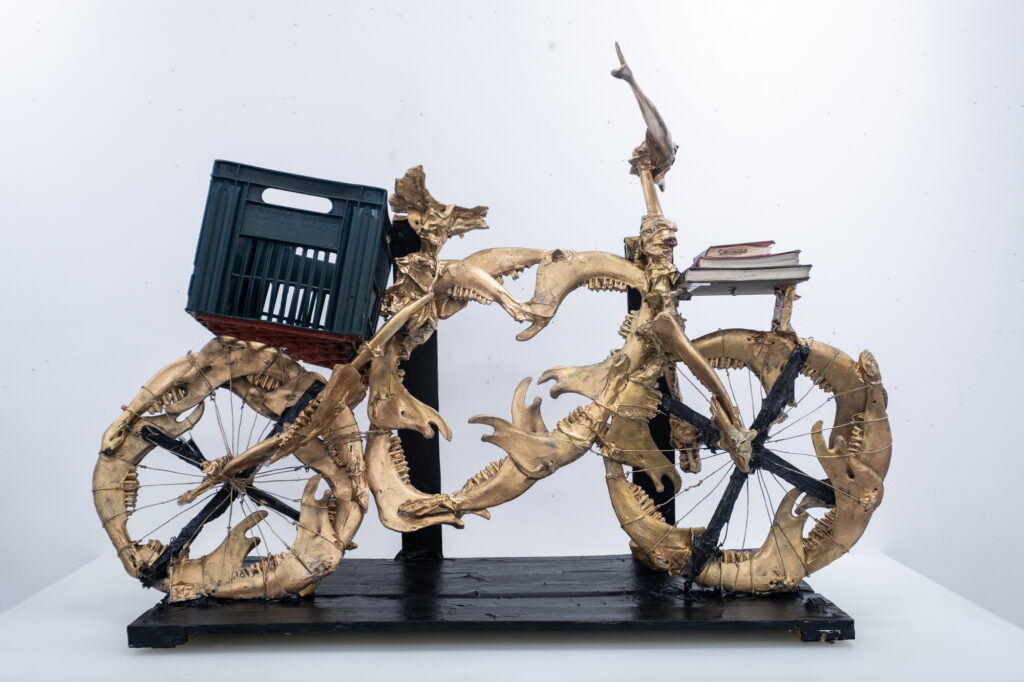
Raw jaw bones and skulls meticulously combine to construct a towering bicycle. Mokgomme’s sculpture emits a sense of presence that borders on the artist’s anecdotal strategy, which experiments with traditions of oral narratives. These methods grant the sculpture a convincing sense of lived reality that surpasses explanation and justification.
Considering the emotional content and sophistication of the sculptures, exploring the fresh animal bones seems a logical step for Mokgomme to take. Experimenting with the bones beyond the aesthetics of paint seems super-charged with the possibilities of complicating these explosive interpretations of contemporary reality. Lastly, the exhibition dialogues with extant ideas of oral storytelling as it seeks to expose the present violent theatrics of South Africa. Tša sefaleng le meraloko e mengwe runs until April 16, 2024. – news@mukurukuru.co.za
- Kolodi Senong is a painter, educator and a postdoctoral researcher at the Wits School of Arts. His creative work revolves around people on the periphery of popular discourse.

Be First to Comment