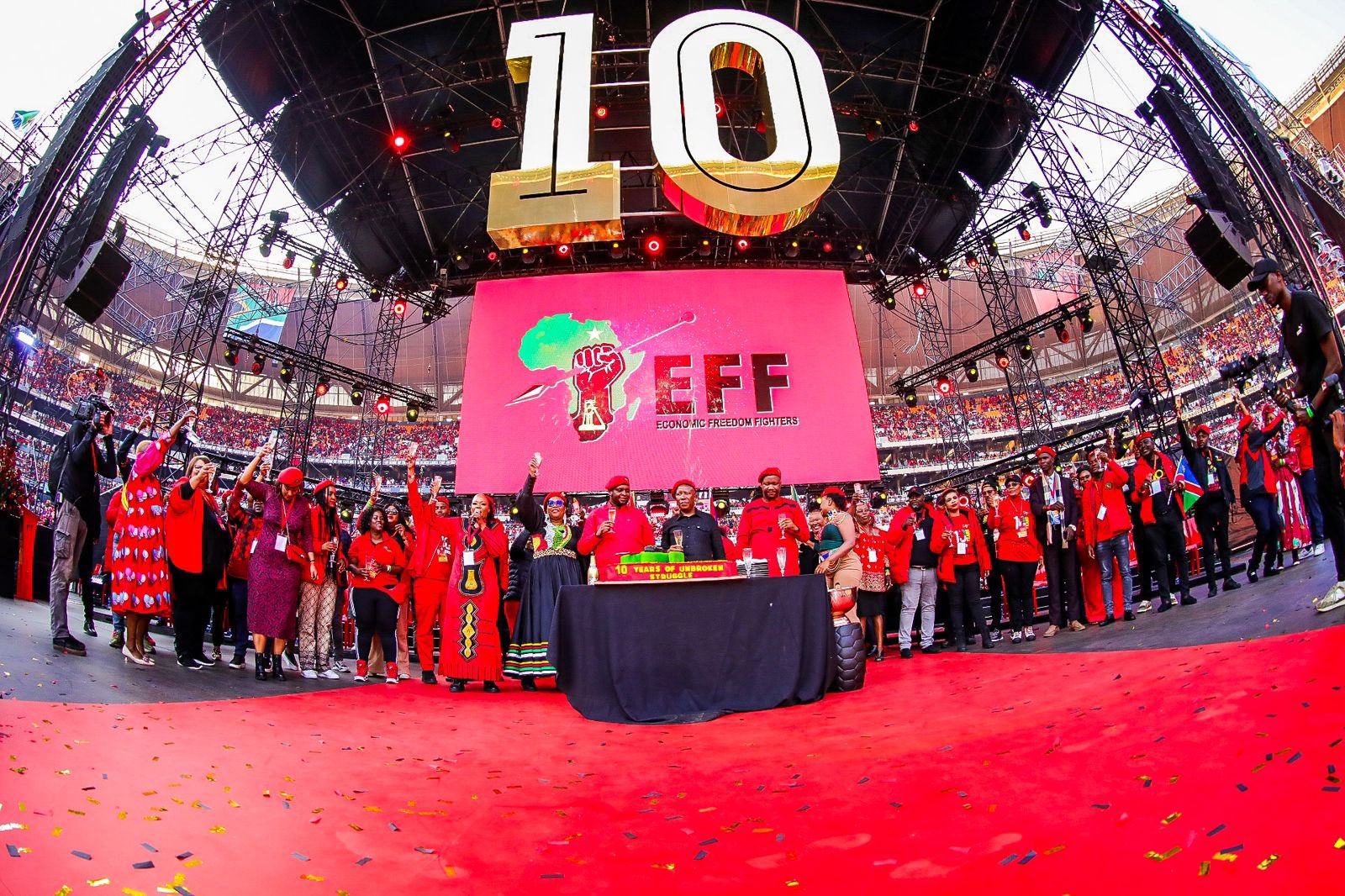
THE EFF wants minister of finance Enoch Godongwana to cancel government contracts of private security companies that fail to pay monies deducted from workers into their health and pension funds.
The party said it met, through its Labour Desk, with the Department of Employment and Labour, the CCMA, and the National Bargaining Council concerning the failure of private security companies to pay benefits and pension funds despite deducting money from workers.
The EFF’s intervention comes after a year of sustained protest action by unions against security companies who have failed to abide by a March 2021 Main Collective Agreement.
The Main Collective Agreement was signed between the National Bargaining Council for the Private Security Sector (NBCPSS), employers, and unions organising in the private security sector.
The agreement approved a health insurance benefits scheme for the sector to be administered by Affinity Health, in which workers were to pay a compulsory R250 monthly insurance, half of which was deducted from salaries.
The benefits include chronic disease management and medication, doctor consultations, and hospital and casualty benefits, including an HIV and TB management program. However, unions and workers have raised the alarm that some companies are failing to comply with the agreement.
The Private Security Industry Regulatory Authority (PSIRA) said in its 2022/23 annual report that 864 improper conduct cases were pending against security service providers for allegedly failing to comply with the Private Security Sector Provident Fund as of March 31 last year.
PSIRA further noted that during the same period, 828 improper conduct dockets were pending against security service providers for allegedly failing to pay the statutory minimum wage. PSIRA did not respond to requests to comment on the status of the reported cases and whether there had been any notable increase or decline in cases.
In 2022 the Kungwini Allied Workers Union (KAWU), the SA Transport and Allied Workers Union (Satawu), and the Abanqobi Workers Union (AWU) reported a case with the Council for Medical Schemes (CMS) against Imvula Quality Protection and Kaelo Risk (Pty) Ltd accusing them of failing to comply with the Main Collective Agreement.
The CMS confirmed receipt of the complaint but said this week the complaint was dismissed “on the basis that it did not meet the statutory requirement of a complaint as defined in Section 1 of the MSA and the issues complained about fell outside the CMS statutory mandate.”
The CMS said in response to our inquiry that “only one complaint was received in 2022/23. Nothing received in the current financial year. It is important to understand that private security companies are not regulated by the CMS and if any such complaints were to be received, they too would be dismissed as out of jurisdiction.”
In February 2023 the unions launched a ‘pay-back-the-money’ campaign’ to demand that action be taken against non-compliant companies. They called for the government to cancel contracts of such companies and for directors to face criminal charges. So far the unions have taken their campaign to Gauteng, Mpumalanga, Free State, Northern Cape, and Eastern Cape where they marched on non-compliant companies and provincial legislatures.

The EFF said its meeting with the Department of employment and labor officials and the National Bargaining Council on February 22 “sat to address the ongoing crisis within the private security sector, which has seen 2 224 security companies deduct money from the salaries of security guards on the basis that it would be contributed to benefits, yet failed to contribute this money to the relevant health benefit funds, pension funds and provident funds that this money was deducted for.”
The EFF said this lack of compliance by private security companies has “resulted in up to R6billion in workers’s monies being stolen…”
The party said it will write to Godongwana to conduct a thorough audit of all contracts with private security companies with government departments and local government authorities, to assess their compliance with Section 13A of the Pension Fund Act and their compliance with labour laws concerning health and provident fund contributions.
Section 13A of the Pension Funds Act imposes a statutory obligation on participating employers to pay contributions to funds not later than seven days after the end of the month into the fund’s bank account and that the minimum information is to accompany the payment of contributions as prescribed not later than 15 days after the end of the month.
The EFF said the meeting also resolved that the minister of employment and labour Thulas Nxesi will write to Godongwana to request that he appraise them of private security companies that are appointed by the government but are non-compliant with regulations.
“All private security companies who are appointed by the government and are non-compliant must be provided with 3 (three) months to repay workers monies to their pension funds should they still be active in the sector, or to workers directly should they be retired. Failure to do so must result in the immediate cancellation of their contracts,” the party said in a statement.
The Department of Employment and Labour did not respond to requests for comment this week, to clarify whether it was indeed part of the meeting with the EFF and if it was aware of the resolutions announced by the party.
According to PSIRA, there were more than 2.8 million registered security officers and over 15 000 registered security businesses on the authority’s database effective 31 March 2023.
The authority said the total number of registered security businesses stood at 19019 while the total number of registered security officers stood at 2 816 638 and that there were 577 444 registered active security officers. There were 3191 new applications received in 2022/23. At least 5295 of the 226 214 total applications were rejected due to various reasons including criminal records or pending cases against applicants. – news@mukurukuru.co.za

Be First to Comment