The lack of access to water in villages under the Capricorn District means residents have to rely on temporary water tankers and communal taps but a project launched by the Coca Cola Beverages South Africa (CCBSA) has brought renewed hope to scores of Limpopo village residents.
On 12 October CCBSA handed over four solar powered boreholes to residents of Matjana in Mankweng east of Polokwane.
“Capricorn and Polokwane have received more than 30 megalitres and 1500 more households are going to benefit, so the message is that the partnership is working and it is yielding results. 5000 households in the villages of Makweng and Moletjie are going to benefit at no cost to the community a total of 4.6 million litres of water per year from this nobel initiative,” deputy minister of water and sanitation David Mahlobo said about the project.
He added that a lot of money is still needed for long term solutions that will ensure water security in the capricorn district and the rest of the province.
“There is no water in Limpopo province and plans need to be optimised to ensure that everyone benefits. There are communities that stay next to dams but they do not get water from those dams and we are working tirelessly with all our stakeholders to ensure that communities benefit,” he said.
Nozicelo Ngcobo, Director of Public Affairs, Communications and Sustainability at CCBSA, said the newly installed Coke Ville systems have the capacity to deliver 13.8 million litres of drinkable water per year.
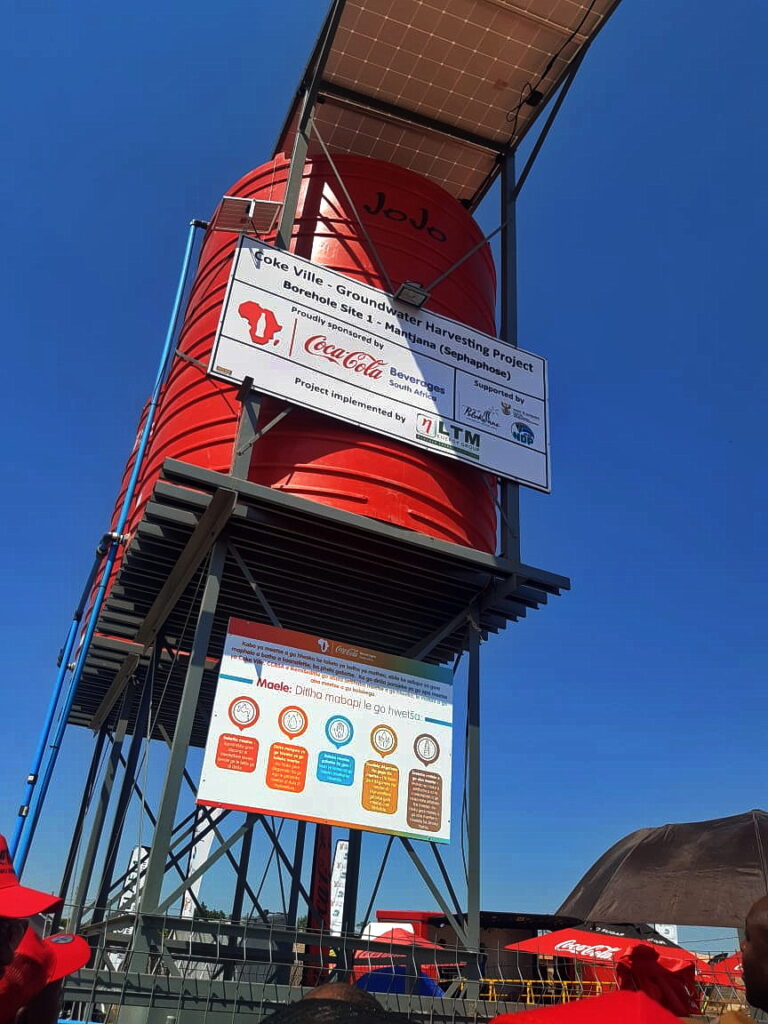
Since the inception of the borehole groundwater harvesting programme in 2020 in Limpopo, over 223 million litres of water were dispersed by the end of 2022 and intend to share an additional 160 million litres of water in 2023.
In Limpopo, CCBSA installed a total of 12 coke Ville Systems in Tshikota in Makhado under the Vhembe District Makhushaneng, in Lebowakgomo, Ga-Mokgopo and Ga-Ramoshwane.
In some of these villages taking a wheelbarrow with buckets to fetch water from a distant communal tap is something that has become a part of their lives but it doesn’t make things better nor get them used to not having water running from their taps.
In Mankweng, Moletjie, Seshego and other sections of Polokwane the matter of water shortage is not something new but a persisting matter that leaves communities without water from their taps for months. While some households in some of these areas say they do get little to no water on some days it does not relieve these communities from dire water shortages that prevent them from taking better care of their homes, families and sanitation.
In the growing demand for access to water with challenges of low water reservoirs, aging infrastructure, growing population, electricity cuts and development of surface water becoming more costly residents feel the severe effects of being without water.
The General Household Survey by Stats SA noted that access to water declined in five provinces in the years 2002 and 2019.
Stats SA also revealed that in 2019, an estimated 44.9% of households in South Africa had access to piped water in their homes.Limpopo had one of the greatest decreases, with a -3.8 percentage point drop.
“A further 28.5% accessed water on site while 12.2 % relied on communal taps and 2.5% relied on neighbours taps’. Although generally households’ access to water improved. 3.1% of households still had to fetch water from rivers, streams, stagnant water pools, dams, wells and springs in 2019.”the Stats SA found.
Rosina Motladi a resident under the Capricorn District said they often resort to hiring those with bakkies to fetch water for them which is costly.
“We really struggle with water in our homes, sometimes the temporary water tankers do not come and sometimes it runs out of water while so many people haven’t gotten to fill up their buckets. This means we will have to buy water and when another water tanker is assigned to our area we worry about the quality of the water. The inconsistent water supply also affects our daily lives and compromises sanitation in our homes,” said Motladi.
Mahlobo implored community members to unite and take responsibility in protecting their newly built boreholes and the solar system accompanying them.
“In our country, there many people who are vandalising infrastructure, we have people amongst us, who are anti-development, and we need the spirit of activism amongst us, who are anti-development, and we need the spirit of activism amongst community members to defeat this phenomenon,” Mahlobo said. – news@mukurukuru.co.za

Be First to Comment