
Renowned photojournalist Dr Peter Magubane was recently honoured by the Department of Sport, Arts and Culture for his immense contribution to the freedom Struggle and journalism. In this article first published in 2016 LUCAS LEDWABA analyses one of Magubane’s powerful images from the 16 June 1976 uprisings
Zithulele Mama
Noma sengifile mina
Ngiyobe ngifele lona
Izwe lakithi
Izwe leSouth Africa…
A young boy stands between two older men in what appears to be a dusty street corner. He holds a dustbin lid in his left hand and a brick in his right hand. His jersey is pulled right up to his nose. He’s only a boy. The man on his right stares intensely ahead, both his hands lowered into clenched fists. To the left of the boy one man cowers in retreat and another leans forward. He also has what looks like a dustbin lid in his left hand and a brick in his right hand.
Furthest behind them another man appears to be running away in the opposite direction. Another stands almost like one waiting in anticipation. The young man, the little boy with the angry, intense look appears to be surging defiantly forward towards the invisible enemy. Who is the enemy?
The photographer has left it all to the imagination.
“Fighting bullets with stones in Alexandra Township, 17 June 1976,” reads the caption. Forty long years have passed since Peter Magubane captured the moment in black and white film.
It was June 2016. Forty years of history hung on the walls of the Museum Africa in Newtown, Johannesburg. Magubane, who now has an Honorary Doctorate in recognition of his work behind the lens, was exhibiting his work on the moment that changed the course of history, 16 June 1976.
On that day pupils in Soweto staged a peaceful march against the apartheid government’s policy to introduce Afrikaans as a medium of instruction in township schools. The apartheid government responded by sending in armed police who opened fire with live ammunition on the unarmed pupils, killing and injuring hundreds. The government’s reaction sparked a full scale uprising that spread across the land.
Magubane and other brave newsmen and women hit the streets with their cameras and notepads, defying strict government restrictions to expose the brutality of the state, capture the bravery of the youth, the fear, agony and grief of the parents.
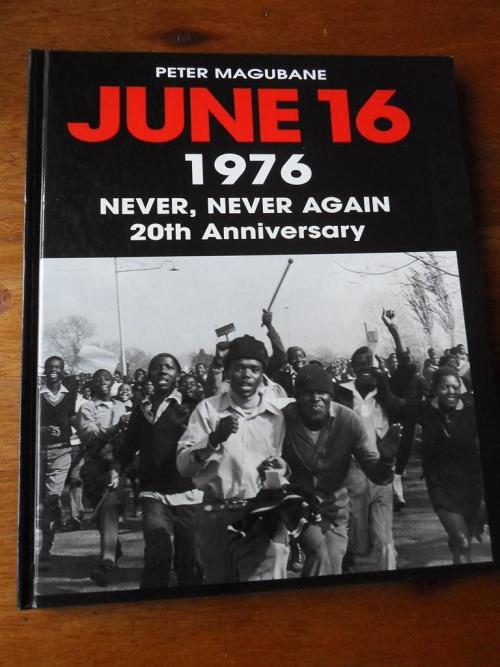
Almost half a century later, more than 30 images of blood, guns, guts, dustbin lids, coffins, clenched fists, fire, defiance, tears, brutality, fear and anguish tell the magnitude of the events of June 1976. The images have been compiled into a book titled simply June 16. But in reality, a book could be written on each of the pictures.
It’s almost half a century since they were taken. I cannot stop wondering what happened to the boy with the dustbin lid? Did the invisible enemy in the photograph kill him? If he survived, what kind of life did he lead after June 1976?
The photographs all leave you with questions that lead to many other haunting questions. How did the youth whose body lies sprawled in the street of Meadowlands, covered in a newspaper, meet his death? What were his last words and thoughts? Who shot him? Where is the killer now? Does the killer remember the fatal shot? Did he celebrate. And if so, what did the killer gain?
If he was killed, did the mourners at his funeral sing Zithulele Mama in his tribute? The haunting, melancholic song, which became the cry of South African youths rising up against the apartheid government speaks of their willingness to die for their land.
In the song, sang in Zulu, a child sings to its mother to hush, for even though the child has died, it did so in sacrifice for the land, this land South Africa. The little boy with the dustbin lid may have sung this song too at some point, who knows?
Yet we may never know all this. What we know though, through this photograph, is that on 17 June 1976, this young man, the little boy, fought bullets with stones in Alexandra Township, Johannesburg as Magubane says in the caption.
Such is the cruelty of history sometimes. It may leave you wounded, bitter and full of questions that may never be fully answered.
Magubane, who was also launching his book titled June 16, told the audience at the opening of the exhibition: “If I did not stand up we would not be having this exhibition. I was prepared to die to see that my country is freed..”
More about Peter Magubane:
https://www.sahistory.org.za/people/peter-sexford-magubane
https://www.icp.org/browse/archive/constituents/peter-magubane?all/all/all/all/0

Be First to Comment