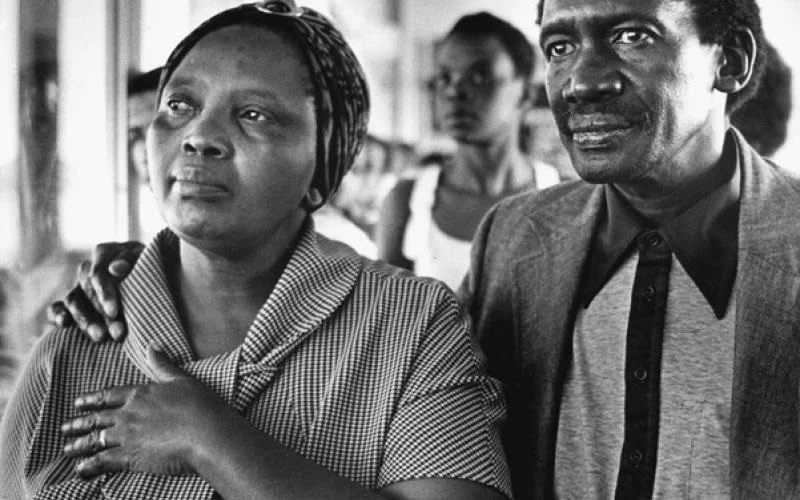
Zondeni Sobukwe may have passed on in 2018 but her voice and freedom fighter spirit continues to find its way into the consciousness of SA’s post colonial public memory writes Mokgadi Mogy Mashako.
Known as the “Mother of Azania” mama Sobukwe still stands as an icon of the struggle for justice and power for all Africans.
A memorial lecture held on Wednesday, 27 July 2022 marked her 95th birthday anniversary where guest speakers reflected her silently fierce combatant character.
Mama Sobukwe, contrary to the little she is known for- mainly that of being a doting wife to Robert Sobukwe, has achieved more than what has been recorded in history.
Not only was she a nurse by profession but an activist in her own right. In fact it was during a protest she was leading at the Victoria Hospital in the Eastern Cape where she met her husband.
Their love story began during those years of battle against white supremacy, whilst she was a trainee nurse and Robert the president of the Student Representative Council at University of Fort Hare in the 1940’s.
Delivering the memorial lecture’s keynote address Senior Research Fellow and political economist Lebohang Pheko said that Mama Sobukwe represents a number of female leaders who have been written out of history.
“We underestimate and downplay the role of the revolutionary transgressive and very difficult role of those who were supposedly keeping the “home fires burning”, when those homes were literally on fire.
“Townships were on fire. It was difficult to just keep the home fires burning. Constant interrogation. Reduced employment opportunities. Ostracization. It was so difficult to be in the home fires,” Pheko said.
Upon getting married in 1954, the couple had four children, Miliswa, Dinilesizwe, and twin boys Dalindyebo and Dedanizizwe, but it was after Robert Sobukwe’s first arrest that Mama Sobukwe was left to raise the children.
In 1960 Robert Sobukwe was jailed and sentenced to three-years imprisonment, for organizing protest action against pass laws that governed the movements and lives of black South Africans. The very same march- that resulted in the Sharpeville massacre left 69 peaceful protesters dead at the hands of apartheid police.
Instead of her husband’s 30 May 1963 release, Mama Sobukwe through the Truth and Reconciliation Commission gave an account of how the government conjured up the General Law Amendment Act.
This act included the Sobukwe Clause, which essentially allowed the Minister of Justice to extend the detention of any political prisoner indefinitely.
“On that day I was knitting the jerseys for the children. He also said that I must cook him dinner, because he was coming back home. When I went to visit him I was told that he was transferred to Robben Island under the Sobukwe Clause,” Sobukwe said.
The government decided to further detain Robert Sobukwe by sentencing him to solitary confinement on Robben Island from 1963- 1969.
Mama Sobukwe who at the time had taken the children to a boarding school in Lesotho upon suspecting her husband’s health had been highly compromised, single handedly and relentlessly advocated for his release.
“When I went to visit him the following year his condition deteriorated. I then wrote another letter. I was writing twice a year asking for his release. I wanted him to be treated. In 1965 or 1966 he complained that his food was served with broken glasses,” Sobukwe told the Commission.
After years of rejection by then Prime Minister Hendrik Vervoed and his Minister of Justice John Vorster, Mama Sobukwe finally received news that her husband would be released in 1969.
“They then released him quickly in 1969… He was banished, to stay in Kimberley for five years. He could not go home. By the time he passed away they were trying to bring you the banning order.
“Nothing came to my surprise or shock, because from the day I met him he was in the struggle and he died in the struggle. Everything was to be expected. I was not too grieved, in the sense that I expected these things,” Sobukwe said.
Reflecting on the brutal nature of banishment, Pheko suggested that banishment was equivalent to being sent to a psychological concentration camp.
“I want us to paint this picture of what it meant when opponents were plucked from their families and cast to the most abandoned parts of the country. What did it do those who were plucked and what did it to those who remained?” Pheko said.
160 people were banished between 1948 and 1986, and as anti apartheid activist Helen Joseph noted the banished were placed “there to live, perhaps to die, to suffer and starve, or to stretch out a survival by poorly paid labour, if and when they could get it”.
Pheko in her stirring tribute lauded Mama Sobukwe for her choice to remain silent and moved that silence was both necessary as much as it was transgressive.
“Mme Zondeni’s silence is as an act of resistance; silence as dissident power to laugh in the face of power and say, silently, I oppose you and to assert your power has no authority over me,” Pheko said.
Mama Sobukwe’s role as mother not only for her children but also for Azania was echoed when she delivered her final requests before the TRC hearing.
http://historicalpapers-atom.wits.ac.za/papers-of-robert-sobukwe;isad?sf_culture=nl
Due to the cognitive violence experienced by her son Didane, who was subject to endless humiliation and trauma when visiting his father on Robben Island and later in hospital where his father died, Mama Sobukwe asked for the new government to provide intervention.
“…Didane would weep when he would go see his father. For a year he could not do anything, he started drinking. Didane is heavily affected. I request that our Government, the new Government contribute in his rehabilitation. If he could learn some form of trade, some skill,” pleaded Sobukwe.
In closing she requested that the Commission refurbish the schools and construct sports fields so that people could be occupied in a proper way.
“This is a powerful thing that the Robert Sobukwe Trust is doing, by forcing us to recreate repositories and shared recollections of who we are, who we were and who we should be,” Pheko concluded.
Acknowledging Mama Sobukwe as a true soldier of the struggle, PAC stalwart Professor Sipho Shabalala contributed to the memorial lecture by offering an account on her humility.
“What was important to me in that regard was I asked myself as to who little am I, that the mother of the powerful leader of the powerful PAC had come to the hospital to see me; to console me; to advice me how to my pain and to give me courage to move forward with the struggle for the liberation of the African people,” Shabalala said.
This after restive forces planted a bomb in Potlako Leballo’s car in 1964 in Maseru, which Shabalala was in, suffered immense injuries and taken to Queen Elizabeth Hospital.
He recalled and validated why Robert Sobukwe described his wife as “ever dignified, calm, an cool, ever-uncomplaining and ever willing.”
“Not only was Mama Zondeni ready to assist and help other people, she was highly appreciative of anything that anyone had done for her,” Shabalala said.
Contemplating on the current political landscape of South Africa Professor Sipho Shabalala critiqued that the country even though “democratic” its people are not emancipated.
“The country has been turned into a Beirut; a Haiti, we see forces of various forms and formations engaged in the destructions of the country, pitting African groups against African groups, families against families,” Shabalala said. news@mukurukuru.co.za

Be First to Comment