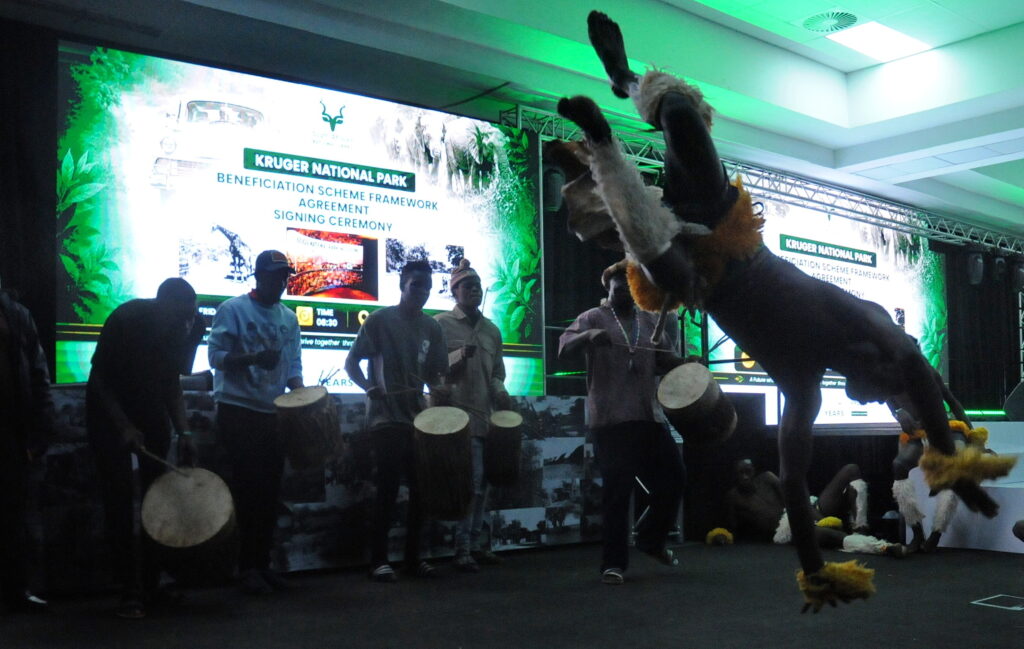
The low winter sun settled over Skukuza Rest Camp as government officials, SANParks executives, traditional leaders, and claimant communities gathered inside a hall overlooking one of Africa’s most famous conservation landscapes.
Outside, the park operated as it has for decades. Tourists moved along dusty roads, cameras hanging from necks, the sounds of birds and distant wildlife drifting through the bushveld.
Inside, the conversation was not about sightings. It was about land.
It was about families removed from ancestral ground. About communities that watched one of the world’s most celebrated national parks rise on soil they once occupied, farmed, and called home. And it was about an attempt, nearly a century later, to redefine who benefits from conservation in a democratic South Africa.
As the country marked 100 years of the Kruger National Park, the government and SANParks signed the Kruger National Park Beneficiation Scheme Framework Agreement, a deal aimed at creating economic opportunities and long-term benefits for communities dispossessed during the park’s creation and expansion.
The symbolism was Impossible to ignore. While the centenary celebrated an iconic conservation institution, it forced a confrontation with the painful human history woven into its foundations.
“Land is more than just the soil and rocks beneath our feet,” Minister of Forestry, Fisheries and the Environment Willie Aucamp said during the signing ceremony. “It represents bloodlines, legacy, and heritage.”
His remarks repeatedly returned to the emotional weight attached to the land and the long road to the agreement. The land claims were lodged in the early 2000s; negotiations on the beneficiation framework began in 2012. More than a decade later, the deal was finally formalised.
For many community members present, the occasion carried both relief and grief. Aucamp acknowledged that some claimants died before witnessing the moment.
“We recognise that some members of the claimant communities have passed on without experiencing this moment,” he said.
The Kruger National Park, established in 1926, has long stood as a symbol of South African conservation success and international tourism. Yet for many Black communities living around its borders, its history represents dispossession and exclusion.
SANParks Board Chairperson Beryl Ferguson addressed that history directly.
“The establishment of the Kruger National Park in 1926 came at a cost to many of the communities represented here today, communities who were dispossessed of land that they had occupied, used and cared for over generations,” Ferguson said.
The agreement signed at Skukuza seeks to create structured ways for claimant communities to benefit economically from conservation and tourism activities linked to the park. But beyond governance frameworks and policy language, the ceremony reflected a broader shift taking place within South African conservation itself.
For decades, the sector operated through exclusionary systems inherited from colonialism and apartheid, systems that protected wildlife while often removing or marginalising nearby communities. Now, as Kruger enters its second century, pressure is growing for institutions to prove that biodiversity protection and social justice can coexist.
Aucamp described the agreement as part of a larger transformation in how conservation must function.
“As government, we are clear: the future of conservation in South Africa is one of inclusive stewardship,” he said. “A model where communities are partners, not spectators.”
Yet despite the optimism surrounding the signing, questions remain over implementation and whether communities will experience meaningful change beyond symbolic recognition.
Ferguson admitted progress had not moved at the pace communities deserved. The focus, she said, must now shift from promises to accountability.
“This is where the real work begins,” she said.
That tension between symbolism and delivery, lingered over the agreement. The deal represents a significant political and historical milestone, but it arrives after years of negotiations, delays, and frustration for claimants.
As the Kruger National Park celebrates its centenary with national pride and international recognition, the agreement serves as a reminder that conservation’s legacy in South Africa has never belonged to wildlife alone. It belongs, too, to the people whose stories were pushed to the margins of that history.
“The next 100 years must be different from the first,” Ferguson said.
Whether the beneficiation agreement becomes a genuine turning point or another unfulfilled promise may ultimately determine what the next century of conservation looks like. – news@mukurukuru.co.za

Be First to Comment