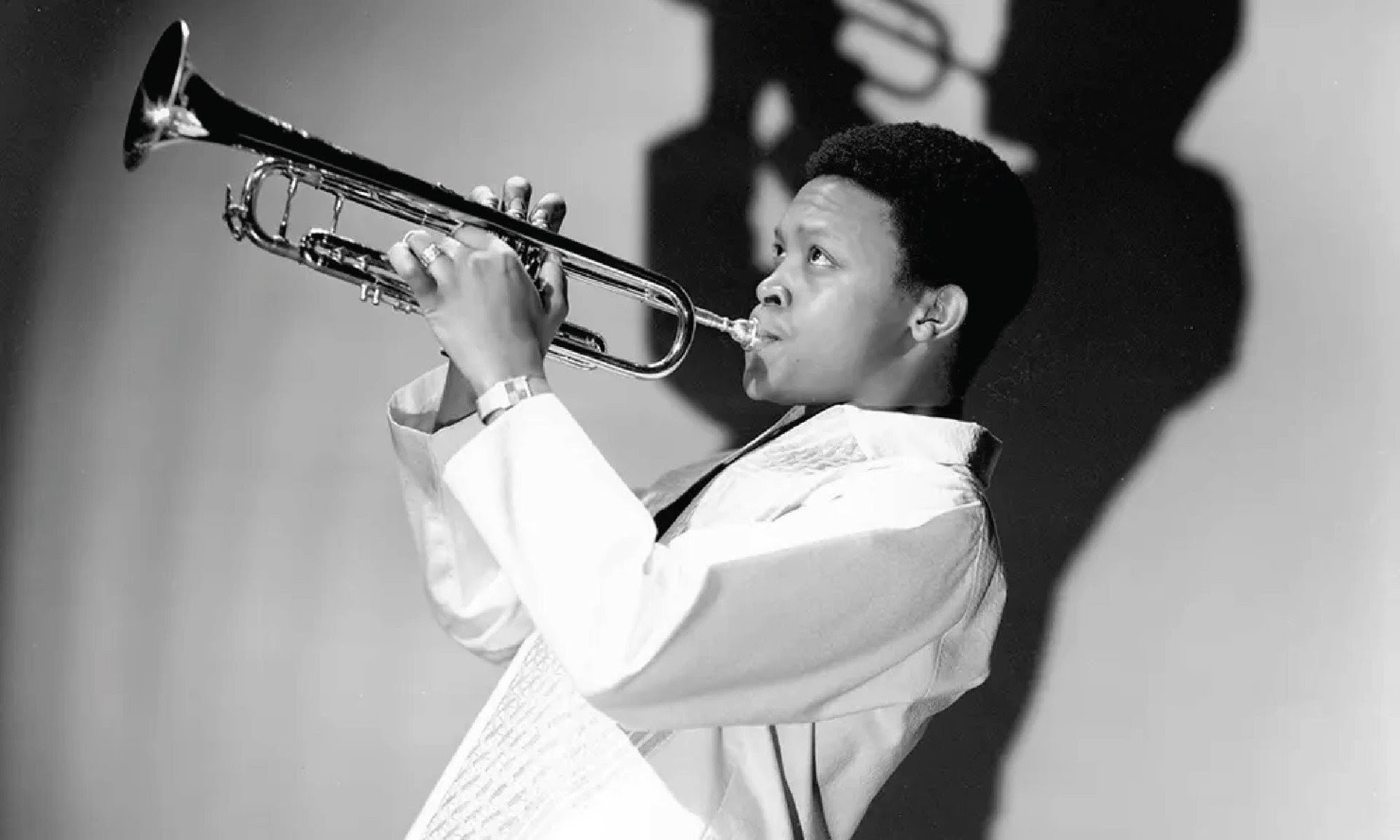
On the eighth anniversary of the passing of Hugh Masekela, we go back in time with this extract from his celebrated memoir Still Grazing: The Musical Journey of Hugh Masekela, which the legendary musician and cultural activist penned with D Michael Cheers
That afternoon Fela invited us to a photo session for his new album, Africa70, which contained the classics “Lady” and “Shakara.” The scene was a garden club on whose dance floor was drawn a large map of Africa.
Topless girls were kneeling all around the map’s outline. We went up to the roof with Fela and the photographer. Fela then told the girls, “When I say smile, you must smile. I don’t want you to grin. You have to smile. You understand me?” “Yes, Fela,” they chimed in unison. “Okay. Ready? Smiiiiile!” he screamed. They all obeyed while the photographer shot feverishly.
The new album was playing in the background while we smoked large spliffs and Fela directed the shoot from the roof. An old Sierra Leonean friend, Frank Karefa-Smart, who worked with the diamond company of Maurice Templesman, joined us at the end of the session.
He was working from Nigeria, Sierra Leone, and Niger, where he had homes, aside from his Riverside Drive apartment in New York. We rode back to Fela’s compound in his slick Mercedes. More food, smoke, and booze. Fela always traveled in a convoy with a minimum of fifty people. That evening we went to a club called the Gondola.
Our entourage must have totaled seventy-five people, mostly women from his concubine stable. An Afro-beat combo was performing, featuring a very talented mulatto vocalist. At the end of the set, Fela took me to meet the singer. He warned me, “This guy loves you so much, he might jump on us and kiss you, Hugh. Watch out.”
He stopped the young man and said, “Hey, you, you’ve been bothering me so much about Hugh Masekela. Here he is. I brought him to you.”
Stunned, the young singer responded, “Who?” Fela repeated, “Hugh Masekela. Here he is.” Confused, the young man said, “Ah! Wow. Me, I no sabie um at all.” (I don’t know who you are talking about.)
Fela whistled the first few notes of “Grazing in the Grass,” and the young man went wild. “Hoojie, Hoojie Makaselaaah.” He embraced me and then lifted me high into the air. He couldn’t stop screaming “Hoojie Makaselaaah.” He ran back to the stage and started his next set earlier than scheduled.
“This is for my greatest idol, Hoojie Makaselaaah.”
He sang his heart out for an hour and some change. We were dancing up a storm and throwing back double cognacs all night. When Fela got the bill, which included drinks for about seventy-five people, he said to the owner, “I don’t have this kind of money, but I tell you what, I’ll come and do a couple of nights here for you for free.” The owner agreed. He couldn’t stop laughing. Fela couldn’t either.
Back at the Mainland Hotel the next morning, I woke up early and realized that I had run out of toothpaste, so I went into the marketplace next to the hotel to find some. It was a long, rectangular structure with a corrugated iron roof and large wooden beams holding it up. The earthen floor was swept spotlessly clean, and hundreds of stalls crowded neatly next to each other, displaying all manner of traditional herbs hanging from nails.
The cabinets were lined with thousands of bottles filled with dark mixtures of tonics with bark and roots floating at the bottom. The pungent smell of leaves, branches, and barks smoking on top of braziers filled the air.
Many elderly men and women, their skin pulled very tightly against their skulls, stared at me with glazed, bloodshot eyes from their chairs and benches, where they sat looking past me into space. They seemed slightly hypnotized.
From some of the shelves hung animal bones and human and animal skulls. I had just asked one of the attendants near the entrance if she could tell me where I could get some toothpaste, when I realized this was not a grocery store. Chills ran through my body, and goosebumps were breaking out on my skin. A cold feeling hit the back of my neck. I ran out of there with my hair standing on end, my teeth chattering. I was shaking like a leaf.
After breakfast we took a taxi to Fela’s house. I told him about the mysterious market. He stood up. “Hugh!” he screamed.
“Nobody has ever walked into that place alone and lived to tell about it. That is the supermarket where all the witch doctors, diviners, and traditional healers shop. It is the city’s main juju and voodoo supply store. You are one lucky motherfucker to be standing here in front of me.”
At the Gondola, we had met the managing director of Decca Records in Nigeria. Excited to meet me, he invited us over to dinner the following evening. That evening we left Fela’s compound in a convoy of ten minibuses.
The girls were carrying Fela’s records and singing in the minibuses while hanging head and shoulders out of the vehicles’ windows, banging on the side panels. In Frank Karefa-Smart’s Mercedes, following the convoy, we were shaking our heads in utter bafflement. When we arrived, our host was startled to see close to one hundred people.
Fela’s girls burst into the huge living room, started to move furniture from the middle of the room, put on some of Fela’s records, and began dancing frantically. It was the beginning of a roaring party. The poor guy’s wife was crimson as the girls pulled her to the dance floor and gyrated sensually all around her ass, urging the woman to imitate them.
The couple was mesmerized as we emptied their bar. Fela used the most vulgar language he could come up with in conversation with the man’s wife. Our host was dumbfounded. We never got to eat. We just danced all night with the girls and drank ourselves silly. Our host and his wife had no choice but to join us.
I sat in with Fela’s band at the Shrine, a shed with open sides and a corrugated fibreglass roof. The venue could accommodate up to a thousand people on the dance floor. There were seats near the stage on both sides and in the front. In the rear of the long hall were more terraced bleacher seats.
Fela’s band comprised two alto saxes, two tenor saxes, a baritone sax, three trum- pets, four guitars, a bass guitar, four rhythm jembe hand-drum percussionists, one conga and bongo master drummer, a regular trap drummer, and two male percussionists who marched back and forth in front of the band playing a cow- bell and wooden blocks called claves, acting as a metronome for the whole ensemble. Ten or more girls sang unisons with and background responses to Fela’s guttural but beautiful melodic chants, scatting, and riffs.
**Still Grazing – The Musical Journey of Hugh Masekela is published by Jacana. The book retails at R380.

Be First to Comment