Last updated on 4 December 2023
Shoks Mnisi Mzolo takes a sho’t left from the claustrophobia of the concrete jungle of Gauteng and concludes the beauty of the mountain kingdom of Lesotho is unscriptable
A reluctant drizzle ushered in a new day. But now, two hours later as the mercury races north, you wouldn’t guess it. Last night’s soundscape was filled by croaking frogs but this morning it’s birdsong’s turn. The sky is cloudless as if to show off, or showcase, Lesotho’s enchanting panorama. No matter how determined it is in its blaze, the sun isn’t shining, and it never shines, all the way to the gorges at Maletsunyane Falls because the crags bar the rays from ever flirting with the waterfall.
My sexagenarian companion makes mountain climbing seem like a walk in the park. His nimbleness and fitness level stun me, a city rat taking refuge in Lesotho’s rustic Semonkong from Gauteng’s jungle, replete with bullies in neckties, a jungle teeming with taxis and where taxes – like colluding banks and interest rates – call the shots, and the jungle where talk radio is stuck in the Armageddon frequency.
A kingdom in the grip of poverty
The drizzle-scorcher is a metaphor for the riddle that stalks Lesotho. While poverty headcount has fallen markedly it’s still high: a third of the 2.5-million-strong population lives below the breadline, according to World Bank stats.
A fifth of the South African population was, at last count, languishing below the poverty line but the supersized neighbour’s Gini co-efficient, which measures the level of inequality (a relic of Apartheid), has worsened to 63 – the worst in the world (coupled with a tragic distinction as the nation worst hit by foetal alcohol syndrome disorder) – while Lesotho’s, off a high base, has calmed to 44, reports the World Bank.
A painfully stunning land with a history of valour
Beyond aching figures is a painfully stunning land. The land boasts natural beauty aplenty. It is thus an indictment that, given high levels of joblessness (pegged at 20%), tourism remains “untapped gold” to borrow from Thabo Maretlane, head of T-Connexion, a marketing company that also organises the Moshoeshoe Walk.
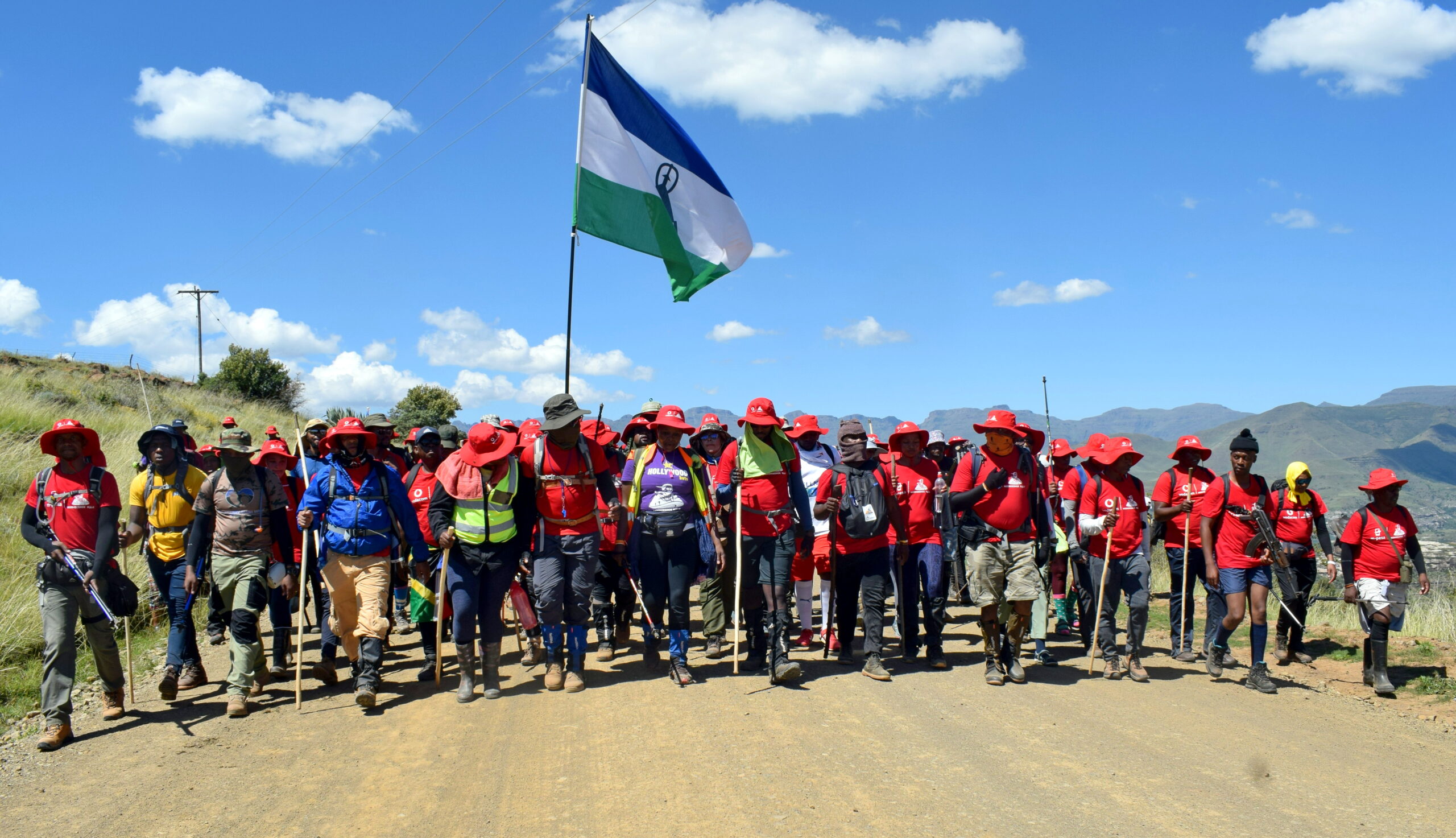
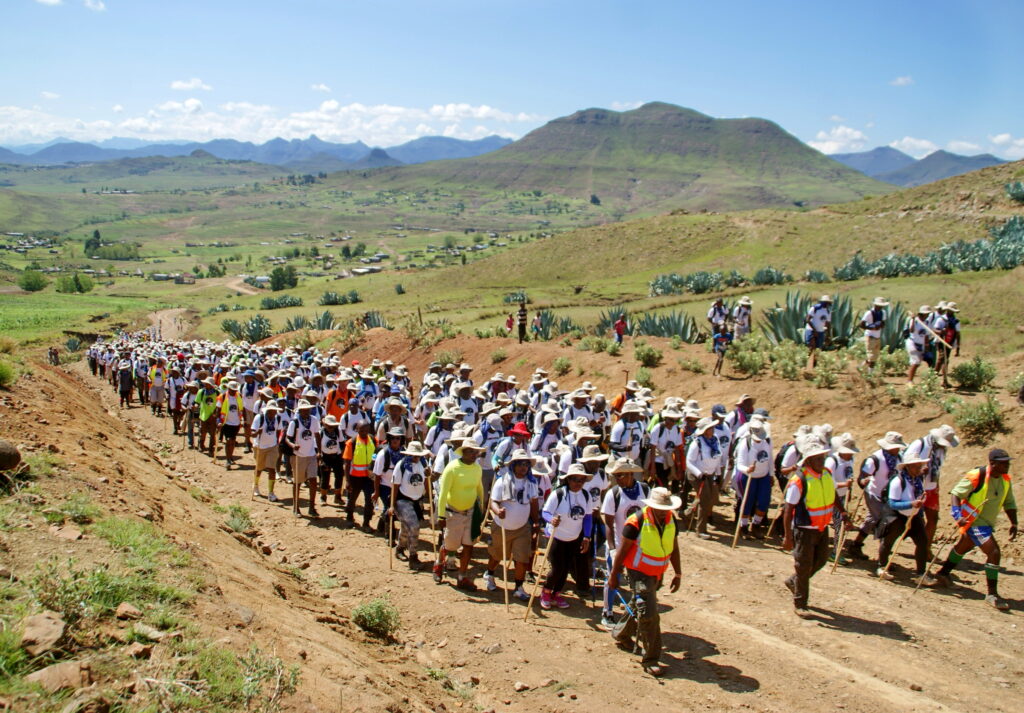
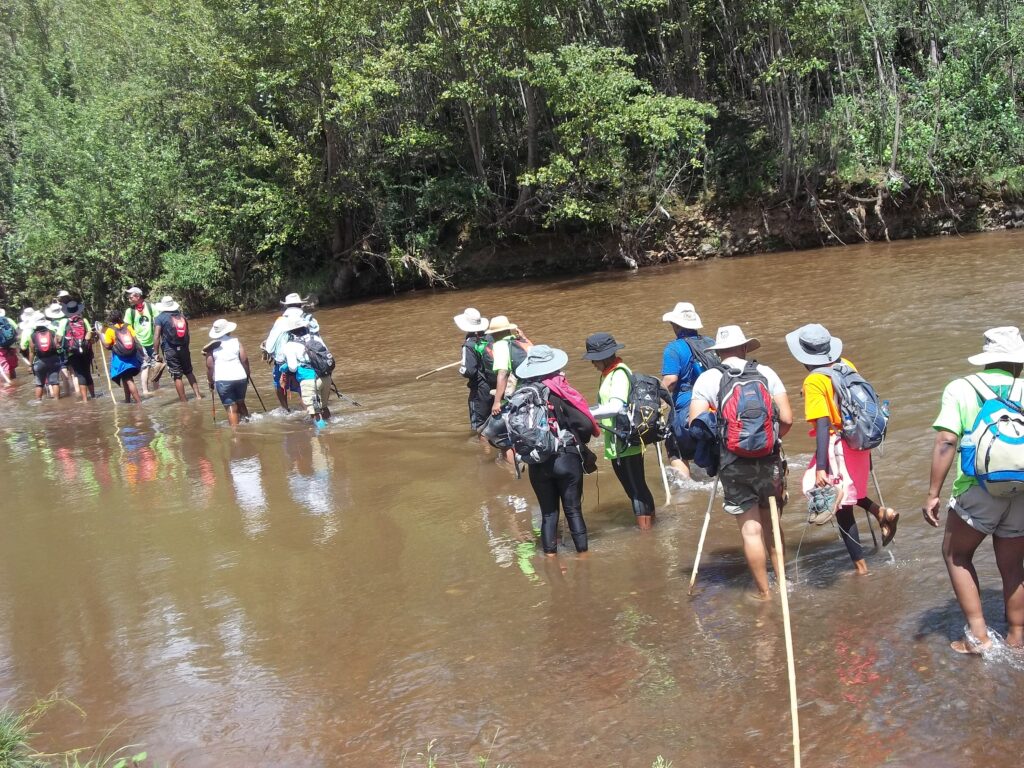
The walk is a tribute to the exodus from Butha-Buthe to Thaba Bosiu, so named because Moshoeshoe’s people made it here one night in July 1824 after nine days of wading umpteen rivers and navigating a taxing topography with children, the elderly, and livestock in tow. Two centuries later, pilgrims travel exceptionally light and take three days to cover the 120 km distance to Thaba Bosiu, an impenetrable plateau near Maseru.
Suitably considered the cradle of Basotho, the plateau is the nation’s most sacred heritage site and is among Southern Africa’s most revered sites. It was at Thaba Bosiu that Basotho fought some of their wars but the decisive battle of December 1852 was fought in Berea.
Basotho beat the Anglo red coats, once more, only for King Moshoeshoe I to sue for peace. In fact, Basotho were consistent in their formula: stuff attackers with humble pies. Each attacker had their turn, from the Anglo to the Boer and the Griqua and AmaHlubi. Add to the list Queen Mother ’MaNthatisi’s Batlokwa, whose raids on Butha-Buthe caused Moshoeshoe’s people to migrate. The fact that, to this day, this country is entirely surrounded by another is a tribute to the many battles that Moshoeshoe’s men fought. That was then.
1,1 million visitors flock to Lesotho annually
So we turn to the present when tourists, pegged at 1.1-million visit the Mountain Kingdom each year to Botswana’s almost 2-million. Broadly, Africa hosts 70-million visitors a year versus France’s 90-million.
The Mountain Kingdom’s share is insignificant especially given the land’s natural beauty, geographic proximity to the regional hub – just a five-hour drive from Joburg coupled with regular flights between the latter and Maseru. What’s more, this is the land of Khotso, Peace, as the age-old greeting goes. So, where’s the problem?
Consider Maseru’s oblivious marketing strategy and top-level traffic with Motlatsi Maqelepo becoming in November, the fourth tourism minister since 2018. A youthful scientist, Maqelepo, who left health for tourism via a reshuffle, must defer to his “ability to turn everything that I touch to gold”.
He once told Public Eye that the economy can be transformed “within five years”, singling sectors like agriculture, mining and tourism. Now that Maqelepo is in charge, he must walk the talk and enable the tourism sector to at least double revenues and profits, powered by a steady growth in tourist numbers, and lessen over reliance on South Africa which accounts for 85% of Lesotho’s traffic according to the World Travel & Tourism Council. At 29%, Botswana’s reliance on South Africa is also high but not unhealthy.
Prime Minister Sam Matekane, who weeks ago survived a vote of no-confidence after just a year in office, was expected to do much to drive accelerated and inclusive growth. The results are yet to be seen.
Crags and water aplenty in the gorges of Maletsunyane
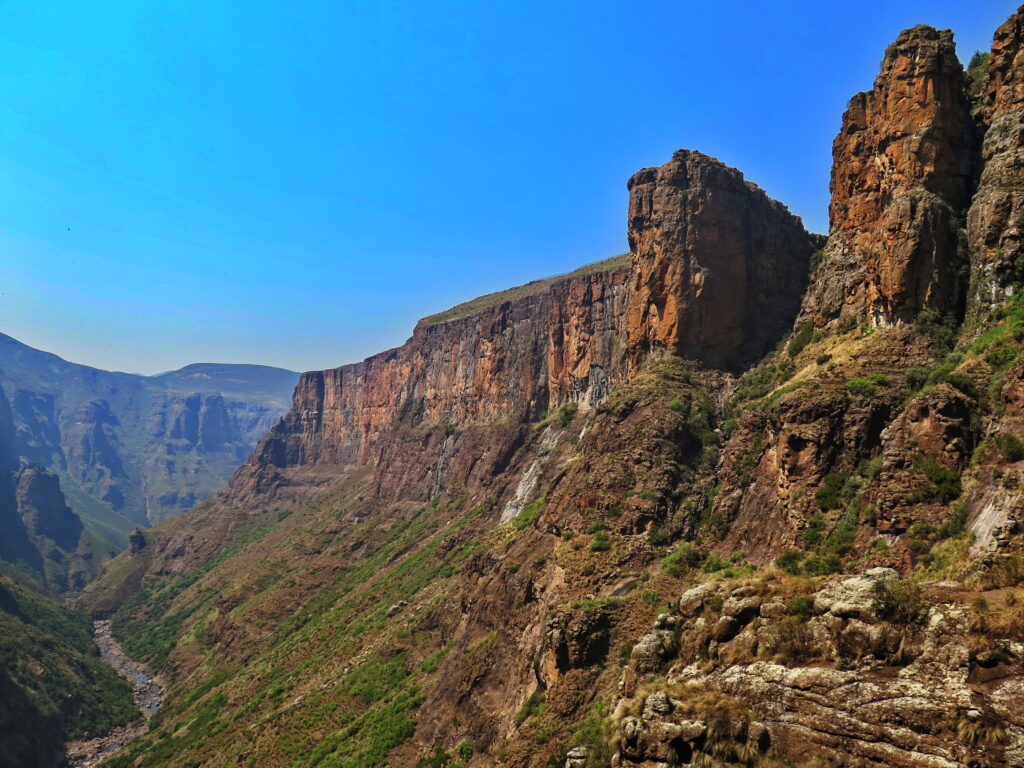
Far from holding on to the saddle, like Matekane, my job involves nothing but to sit back and relish the mesmerising Maletsunyane show. The water plummets some 200m and causes a spray visible from miles away. Right there is Semonkong’s etymology. Semonkong is home to an estimated 8,000 souls who answer to villages like Ha Lechesa, Ha Tau and Lets’eng. Experiencing the drama that is the reverberating thunder, a natural soundtrack – and in the company of crags and water aplenty and verdant surrounds – is as captivating as it’s meditative.
To the far west, somewhere in Mafeteng, clouds smooch mountains. The sight of braes, valleys and all is pleasing. In an alpine, water-rich country, mountains come in many shapes and colours: green, beige and brown blankets. In September, mountains in the Highlands spotted white caps. But, cliffs are a sobering reminder for hikers and horse-riders to stick to “un-coloured” water: to stay sober.
For its part, Maletsunyane River, relaying white-brown-white water, flows in a south-westerly direction before giving up to Senqu – the river with many names. Also called iGqili, Kai !Garib (also spelled Gariep and Xhariep) and Oranje (Orange), the circuitous 2,400 km-long waterbody scythes the kingdom and South Africa to eventually, separate the latter from Namibia.
The tiny Semonkong plays host to the Maletsunyane Braai Festival that attracts thousands each November. It might easily be the highest point above sea level to host a festival that, this year, included Ntate Stunna. As geography buffs would note, Lesotho has the world’s highest-lowest point. Yes, the highest-lowest point – estimated at above 1,000m above sea level. Not to be left behind, paleontological types would gleefully add that the land is home to one of the world’s largest concentration of dinosaur footprints, such as Lesothosaurus’. Hikers probably call these climes their paradise and photographers their El Dorado.
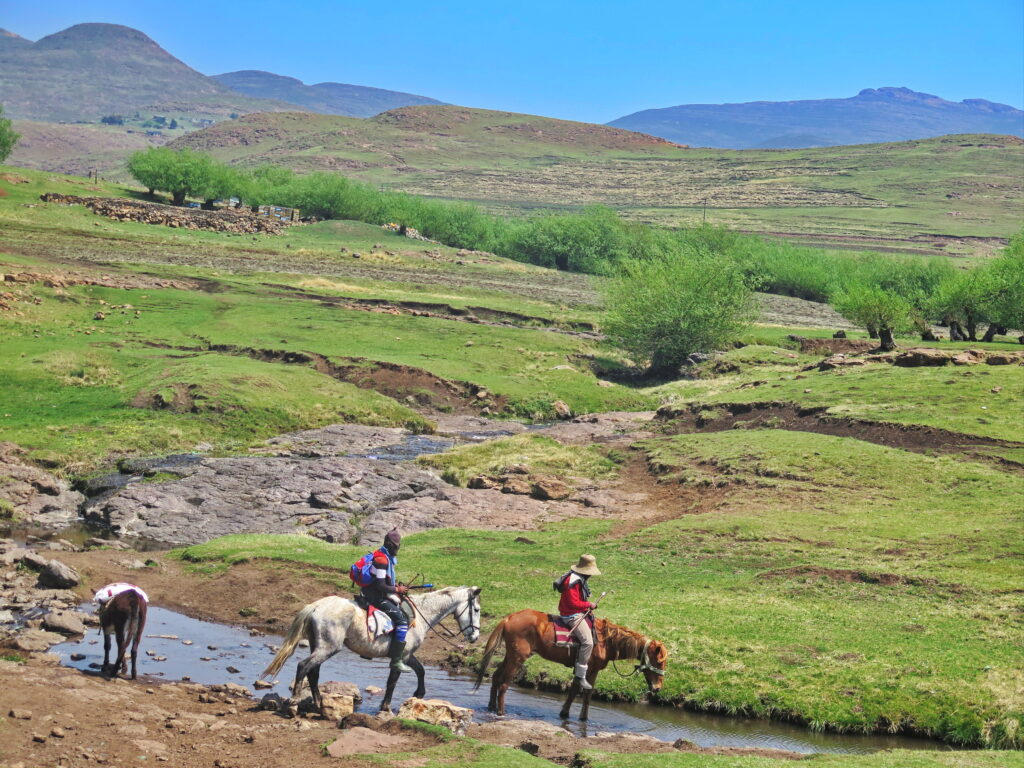
To the north-east is Thabana Ntlenyana, the kingdom’s highest point – at nearly 3,500m above sea level. While on geography, or transport, let’s note that sturdy Basotho ponies abound. That is so, as with mules, horses and donkeys, because of the rugged terrain. Four-wheeled machines take a back seat with four-legged creatures stepping in to take people to and fro in the countryside.
Just like urban centres, public spaces in places like Semonkong have accordion players. Such cool vibes send me to the Famo milieu well-reflected in Zakes Mda’s Wayfarers Hymns. A Radio 2000 interview with bassist Bakithi Kumalo took me to the 1980s’ Ke Ikhethetse e Motle by Tau Tsa Mats’ekha, the Famo kings who birthed pop-folk artist Paul Simon’s accordion-rich The Boy in the Bubble.
The ubiquity of fields, in just about any inhabited area, mocks the concept of food insecurity. Here’s another insecurity: power. You have to wonder why – if Eskom or Pretoria, or both, is/and either grappling or groping in the dark – property developers are so slow to switch to renewable energies. First, load-shedding across the border announced itself more than 15 years ago. Many annual climate change jamborees later, the negligible pace at which construction firms are transforming their specs exposes a fabricated dilemma: profits versus preservation.
With the waterfall now behind me, and to soundscape surrendering to gurgling rivers and grazing livestock (from goats to cattle), I relish the long walk. Lighthouse Family’s Free/One plays in my head, mingling with the actual sounds of the falls – audible for some distance. Yes, it was legendary singer-pianist Nina Simone’s 1967 version that, to borrow from the 21st century, amplified the song’s reach. The resonant seminal I Wish, originally recorded this month 60 years ago as an instrumental, was composed by pianist Billy Taylor a fellow cat.
Thank Almighty, Simone and Taylor survived White House’s brand of Apartheid and lived to see Namibia and South Africa become free (if universal suffrage is the yardstick). Today, I feel free but it’s not enough. Violence and abuse (verbal and so on), displacement, the so-called ethnic cleansing and runaway hunger continue to stalk the 21st century.
The five-hour trip from Gauteng to Maseru offered silent commentary on South Africa’s present, some not inspiring. The sight of countless well-fed police officers is plain sad. “Lethabo Power Station”, reads one road sign. Misnomer. Where is the power? Try concertina-like load-shedding that erodes the nation’s lethabo, affects health outcomes, and drives prices higher. Deep in south eastern Free State – on R708, around Hlohloloane (colonially Clocolan) – the road worsens, forcing motorists to almost crawl as this section becomes a bumpy gravel track. Why?
Leaving Semonkong is a constant reminder of what I already know: I am not done with this town of goat-and sheep-shearing villages. Thabana li Mmele, an udder-shaped mountain, and villages like Ha Dinizulu, Ha Mampho and others come in and out of the frame. Road signs to Roma, a university town, signal the history-rich Thaba Bosiu: it’s like a scan through history pages to 1824, the beginning of the story of this country. On the last stretch to Maseru, en route to Gauteng, I’m humbled into conceding that Lesotho’s beauty is plain unscriptable after all. – travel@mukurukuru.co.za

Be First to Comment