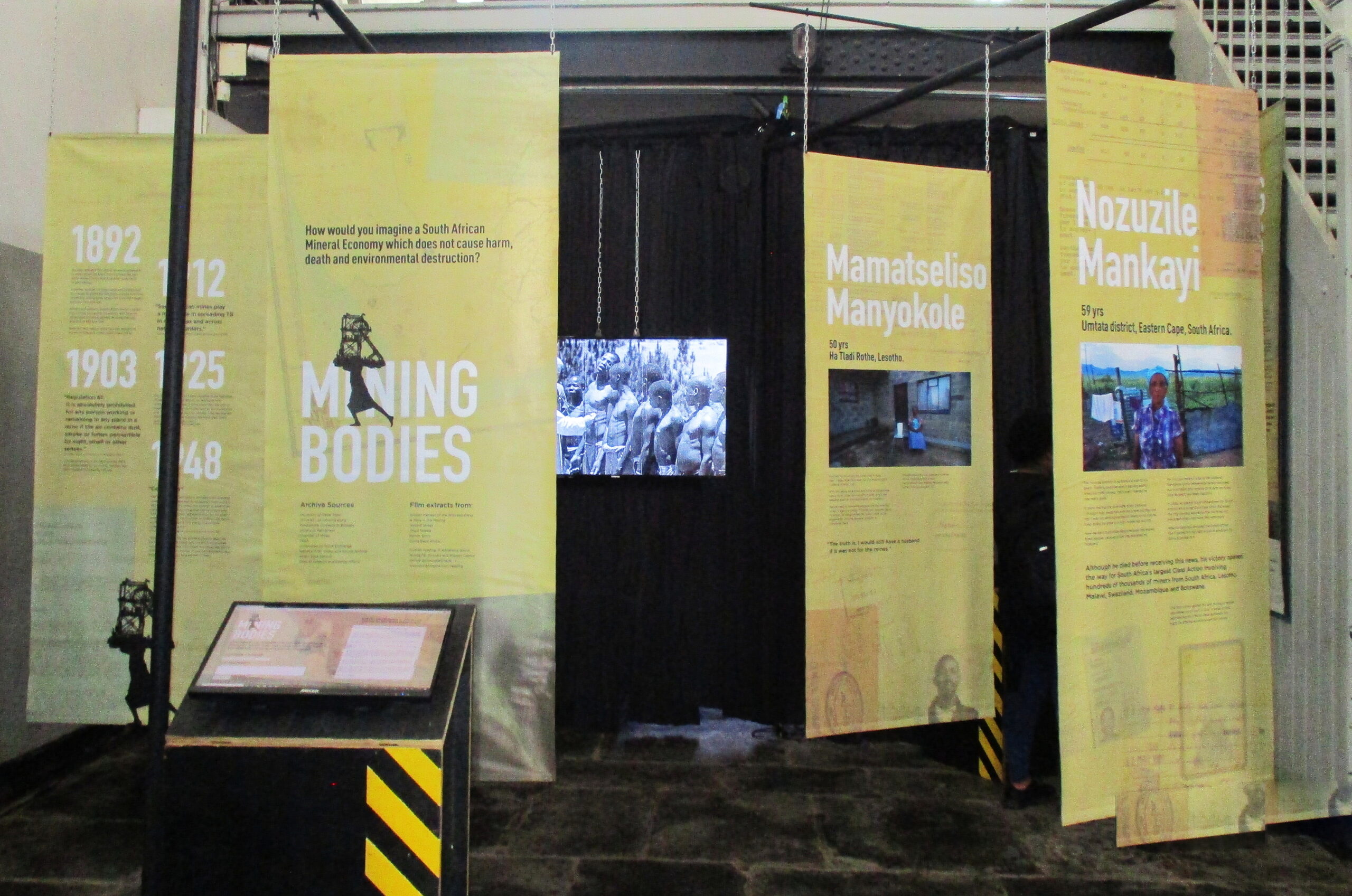
The Miners Bodies exhibition recently opened at the Constitution Hill in Johannesburg. KOENA MASHALE graced the event and reports on the challenges faced by former gold mineworkers suffering from silicosis and their beneficiaries
“It was not easy after my husband died.”
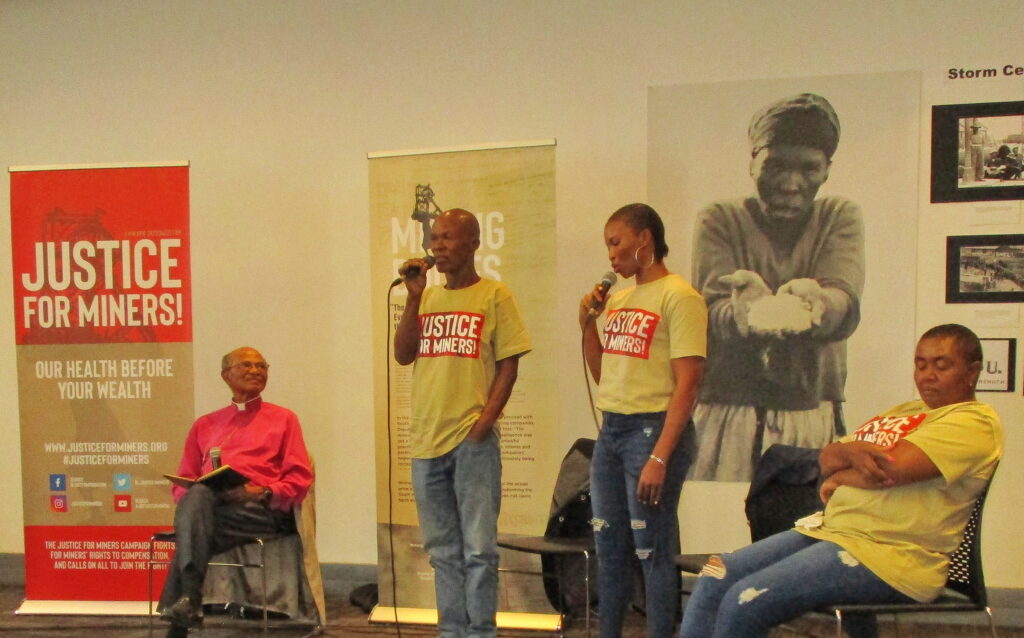
These are the words of Nomampondomise Mbabama-Botile, the widow of a former gold mineworker who died from the lung disease silicosis at the opening of the exhibition organised by the Justice for Miners Campaign on Human Rights Day.
The day 21 March in South Africa is historically linked to the Sharpeville massacre where 69 people peacefully protesting against the government’s pass laws were massacred by police.
The Justice for Miners Campaign is engaged in a struggle to assist former gold mine workers who contracted the deadly lung disease silicosis as a result of exposure to silica dust to fight for compensation from their former employers.
Mbabama-Botile’s husband passed on in 2018, leaving her with no means to take care of her family as her husband was the breadwinner. She said living with and taking care of someone with silicosis was hard.
“It wasn’t easy to live with someone who kept getting worse daily and he tried his level best to fight for his life, but he was eventually hospitalised at the Krugersdorp Hospital and that is where he passed,” she said.
Silicosis is an incurable form of lung fibrosis caused by the inhalation of dust containing silica. Some forms of the disease have long latency periods whereby the patient will display symptoms of illness long after having left the mines.
Catherine Meyburg of the Justice for Miners Campaign chillingly described silicosis as “someone basically drowning in their own mucus, being suffocated by their lungs.”
Mbabama-Botile expressed how she couldn’t celebrate Human Right Day when she’s constantly trying everything to get what the mine owes her husband.
“We tried to visit the mining companies but they sent to Tshiamiso Trust and they claimed that there was some sort of lump sum that he had received in 2016. When we met with the Trust in 2021, we submitted all necessary documents and we still have not been compensated and life isn’t easy at all,” she said.
The Tshiamiso Trust was established in 2020, following a 2016 high court judgment to give effect to the settlement agreement reached between six mining companies and claimant attorneys in the historic silicosis and TB class action.
The companies are African Rainbow Minerals, Anglo American South Africa, AngloGold Ashanti, Harmony Gold, Sibanye Stillwater and Gold Fields.
She explained how since her husband had passed, she has no way to feed her children as she has no job and none of her children has jobs either.
Mbabama-Botile said one of the main challenges she faces with the Trust is that they question the cause of her husband’s death, as the death certificate states that he passed due to natural causes but in actual fact, he died due to silicosis and tuberculosis.
She went to medical institutions to fix this and once she had approached the Trust with this, they give her the same run-around, telling her that they need medical records.
“It’s a constant challenge to try and get this dealt with because it’s either you have the wrong documents or when you call them to ask for progress on the matter, they don’t respond. Often, they don’t even answer our calls. It’s very difficult to continue living like this, our children have to go to school but we can’t even give them that and Tshiamiso Trust is failing us,” Added Mbabama-Botile.
Meyburgh explained how many families carry the burden of the diseases that come from the mines. That families are stuck in a situation where they cannot look after their families because everyone’s attention is on this sick human being who can barely use the toilet without any assistance.
“You come across these stories, from Free State to Lesotho, all the way to Mozambique and it’s the same things. These stories are repeated and it’s a devastating thing because when these people get sick they’re thrown to the street. After all, the mines have no use for them anymore and their families have no idea what to do or how to help them. This is what is happening, and the mining companies have no care,” explained Catherine.
Catherine further explained how families have to repeatedly get x-rays and documents to prove that their partners, uncles, and brothers had silicosis but it’s a hard diagnosis to pick up. She said that the disease can be hidden by the presence of TB and that if one has silicosis, they are more susceptible to getting TB.
“Some people don’t even know they can get compensated, they are let go from the mines and that’s it. No one tells them the steps to go through, no one tells them Tshiamiso Trust exist and it is that kind of bureaucracy we live in,” she said.
Tshiamiso Trust’s acting chief executive officer Lusanda Jiya said they had paid out the first billion rand to over 11,000 families in March.
“We know that there are many frustrations, and we know that no compensation will never be enough to undo the suffering endured by mineworkers and their families. However, we are committed to deliver on our mandate and to ensure that every family that is eligible for compensation receives it,” said Jiya
“Trusts are limited both in terms of the time in which they can operate, and the extent to which they can assist those seeking compensation. The Tshiamiso Trust has a lifespan of 12 years, ending February 2031. It cannot change the compensation system and it cannot help people who do not meet the criteria for compensation. What it can and will do is spend the next 8 years using the Trust as a tool to deliver benefits to as many qualifying ex-mineworkers as possible, by empowering claimants and potential claimants with the correct information and servicing them in the best way possible, within the constraints of the Trust Deed. Unfortunately, the eligibility criteria dictated by the Trust Deed results in the majority of claims being rejected for medical reasons alone, and many claims, especially for deceased mineworkers taking far longer to process than we’d like,” Jiya said.
Bangumzi Balakisi, an ex-mine worker who was stationed at a Randfontein mine and was retrenched because he was sick was sent home after being paid only R15000 compensation.
Balakisi said he didn’t know what to do, it wasn’t until he went to the doctor and was asked whether or not he was compensated that he answered no. He said the doctor sent the diagnosis document to the mines and a form came back for him to fill out, this took place in 2006.
“Six months passed, and I had still yet to hear anything from them. They even advised me to open a bank account which I did but after some time passed, the account was closed. It wasn’t until sometime after that, that R48 000 was deposited into the Absa account, which the account deducted R1000 for fees and I was left with R47 000. I only got R47 000 from the mine for my illness,” explained Balakisi.
The exhibition runs until March 27.
“The mines eat men. Even when you have left them, the mines may be eating you,” reads a comment by former mineworker Thandile Qwalele who passed in 2009 from lung disease. – news@mukurukuru.co.za

Be First to Comment