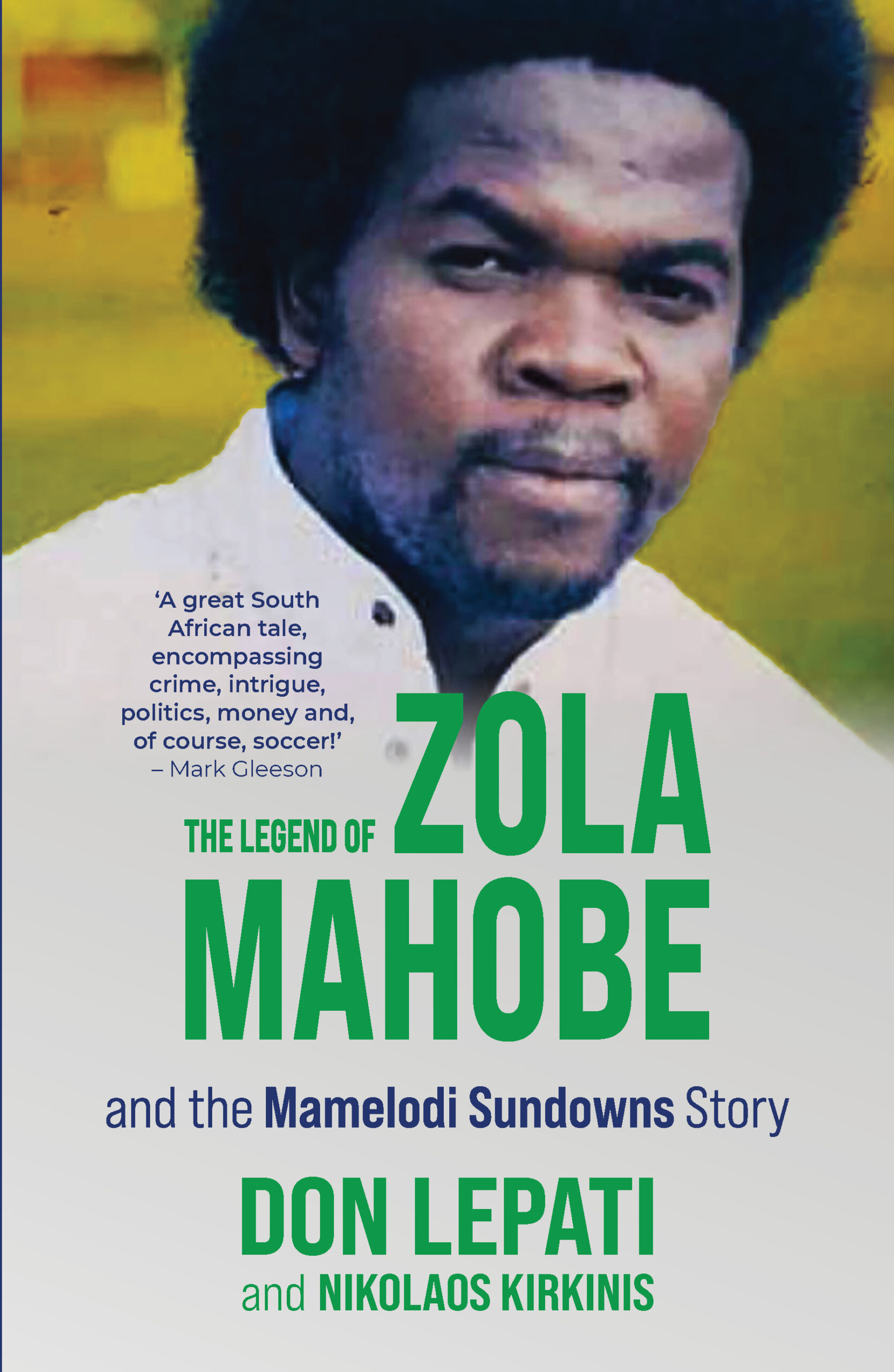
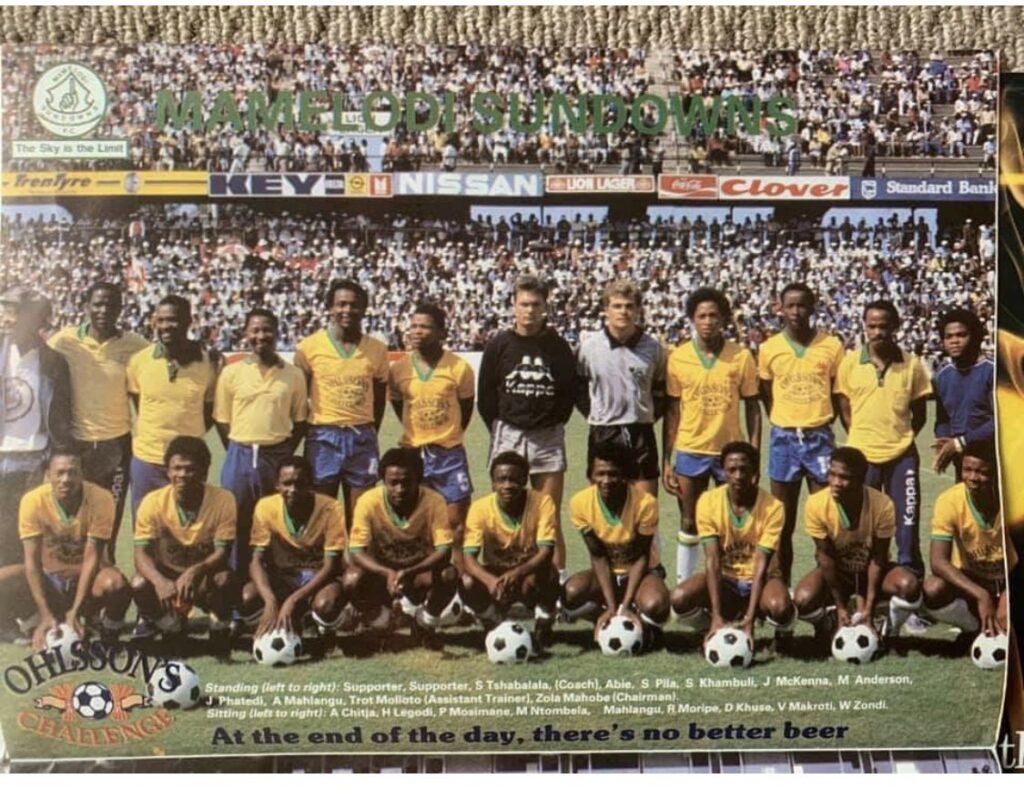
ZOLA Mahobe was a multi-millionaire businessman and fraudster who hogged the headlines for his flashy, extravagant lifestyle after buying Mamelodi Sundowns Football Club which was playing in South Africa’s National Soccer League in the 1980s. Among his many flamboyant displays of wealth -Mahobe made history by taking his entire squad and their partners to the FA Cup final in London. But the source of his millions was later revealed – resulting in a lengthy jail term. In this extract from the book The Legend of Zola Mahobe and the Mamelodi Sundowns story – co-authors Don Lepati and Nikolaos Kirkinis detail the beginning of the end for the late tycoon
AFTER London, Mahobe started to work on another of his grandiose schemes. This time he planned to take the Mamelodi Sundowns players on a learning tour of the major soccer centres of Brazil. ‘Ma-J, Ma-Six, Ma-Stix, the time has come to take the guys to Brazil,’ he said to Jabu, Six and Stix during one of their briefing sessions. ‘I want them to learn their game. They can dance; we can dance. They can dance the samba; we can dance the pata pata.’
Jabu, Six and Stix also did not know how Mahobe was making his millions. It was not their place to ask. Their motto was, ‘If you don’t know, then there is nothing to tell’. That way they could all stay protected. But he always insisted his money was coming from his businesses.
He let his travel agency, Via Africa, start work on the travel plans. But all the brouhaha about the trip forewarned the Brazilian consulate in Botswana, and they were refused visas. Brazil had ended diplomatic relations with South Africa in 1985, and had even imposed sanctions against the country in protest against apartheid. In the same year, they opened a consulate in Botswana. Mahobe and his travel party were disappointed. More than England, Brazil was the place he wanted to take his players.
Many suspected interference by the apartheid South African government in the refusal of the visas, but it is generally accepted that they were refused because of the sports boycott against South Africa. The stunt that Mahobe had pulled in London was not going to happen in Brazil. After all, the president of FIFA at the time, João Havelange, was a Brazilian.
The sports boycott had earlier turned into big news around the world when Zola Budd, a White athlete from Bloemfontein, broke the women’s 5 000 m world record. The performance was not recognised because it took place in apartheid South Africa. She later obtained a hurriedly arranged British citizenship and made headlines during the 1984 Los Angeles Summer Olympics when she tragically collided with American medal hopeful Mary Decker. The two had been on everybody’s lips during the build-up to the Olympics, with some predicting that Budd would win it and others supporting Decker. Budd ran barefoot, while Decker wore spikes. Budd, while attempting to take the lead, cut in front of Decker and collided with her. Their hopes melted into tears. Later, Budd came back to South Africa and had an excellent season in 1991, when she was the second-fastest woman in the world over 3 000 m.
News of his plans to take the team to Brazil so soon after London made the alarm bells ring louder around Mahobe. More people started questioning whether his businesses could sustain his lifestyle, while to others he was an apartheid-era hero who was doing good things for the South African people, especially soccer fans. The latter did not care where the money came from, as long as he continued to do ‘the Lord’s things’ with it. Nobody knew where many of the Black apartheid-era tycoons got the money to start their businesses from, or whether their wealth came solely from their businesses; nobody cared.
Despite the money alarms going off, the people at Standard Bank, where Mahobe kept his cash, slept peacefully. They knew him only as one of their valued clients and had not made the connection between him and their faithful employee, Tebello Snowy Moshoeshoe.
* * *
Gladys knew that Mahobe and Snowy must have been doing something illegal. Why was Snowy still working at the bank when her salary could not pay for her lifestyle? Why was she still working there when her boyfriend, who was willing to do anything for her, had so much money? He was even giving away some of it to his players, officials, and ordinary people. Overseas trips, expensive cars, houses, gifts, financial bailouts. She wanted in, but Snowy would not admit her. In fact, since their fallout in London, they had been engaged in a cold war.
In the office they shared, Gladys did paperwork and Snowy worked on the computers.
‘Mngani, can you show me how to work the computers?’ asked Gladys one day. This took Snowy by surprise, especially since their relationship had gone sour. She was saying it on purpose. What was she playing at?
‘Haibo! You know I can’t do that,’ she said.
‘Just curious. Bet you could manipulate the computers if you wanted to.’
‘Why would I do that? And please don’t play buddy-buddy with me. We both know that we aren’t buddies any more.’
But she knew that Gladys was onto her.
Thoughts of vindication started to build up inside Gladys. Queen Snowy had to pay. She wanted a way of anonymously whispering to someone in management that Snowy was Mahobe’s girlfriend, so that they could make the connection between his extravagant lifestyle and the bank. Her chance came when Mahobe and Snowy appeared on the cover of the Mamelodi Sundowns Magazine.
The magazine feature provided her with the opportunity she had been looking for. It had everything about Mahobe and Snowy’s extravagant lifestyle, including the trip to London and the foiled plan to tour Brazil. It was all there. All she had to do was to draw the attention of the Standard Bank managers to it. But she had a problem: not many White people read ‘Black’ magazines. But maybe the picture of Snowy on the cover would attract their attention.
She took the magazine to work, but she did not know how to draw the managers’ attention to it. She kept it in her desk drawer for days, thinking about how to do it. Should she just leave it on top of the desk? But the managers hardly ever gave her a glimpse. They came to the office now and then, but it was to Snowy’s workstation that they went. They usually didn’t pay much attention to her. She also had another problem: even if she put it on the desk, how was she going to do it without Snowy noticing?
Then one day she left work late. Before she left she had been looking at the magazine, contemplating what to do, and she left it on top of her desk by mistake. The following day Snowy arrived earlier and discovered the magazine. She got a fright. What was Gladys up to? She was still standing next to the desk and staring at it, wide-eyed, when Gladys walked into the office. With hands trembling, Gladys quickly grabbed it and walked out of the office. She did not say hello. Finding the nearest wastepaper bin, she tore up the magazine and disposed of it. They never talked about it, but the tension was there, and it was unbearable. Snowy knew that Gladys was onto her. Should she confront her? She did not.
But Gladys went looking for another copy of the magazine. Her boyfriend, Stix, had many copies of the magazine at his place. One day she was summoned to the office of one of the managers and immediately she saw the opportunity she had been looking for. With Snowy looking on, she pulled open the drawer of her desk, took out the magazine, and carried it with her to the manager’s office. Snowy was horrified. Gladys was finally doing it.
Gladys came back without the magazine. Snowy did not ask anything. She knew it was done; her world was beginning to turn upside down. Her head was spinning. She felt a cold trickle of sweat run down her left armpit and disappear somewhere. She needed something to drink. She left her desk and went to the kitchen to get some water. The seed had been planted. All thatmattered now was whether it had been planted in fertile ground.
Gladys was in luck. The manager noticed Snowy on the cover and started reading the feature on her and Mahobe. Then the bells finally started to ring at Standard Bank. They started getting curious, asking more and more questions about Mahobe and Snowy’s lives.
‘How can she live such a glamorous life on just R700 a month?’ asked one of the bank managers.
‘Just look at her clothes,’ said another. ‘How does she pay for all that? Or is it her boyfriend who is doing the paying? Mind you, they have just come back from London, where the boyfriend took the whole team and officials and their spouses on an all-expenses-paid trip. If they love each other so much, what is she still working for as an office clerk?’
‘Maybe she just needs the job to keep busy.’
‘I doubt it. Something isn’t right.’
‘Have you ever asked yourself where her boyfriend gets all the money from?’
‘I hear he is a businessman. But, goodness, to spend money like that!’
There were so many questions. #ends
*About the book: Publication date: 31 October 2022 Price: R320,00 Pages: 250
About the authors:
Don Lepati is a former university lecturer and author of two self-published books. He lectured at the National University of Lesotho, the University of Zululand, MEDUNSA, and the National School of
Public Health. Lepati holds a BA in Economics and Statistics and a MSc in Mathematics and Statistics from Queen’s University.
Nikolaos Kirkinis is the author of The Curse of Teko Modise, Strike a Rock – The Thembi Kgatlana Story which was selected for the 2021 Exclusive Books Homebru promotion, and Ghetto Ninja: The Junior
Khanye Story.

Testing testing 123