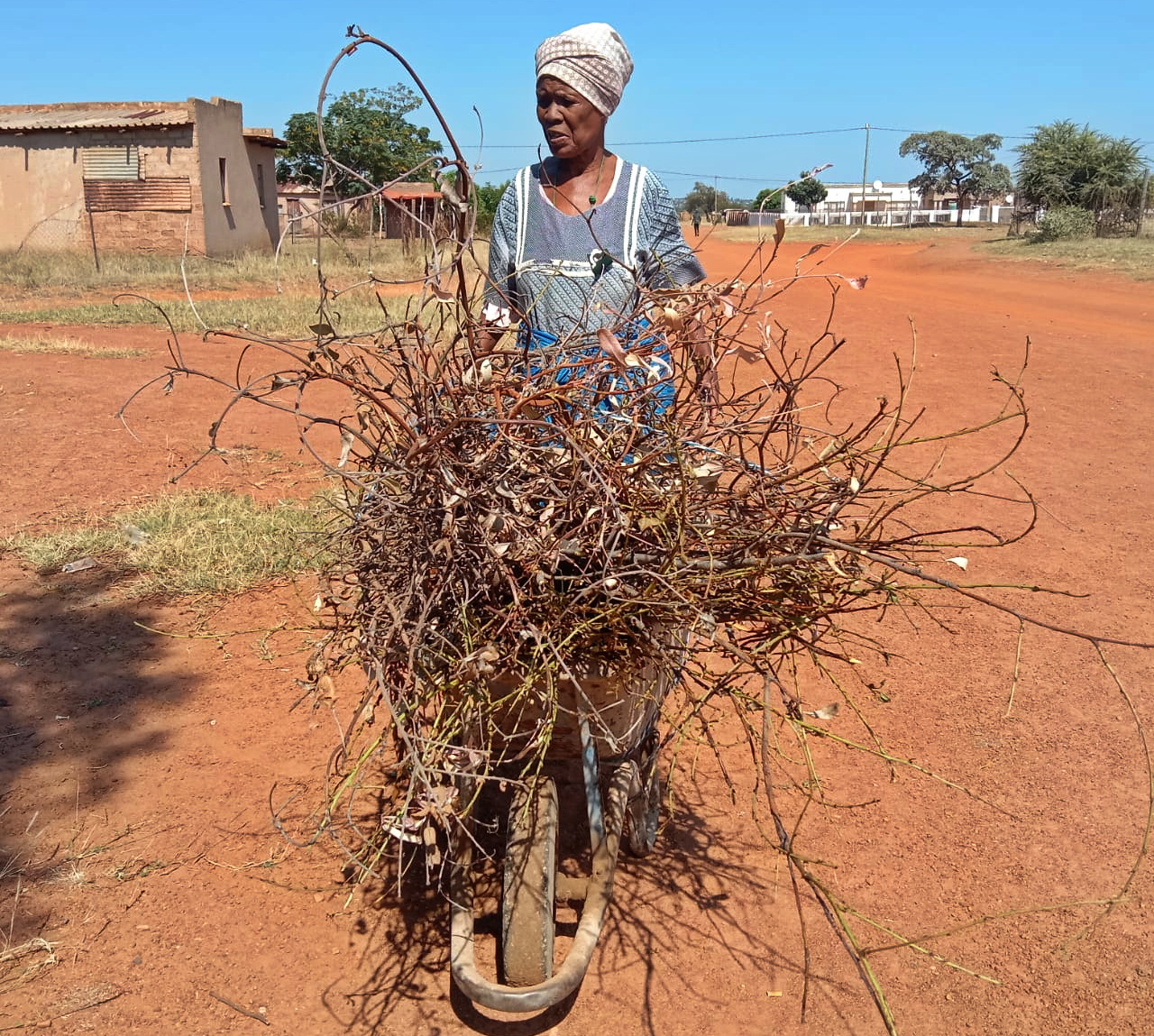
EIGHTY-year-old pensioner Maria Legong walks about 10 km daily to collect firewood as a way of saving electricity to prepare water and cook for her grandchildren. Legong spends more than R200 a month on electricity.
“I spend a lot of money on electricity while I have other essentials to take care of. I spend a lot on my grant (older persons grant) money on electricity. With the money I receive I have to buy food, pay for the societies (funeral insurance) and spend a lot on electricity,” said Legong.
The old age social grant is R1980 per month and R2000 for persons over 75 years old.
The National Energy Regulator of South Africa (NERSA) approved an average tariff increase of 9.61% for Eskom’s standard tariff customers. The increase for Eskom’s standard tariff took effect from 1 April. However civil society and social rights bodies have slammed the increase saying it would not be affordable to many poor people.
Legong of Allemansdrift, a settlement in Dr JS Moroka local municipality in the Mpumalanga province is among scores of frustrated residents who are furious about the raise in electricity tariff as they are already spending a lot of money on electricity.
She is worried about her safety when collecting firewood.
“I have to wake up early every day to collect wood for my grandchildren to eat and bath and it is not safe for a woman of my age to go to the bush. But I have to go as it breaks me to see my grandchildren bathing with cold water as we also encounter a problem of the electricity going out two times a day. From 5 to 7 in the morning and 5 to 7 in the evening,” she said.
“This is too much to bear; this electricity is now too expensive. We used to buy R20 electricity which lasted long, now R20 electricity lasts for a few days as it has 11 units. The government must do something about this problem because we cannot continue paying for the electricity that is expensive but not there when it is needed,” said Legong.
Another pensioner Solomon Skhosana,60, also of Allemansdrift spends R300 on electricity monthly. He is helping the community by providing them with water which he sells for the amount R2 per bottle (20 and 25 litre).
He has a borehole which uses an electric pump. He also uses the electricity to light his eight room house, cook, iron and for the fridge which uses a lot of electricity as it must always be on.
“The electricity is very expensive, even the money I made from selling water does not make any difference. When you bought R100 electricity you got only 50 units which means the other R50 is gone for nothing. I used to buy electricity for R100 and get 80 units. Now with the same amount you get 50 units. They now add R5 VAT, all in all you will be using R105 but the units do not increase,” said Skhosana.
“This is not the only problem; the power goes two times a day which results in harming our appliances. Eskom does not communicate with the residents when taking out the electricity. They must tell us so that we can be prepared,” he said.
Unemployed Maltase Malaki ,29, started a business selling kota to beat the high rate of unemployment in Allemansdrift.
The results of the Quarterly labour force survey (QLFS) for the fourth quarter of 2021 shows that the employed persons increased by 262 000 to 1.5 million, and the number of unemployed persons also increased by 278 000 to 7.9 million in the 4th quarter of 2021 compared to the 3rd quarter of 2021.
The number of discouraged work seekers decreased by 56 000 (14%) and the number of people who were not economically active for reasons other than discouragement decreased by 341 000 (2,4%) between the two quarters.
Stats SA said these changes in the labour market resulted in the official unemployment rate increasing by 0,4 of percentage point from 34.9% in the third quarter of 2021 to 35.3% in the fourth quarter of 2021-the highest since the start of QLFS in 2008. The unemployment rate according to the expanded definition of unemployment decreased by 0.4 of a percentage point to 46.2% in quarter 4 2021 compared to quarter 3 2021.
Mahlake’s business makes use of electricity on a daily basis. Mahlake spends about R500 on electricity monthly.
“This issue of raising electricity will badly affect my business meaning when the electricity goes up I must raise the prices which will result in me losing my customers. Apart from using electricity, I tried using gas but it is also expensive as I have to travel miles to refill it,” said Mahlatse.
Mahlake says even he is facing a challenge in electricity, he was able to change a life and employ one employee.
President Cyril Ramaphosa has acknowledged the power supply crisis saying it is one of the greatest threats to economic and social progress. Ramaphosa has said as a result, several new energy generation projects will be coming online over the next few years. – news@mukurukuru.co.za

Be First to Comment